Morocco FA chief Lekjaa concerned over lack of home-based players in Atlas Lions’ 2026 World Cup squad, vows to fix problem
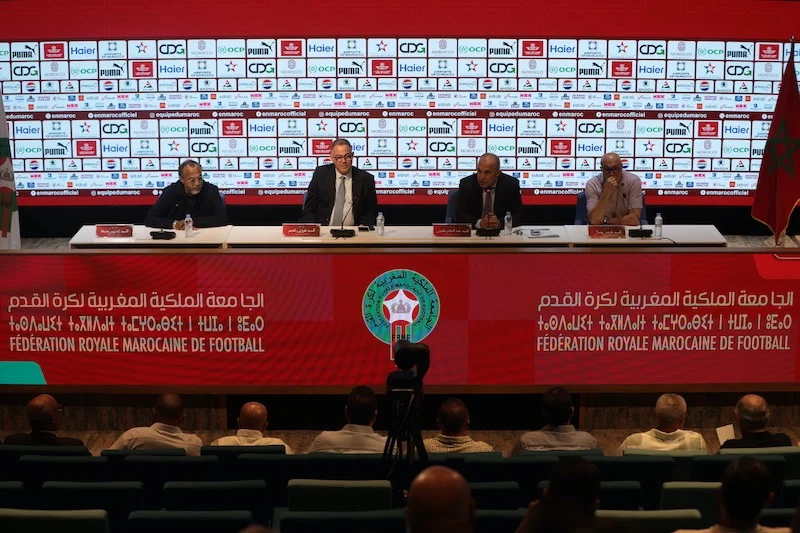
President of the Royal Moroccan Football Federation (FRMF) Fouzi Lekjaa has called for the implementation of a clear development strategy aimed at improving the quality of locally trained players and increasing their presence in Morocco’s national teams.
The decision to meet coaches in the first and second divisions of the Botola Pro League stem from the lack of home-based players in the Morocco squad for the recently concluded World Cup tournament in North America, where only two reserved goalkeepers made the cut.
The Morocco FA president expressed concern over the growing gap between players developed within the domestic league system and those representing Morocco at international level.
“Looking at the results of the last World Cup, we find that the national team included only two reserve goalkeepers from the domestic league, without any midfielders or forwards from this league, whereas previously the domestic championship provided the national team with entire squads,” Lekjaa said.
He stressed that the issue is not limited to the senior national team, but is also evident across Morocco’s youth categories.
According to Lekjaa, Morocco’s Olympic team and the Under-17 national team that reached the FIFA U-17 World Cup quarterfinals have relied heavily on players developed outside the domestic league structure, with only a few exceptions from certain clubs and the Mohammed VI Football Academy.
“We face a collective responsibility that requires us to answer a fundamental question: why has national football, with all its regional leagues and structures, been unable to secure a stronger presence within our national teams?” he questioned.
Lekjaa also highlighted the challenges facing Moroccan clubs, including financial difficulties, accumulated debts, and disputes with FIFA and other football authorities.
He described the current period as a turning point for Moroccan football, with the country preparing for a new era leading up to the 2030 FIFA World Cup, which Morocco will co-host alongside Spain and Portugal.
“This marks the end of one phase and the beginning of another. As a football family — coaches, club presidents and officials — we must create a clear roadmap to raise the level of the game and develop our system to meet the demands of hosting the World Cup,” Lekjaa added.
Meanwhile, FRMF Technical Development Director Fathi Jamal admitted that despite significant investment in youth development, the expected results have not yet been achieved, particularly regarding the integration of young talents into professional football.
Jamal revealed that Morocco’s Under-18 national team currently in Spain consists of 20 players from local clubs and only one player from the regional league.
However, he expressed disappointment that most of these young talents are not receiving regular playing opportunities in the Botola Pro League.
“Unfortunately, none of these players participate regularly in the national championship, except for limited appearances where they receive a few minutes from clubs such as Raja and Wydad,” Jamal explained.
He pointed out that many of the country’s emerging talents come through the Mohammed VI Academy before joining clubs such as Ittihad Touarga, which has become an important bridge between youth development and professional football.
Jamal urged coaches and club officials to work together to create a better pathway for young players.
“We know that coaches face pressure and constraints at their clubs to achieve results. That is why another meeting will be held with club presidents, because they are directly responsible for creating the right environment to integrate talented players,” he said.
He added that the ultimate objective of Morocco’s youth development programme is to produce elite players capable of competing at the highest level.
“This can only happen by integrating them into the first and second divisions. We are working towards a collective agreement and a joint action plan to ensure the success of this initiative and the continued development of Moroccan football,” Jamal concluded.
-
 Baartman aiming to stay in South Africa’s Olympic qualification push Sep 30, 2026
 -
Engen reveals redesigned trophy for 2026 Champ of Champs tournament Sep 30, 2026
-
2026 Engen Champ of Champs draw sets up three days of South African youth football Sep 30, 2026
-
Mohamed Ouahbi pleased as Morocco make winning start to AFCON qualifying Sep 30, 2026




-
AFCON 2025: Fixtures, Results, Scores and Standings Jan 18, 2026
-
Leadership and long-term vision key to rescuing Zamalek and inspiring Egyptian football – Hany Abou Rida Nov 5, 2025
-
Match hero Taiwo Awoniyi reflects on team effort after Chelsea triumph May 5, 2026
-
South African giants Orlando Pirates set to lose influential forward Monnapule Saleng Mar 19, 2025




-
AFCON 2027 Qualifiers: McCarthy warns South Africa to expect tough test against Eritrea Sep 29, 2026
-
AFCON 2027 qualifiers: Algeria, Morocco and Nigeria among winners on opening matchday Sep 26, 2026
-
AFCON 2027 qualifiers: Burkina Faso held by Benin in Group F Sep 25, 2026
-
South Sudan vs Egypt: Where to watch AFCON 2027 qualifier Sep 29, 2026