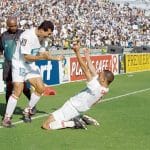
World Cup 2026: Pierluigi Collina’s VAR verdict rocks Egypt as FIFA chief backs Argentina goal call

FIFA Referees Committee chairman Pierluigi Collina has delivered a decisive verdict on the biggest refereeing flashpoint from Egypt’s World Cup knockout defeat to Argentina, insisting the decision to disallow Egypt’s goal was correct.
The former elite referee addressed the controversy after Egyptian supporters questioned the decision to overturn the goal during the round-of-16 encounter, with some fans claiming the defending champions had benefited from favourable officiating.
However, Collina defended the standards of refereeing at the 2026 World Cup and dismissed suggestions that officials had been influenced by external pressure.
“Overall, we are satisfied. However, with such a large number of matches played in a relatively short period of time, it is natural that some things do not go as planned,” Collina said in an interview published by FIFA.
The Italian also strongly rejected accusations against match officials, warning that attacks on referees’ integrity have no place in football.
“Of course, constructive discussions about decisions will always be an integral part of football, but unfounded allegations have no place in our sport,” he said.
“No one can question the integrity of the referees at the 2026 World Cup.”
VAR intervention explained as Collina backs overturned goal decision
Collina revealed that FIFA’s refereeing department reviewed both major incidents from the Egypt-Argentina match — the disallowed Egyptian goal and a late penalty appeal involving Mohamed Salah — and concluded that both decisions were correct.
The most debated moment came when Egypt saw a goal ruled out after VAR intervened, a decision that sparked criticism from fans and several refereeing analysts.
Collina explained that VAR is permitted to examine the attacking phase leading up to every goal and can recommend an on-field review if an offence is identified.
“After every goal, the VAR checks the attacking possession phase. If an offence is detected during the build-up and is considered to have contributed to the goal, the VAR recommends an on-field review,” he said.
“There is no specific limit regarding the distance from goal or the time that has passed between the offence and the goal.”
Using the incident as an example, Collina said Egypt midfielder Marwan Attia committed a foul on Argentina defender Lisandro Martinez during the build-up.
“In the example of what happened during the Argentina and Egypt match, Egypt’s number 19, Marwan Attia, clearly stepped on the foot of Argentina’s number 6, Lisandro Martinez. We consider this an offence,” he explained.
“Whether the offence appears obvious or not, if the referee does not see it on the field, VAR can intervene.”
Salah penalty appeal remains a matter of judgement
Collina also addressed Egypt’s late penalty appeal involving Mohamed Salah and Martinez, but acknowledged that such decisions often involve interpretation.
The Egyptian forward appeared to have a claim after contact inside the penalty area, but the referee and VAR opted not to award a spot-kick.
“Another example occurred at the end of the same match. The referee and VAR considered the contact between Mohamed Salah and Martinez to be normal contact,” Collina said.
“Of course, there will always be an element of personal judgment in some decisions, but we are satisfied with how this principle has been applied throughout the tournament.”
The comments are likely to intensify debate among Egyptian supporters, who remain unhappy with the controversial moments that shaped their elimination against the world champions.
-
 Mamelodi Sundowns move six points clear at top of South African top-flight after thrashing Siwelele FC Sep 10, 2026
 -
Ivory Coast coach to announce squad for Ghana, Somalia AFCON 2027 qualifiers on September 16 Sep 10, 2026
-
Reisinho rejects Cardoso’s suggestion that South Africa affected Mamelodi Sundowns spell Sep 10, 2026
-
Senegal new coach Patrick Vieira drops captain Kalidou Koulibaly and Pathé Ciss for AFCON qualifiers Sep 10, 2026



-
AFCON 2025: Fixtures, Results, Scores and Standings Jan 18, 2026
-
Leadership and long-term vision key to rescuing Zamalek and inspiring Egyptian football – Hany Abou Rida Nov 5, 2025
-
South African giants Orlando Pirates set to lose influential forward Monnapule Saleng Mar 19, 2025
-
Full schedule for 2025 Africa Cup of Nations in Morocco confirmed Feb 12, 2025




-
Al-Ittihad turn to Morocco’s Chemsdine Talbi after failed Anis Hadj Moussa move Sep 3, 2026
-
Orlando Pirates backed to overcome La Cure Sylvester in CAF Champions League opener Sep 4, 2026
-
Inter Milan v SSC Napoli: draw tipped in closely matched Serie A meeting Sep 3, 2026
-
CAF confirms kick-off times for Confederation Cup preliminary-round matches Sep 4, 2026