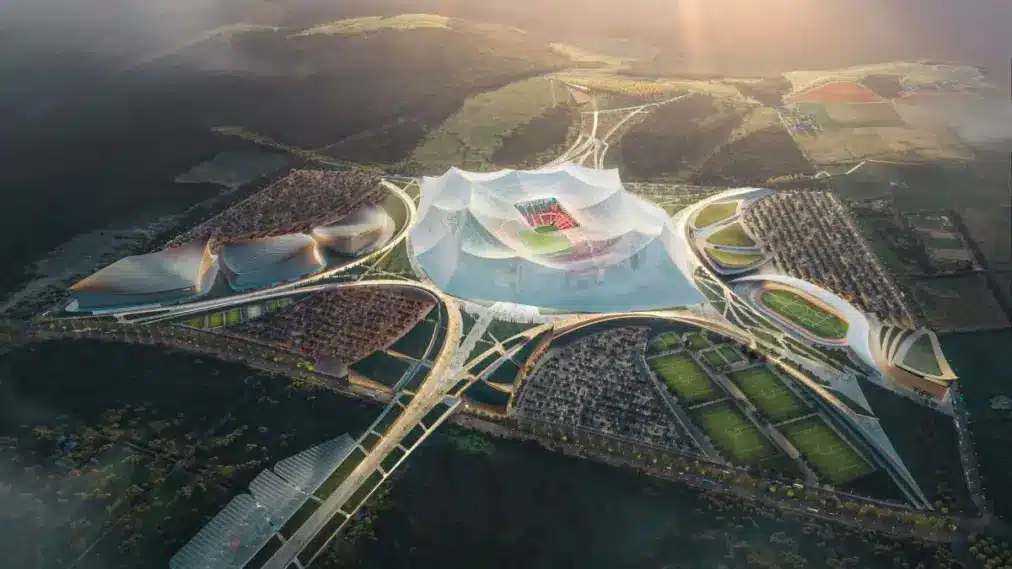
Morocco’s planned 115,000-seat Grand Stade Hassan II in Casablanca has emerged as a serious challenger to Madrid’s Santiago Bernabeu to host the 2030 World Cup final, in what insiders now describe as an unexpectedly open contest.
According to reporting by The Athletic, a combination of Morocco’s aggressive lobbying and Spain’s institutional turbulence has dramatically reshaped what many in football had long assumed was a foregone conclusion in favour of the Real Madrid stadium.
Spain, Portugal and Morocco will jointly stage the 2030 World Cup, while the first three matches are set to be played in Uruguay, Argentina and Paraguay to mark the tournament’s centenary. FIFA, however, has yet to decide where the final will take place.
Bernabeu no longer ‘untouchable’ favourite
The Spanish Football Federation (RFEF) has been pushing the revamped Santiago Bernabeu – refurbished at a cost of around €1.5bn – as the logical venue for the final.
With its rich history, cutting-edge facilities, Madrid’s proven capacity to host major events and Spain’s heavyweight status in world football, the stadium has long been viewed as the natural choice.
But confidence inside the Spanish camp has notably diminished.
“Il y a dix-huit mois, il etait impossible pour le Bernabeu de perdre la finale. Mais aujourd’hui, je ne serais pas surpris, car la position de la RFEF est tres faible comparee a tout ce que le Maroc a accompli,” a source close to the Spanish bid told The Athletic anonymously.
That shift in tone reflects a broader change in the political and diplomatic landscape surrounding the 2030 showpiece.
Morocco’s billion-euro bet on a ‘from-scratch’ final
Morocco has made no secret of its ambition to host the final at the future Grand Stade Hassan II, a vast new arena under construction near Casablanca which, with a projected capacity of 115,000 seats, is set to become the largest football stadium in the world.
The Moroccan authorities have committed close to €1bn to the stadium project alone, excluding major new rail and motorway infrastructure planned around it.
Rabat’s pitch rests on a clear argument: a completely new stadium can be designed from the ground up to satisfy FIFA’s most stringent technical and commercial requirements in a way that a modernised existing ground, however iconic, cannot.
Moroccan officials and sources close to the bid also frame the choice as a matter of global balance. They argue that awarding the final to Casablanca would be more “fair”, given that Africa has only hosted one World Cup final in history – the 2010 showpiece in Johannesburg, South Africa.
Powerful players and fragile institutions
Morocco’s efforts are being spearheaded by Fouzi Lekjaa, president of the Royal Moroccan Football Federation (FRMF), a government minister and a member of the FIFA Council. He is widely regarded as one of African football’s most influential figures and is said to have a close relationship with FIFA president Gianni Infantino.
By contrast, the RFEF is emerging from several years of institutional crisis and leadership upheaval. Its current president, Rafael Louzan, is viewed by insiders as lacking the international reach and political capital that Lekjaa enjoys.
Relations between the RFEF and the Spanish government are described as uneven, adding another layer of uncertainty to Madrid’s lobbying efforts.
The position of Spain’s bid has also been undermined, sources suggest, by the outspoken criticism of FIFA and Infantino voiced by La Liga president Javier Tebas. According to one source close to FIFA, launching such public attacks immediately after Spain’s World Cup triumph only served to “qu’empirer les choses”.
Bernabeu’s last card – and FIFA’s final call
One factor that could yet weigh in Madrid’s favour is the personal relationship between Real Madrid president Florentino Perez and Gianni Infantino, seen by some as the Bernabeu’s final significant asset in the race.
Even so, the dynamic has clearly shifted. What was once regarded as a final effectively guaranteed to the Spanish capital has now become a head-to-head battle between Madrid and Casablanca.
Ultimately, insiders believe the decision will be shaped less by public technical evaluations and more by deliberations within FIFA’s inner circle – with the 2030 World Cup final increasingly seen as a test case for how the organisation balances history, politics, geography and commercial ambition.
-
 Tottenham scouts watch Younes Ebnoutalib score Eintracht Frankfurt winner Oct 20, 2026
 -
Köln consider January move for German-Nigerian attacker Lukas Nmecha Oct 20, 2026
-
Manchester United join Liverpool in race for Borussia Dortmund midfielder Felix Nmecha Oct 20, 2026
-
Mali striker Lassine Sinayoko backs Paris FC to challenge for Ligue top spot Oct 20, 2026


-
AFCON 2025: Fixtures, Results, Scores and Standings Jan 18, 2026
-
Match hero Taiwo Awoniyi reflects on team effort after Chelsea triumph May 5, 2026
-
Leadership and long-term vision key to rescuing Zamalek and inspiring Egyptian football – Hany Abou Rida Nov 5, 2025
-
South African giants Orlando Pirates set to lose influential forward Monnapule Saleng Mar 19, 2025




-
PSG v Barcelona: fiery attacks set up Champions League classic at Parc des Princes Oct 18, 2026
-
Real Betis v Barcelona: kick-off time, TV details and match preview Oct 16, 2026
-
Morocco to face New Zealand as FIFA U-17 Women’s World Cup kicks off in Rabat Oct 16, 2026
-
Klinton Cod leads African journalists, Pundits and Content creators joining José Mourinho on Football.com TV Oct 19, 2026