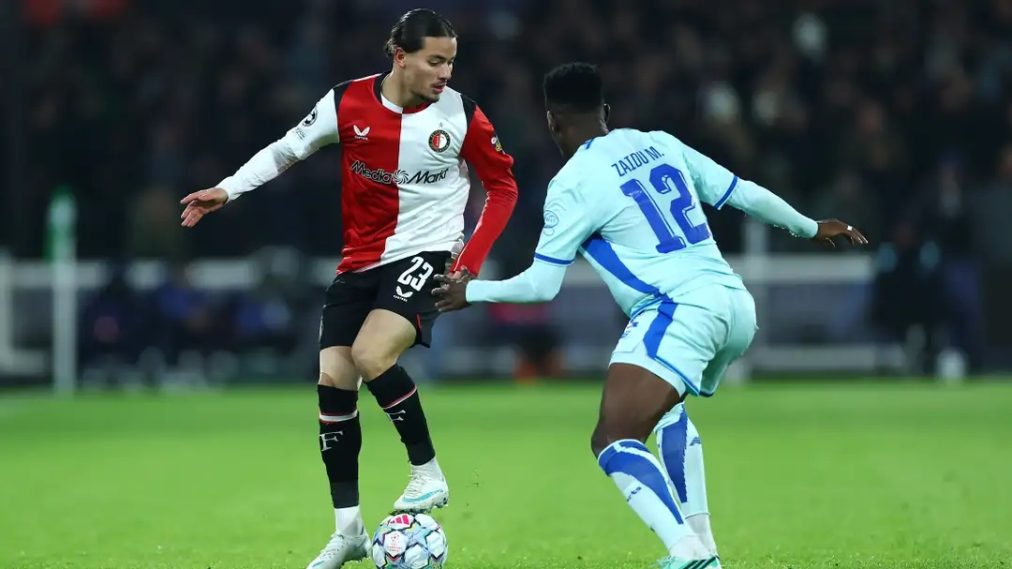
Al-Ittihad’s pursuit of Anis Hadj Moussa is becoming a test of whether financial power can persuade Feyenoord to part with one of their key attacking players in the middle of the season.
The Saudi club are looking for a winger with pace, technical ability and the quality to change games, but Feyenoord believe losing the Algeria international in January could cost them more on the pitch than the transfer would bring financially.
Al-Ittihad’s interest is not new. During the summer, the club were reportedly prepared to offer about €42.5m for the 24-year-old, but the deal collapsed because the financial guarantees presented were not considered sufficient to complete the transfer.
With the winter window approaching, the obstacle is no longer simply the size of the fee. The timing of the proposal and Feyenoord’s desire to retain Hadj Moussa until the end of the season are now central to the negotiations.
Feyenoord’s sporting concerns
Feyenoord’s position reflects the importance of Hadj Moussa to their attack. His ability to dribble in tight areas, beat defenders in one-on-one situations and contribute both to chance creation and goals gives the team several options in the final third.
A substantial offer may therefore be insufficient to change the Dutch club’s stance. Selling in January would leave Feyenoord searching for a replacement quickly, with no guarantee that they could find a player capable of making the same impact, even if they had the money to spend.
The mid-season timing also strengthens Feyenoord’s negotiating position. They have no immediate sporting need to sell, while delaying a decision until the summer would give them more time to reorganise the squad and prepare for any departure.
Player’s preference could prove decisive
The deal is not necessarily closed, however, because Hadj Moussa’s own position could influence the outcome. A move would offer him the chance to experience the Roshn Saudi League and join an Al-Ittihad project with significant domestic and continental ambitions.
If the winger makes a clear request to leave, Feyenoord could face a more difficult decision, particularly if Al-Ittihad return with a fresh offer supported by stronger guarantees than those provided during the summer.
Even then, the player’s wishes alone would not guarantee a transfer while Feyenoord remain committed to keeping him for both contractual and sporting reasons.
Al-Ittihad’s interest is understandable from a footballing perspective. Hadj Moussa offers more than speed in open space: his close control, ball retention and dribbling can create numerical advantages against deep defensive blocks. His age also means he could continue to develop, making him a potential long-term investment rather than a short-term addition.
The Saudi club must nevertheless weigh the cost against other available options so that pursuing one target does not become a burden on their wider transfer plans.
Hadj Moussa began his career in France, developing in the youth systems of Torcy, Montfermeil and Lens. He moved to Belgium with Olympique Charleroi in 2022 and joined Patro Eisden in summer 2023.
In February 2024, he moved to the Netherlands on loan with Vitesse Arnhem. Feyenoord announced his signing in April that year, with his spell beginning in the 2024-2025 season under a contract running until summer 2030.
Born in France, Hadj Moussa chose to represent Algeria after playing for the country’s youth sides. He made his senior debut in March 2024 against Bolivia.
The January window, therefore, could determine whether he begins a new chapter with Al-Ittihad or whether the Saudi club must wait until the summer.
-
 Soccer Laduma issue 1502 highlights contract decisions and transfer uncertainty Nov 26, 2026
-
Orlando Pirates set PSL record as Abdeslam Ouaddou reaches 50 wins Nov 26, 2026
-
Old School finance demands apology over ‘up to 70% off’ Black Friday sale Nov 26, 2026
-
Al Ahly target Orlando Pirates defender Lebone Seema ahead of January transfer window Nov 26, 2026



-
AFCON 2025: Fixtures, Results, Scores and Standings Jan 18, 2026
-
Match hero Taiwo Awoniyi reflects on team effort after Chelsea triumph May 5, 2026
-
Leadership and long-term vision key to rescuing Zamalek and inspiring Egyptian football – Hany Abou Rida Nov 5, 2025
-
South African giants Orlando Pirates set to lose influential forward Monnapule Saleng Mar 19, 2025




-
U17 World Cup 2026: Full schedule for Morocco and where to watch Nov 19, 2026
-
Nice v Paris Saint-Germain: injury-hit champions face confident hosts in Ligue 1 Nov 19, 2026
-
Nice face formidable PSG as leaders chase eighth straight Ligue 1 win Nov 20, 2026
-
Chelsea v Leeds: Blues backed to edge tight Premier League contest at Stamford Bridge Nov 20, 2026