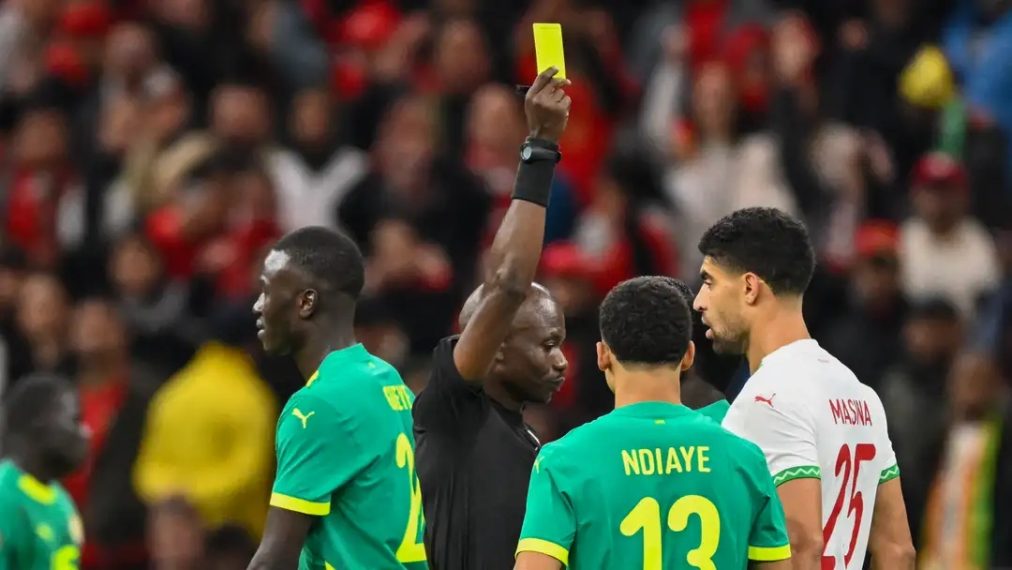
A Tunisian sports lawyer says the Court of Arbitration for Sport (CAS) ruling on the 2025 Africa Cup of Nations final between Morocco and Senegal marks an important development in the “field of play” doctrine.
Mouati Al-Dakhli told Kooora on Friday that Tuesday’s decision confirmed the referee’s authority to determine whether a match should continue, preventing a later appeal from changing the result despite disciplinary offences during the game.
Senegal players left the pitch for about 15 minutes without the referee’s permission, an incident Al-Dakhli described as “undoubtedly a serious disciplinary violation warranting punishment”.
However, he said it was essential to distinguish between the offence itself and its effect on the sporting result.
“The referee did not decide to end the match because the players had left,” Al-Dakhli said. “He allowed play to resume after they returned to the pitch and managed the match through to the end of extra time. His decision to continue and complete the game on the field is therefore protected by the field of play doctrine.”
Al-Dakhli argued that the Confederation of African Football appeal committee had no right to retrospectively replace the referee’s judgment by declaring Senegal’s conduct a definitive withdrawal. Nor, he said, could it cancel a match that had already been completed and brought to a final whistle.
He said the approach was consistent with CAS jurisprudence and with the position adopted by the Swiss Federal Court: decisions falling within a referee’s authority on the field should not be reviewed in a way that changes the sporting outcome after the match has ended.
Disciplinary offence not automatic forfeit
The lawyer said the ruling also reinforced proportionality and the separation between disciplinary responsibility and sanctions affecting a competition result.
“Applying Article 84 of the Africa Cup of Nations regulations, concerning withdrawal and a 0-3 forfeit, requires a team to refuse definitively to complete the match in a way that makes its sporting conclusion impossible,” he said.
Where a team returns to the pitch, the referee authorises play to restart and the match is completed, misconduct should instead be addressed through disciplinary, financial and suspension measures, rather than by changing the winner through a later administrative or appeal decision.
That distinction explains the difference between the CAF disciplinary committee’s decision and the appeal committee’s ruling. The disciplinary body imposed total fines of $615,000 and suspended Senegal coach Pape Thiaw for five matches over the incidents in the final. The appeal committee later awarded Morocco a 3-0 victory and the title.
CAS overturned that appeal decision and restored the disciplinary committee’s position, leaving Senegal’s 1-0 victory after extra time unchanged.
Field of play doctrine is not absolute
Al-Dakhli stressed that the doctrine does not give referees complete immunity from legal scrutiny. It may be set aside where bad faith, fraud, bias or corruption is established, or where there has been a legal error in applying competition regulations outside the referee’s technical assessment of events.
He also called on continental federations, national sports bodies and Arab refereeing authorities to update regulations covering withdrawals and temporary stoppages. Clearer criteria, he said, are needed to distinguish a definitive withdrawal from an interruption followed by a restart, and to define the boundary between a technical error and a legal one.
Such clarification would reduce conflicting decisions between disciplinary and appeal bodies. Al-Dakhli described the field of play doctrine as an “existential safety valve for competitive sport”, protecting what is settled by the referee and completed on the pitch from being overturned later.
-
 Rayane Bounida scores for Ajax and dedicates celebration to injured Jorthy Mokio Nov 27, 2026
-
Bournemouth slap £100m price tag on Eli Junior Kroupi as PSG reignite interest ahead of 2027 summer window Nov 27, 2026
-
Nourdin Boukhari criticises CAS decision to award 2025 AFCON title to Senegal Nov 27, 2026
-
Roma make contact with Nottingham Forest over January loan move for Callum Hudson-Odoi Nov 27, 2026




-
AFCON 2025: Fixtures, Results, Scores and Standings Jan 18, 2026
-
Match hero Taiwo Awoniyi reflects on team effort after Chelsea triumph May 5, 2026
-
Leadership and long-term vision key to rescuing Zamalek and inspiring Egyptian football – Hany Abou Rida Nov 5, 2025
-
South African giants Orlando Pirates set to lose influential forward Monnapule Saleng Mar 19, 2025




-
Nice face formidable PSG as leaders chase eighth straight Ligue 1 win Nov 20, 2026
-
Chelsea v Leeds: Blues backed to edge tight Premier League contest at Stamford Bridge Nov 20, 2026
-
Liverpool v Manchester United: kick-off time, TV details and match preview Nov 20, 2026
-
Barcelona v Villarreal: Probable line-ups for Sunday’s La Liga clash Nov 21, 2026