Uganda’s Hoima Stadium puts pressure on Kenya’s delayed Talanta project
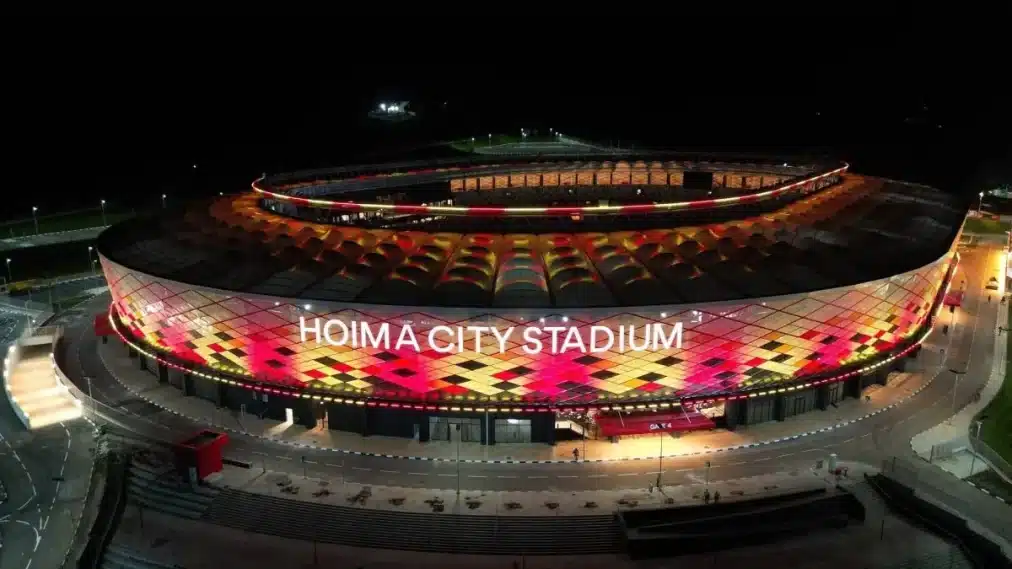
Kenya’s ambitious Talanta Sports Stadium project has come under scrutiny following comparisons with Uganda’s Hoima City Stadium, which has already been completed and commissioned despite having a smaller seating capacity.
The 60,000-capacity Talanta Stadium has been presented as a major addition to Kenya’s sporting infrastructure, with expectations that it will establish Nairobi as one of Africa’s leading destinations for international sporting events.
The facility is also expected to host a high-profile inauguration match between German giants Bayern Munich and Dutch side Ajax on January 5, 2027.
However, while Kenya continues to work towards completing its flagship sporting project, Uganda has already delivered a multi-sport complex in Hoima that has attracted attention for its extensive range of facilities.
Although Talanta is three times larger in seating capacity than Hoima City Stadium, which accommodates 20,000 spectators, the Ugandan facility appears to offer a broader sporting ecosystem.
Talanta Stadium features five levels, a hybrid playing surface, 52 skyboxes, VIP and VVIP sections, extensive media facilities, nine entrance gates and a 30-metre evacuation boulevard.
Its exterior also incorporates LED technology and a musical fountain, while the overall design focuses primarily on football and rugby.
The Kenyan government sees the project as a major national sporting landmark, but comparisons with Hoima have raised questions about the range of facilities being delivered for the money invested.
Hoima offers more than a football stadium
Unlike Talanta, Uganda’s Hoima City Stadium was conceived as a multi-sport complex designed to accommodate several sporting disciplines.
According to Uganda’s National Council of Sports, the facility includes a 20,000-seat main stadium, a 2,000-seat indoor arena, a semi-Olympic swimming pool, an outdoor training pitch, a running track, two basketball courts and two volleyball courts.
The complex also features 839 parking spaces, a presidential suite, 12 skyboxes, VIP lounges, eight elevators, 59 sanitary units and 13 dedicated disability-accessible toilets.
Its indoor arena can accommodate basketball, volleyball, netball, badminton, table tennis, martial arts, boxing and kickboxing.
Additional facilities include a fitness centre, medical and doping-control facilities, a television studio, Wi-Fi, a cafeteria and dedicated athlete areas.
The changing rooms are also equipped with lockers, showers, physiotherapy beds, ice boxes and coaches’ offices.
These facilities have strengthened the argument that Hoima offers a comprehensive sporting environment rather than simply a venue for hosting football matches.
Construction timelines raise questions
Another major point of comparison is the time taken to complete the two projects.
Construction of Hoima City Stadium began in September 2024, with the facility officially completed and commissioned in December 2025.
Ugandan authorities indicated that the project was delivered in 14 months, ahead of the original 18-month construction period.
Talanta Stadium, meanwhile, began construction in 2024 but has experienced a longer and more complicated completion process.
As recently as October 2026, Kenyan officials indicated that the main stadium was approximately 94 to 95 per cent complete, with external works and other facilities still requiring attention.
The Kenyan government has subsequently targeted the end of December 2026 for the stadium to be ready.
The difference has prompted questions about why Uganda has already commissioned and begun operating its stadium while Kenya continues to work towards completing its much larger project.
Cost of the projects under scrutiny
The financial implications have also become part of the debate.
According to parliamentary records, Kenya’s Talanta Stadium contract was awarded at Ksh45.848 billion, representing an increase from the project’s earlier approved cost.
The government attributed part of the increase to taxes, levies and import-related charges.
Uganda’s National Council of Sports, meanwhile, lists the cost of Hoima City Stadium at approximately US$129 million, although wider government communication has also referred to Ksh152 billion released from the Petroleum Fund for the project.
The different currencies, financing arrangements and project specifications make a direct comparison of the two construction costs difficult.
Nevertheless, the figures have raised questions about value for money, particularly regarding the facilities being delivered and the time required to complete the projects.
Hoima’s operational systems impress
Beyond its sporting facilities, Hoima has also attracted attention for its security and building-management infrastructure.
The stadium reportedly has 279 security cameras, including facial-recognition technology, alongside access-control systems, fire alarms, emergency communication infrastructure and public-address facilities.
Its central building-management system can remotely control functions such as air conditioning, lighting, generators and pitch irrigation.
However, the Ugandan facility has not been without challenges.
A Confederation of African Football (CAF) inspection in February 2026 found that Uganda’s proposed AFCON venues, including Hoima, did not fully satisfy Category 4 requirements.
Among the issues identified at Hoima were spectator segregation, movement between different sections of the stadium, dressing-room standards, media facilities, the mixed zone and the positioning of team benches.
CAF consequently required operational adjustments before the venue could fully meet its requirements for hosting major continental competitions.
This means Hoima should not be regarded as a flawless facility. However, the challenges identified largely concerned operational arrangements within an already completed and functioning stadium.
Kenya also faces outstanding requirements at Talanta.
A parliamentary inspection in October 2026 raised concerns about accessibility, transport arrangements, crowd management, specialist systems and regulatory inspections.
Accessibility concerns add to Kenya’s challenges
Accessibility has emerged as another important area in the comparison.
Hoima’s specifications include 13 disability-accessible sanitary units, eight elevators, including dedicated facilities for persons with disabilities, and designated viewing areas for spectators with disabilities.
Talanta also incorporates elevators and accessibility provisions into its design.
However, a Senate inspection exposed concerns after officials from Kenya’s Ministry of Labour and Social Protection reportedly could not conduct an accessibility and occupational-safety assessment because they had not been granted access to the stadium.
The development raised questions about the preparedness of a facility being promoted as a world-class sporting venue.
Talanta remains an ambitious project
Despite the comparisons, Talanta Stadium has ambitions that extend beyond football.
Its 60,000-seat capacity, 52 skyboxes and commercial facilities are expected to make it a major destination for international sporting competitions, concerts and other large-scale events.
Its size and design also make it one of the most ambitious stadium projects in East Africa.
Building a 60,000-seat international stadium in Nairobi presents different engineering, logistical and operational challenges from constructing a 20,000-seat facility in Hoima.
However, the comparison is less about seating capacity and more about delivery, functionality and value for money.
Uganda has already commissioned a stadium equipped with an indoor arena, swimming pool, basketball and volleyball courts, fitness facilities and modern security systems.
Kenya, meanwhile, is still working towards completing its flagship project and addressing outstanding operational requirements.
Talanta could eventually become one of Africa’s leading sporting venues, but its success will ultimately be measured by more than its impressive architecture and seating capacity.
For Kenya, the challenge is to ensure that the billions invested translate into a fully operational sporting complex capable of serving athletes, spectators and the wider sporting industry.
Until then, Hoima City Stadium will remain an uncomfortable reminder that delivering a world-class sporting facility is about more than announcing ambitious plans and celebrating construction milestones.
-
 Uganda’s Hoima Stadium puts pressure on Kenya’s delayed Talanta project Nov 19, 2026
-
FIFA appoints Daniel Amokachi, four others to Nigeria Football Federation normalisation committee Nov 19, 2026
-
Philippe Yao backs Cote d’Ivoire to beat Uzbekistan 3-0 in Coupe du monde U17 opener Nov 19, 2026
-
Morocco U17 and Fiji U17 name full squads ahead of Under-17 World Cup opener Nov 19, 2026




-
AFCON 2025: Fixtures, Results, Scores and Standings Jan 18, 2026
-
Match hero Taiwo Awoniyi reflects on team effort after Chelsea triumph May 5, 2026
-
Leadership and long-term vision key to rescuing Zamalek and inspiring Egyptian football – Hany Abou Rida Nov 5, 2025
-
South African giants Orlando Pirates set to lose influential forward Monnapule Saleng Mar 19, 2025




-
AFCON 2027 Qualifiers: Benni McCarthy likens Kenya’s clash with South Africa to ‘David versus Goliath’ Nov 13, 2026
-
Morocco aim to extend lead against Niger in 2027 Africa Cup of Nations qualifier Nov 13, 2026
-
Serbia v Germany: Vlahovic absence adds to pressure on Klopp’s side Nov 12, 2026
-
AFCON 2027 Qualifiers: Pitso Mosimane warns South Africa against dangerous Kenya Nov 13, 2026