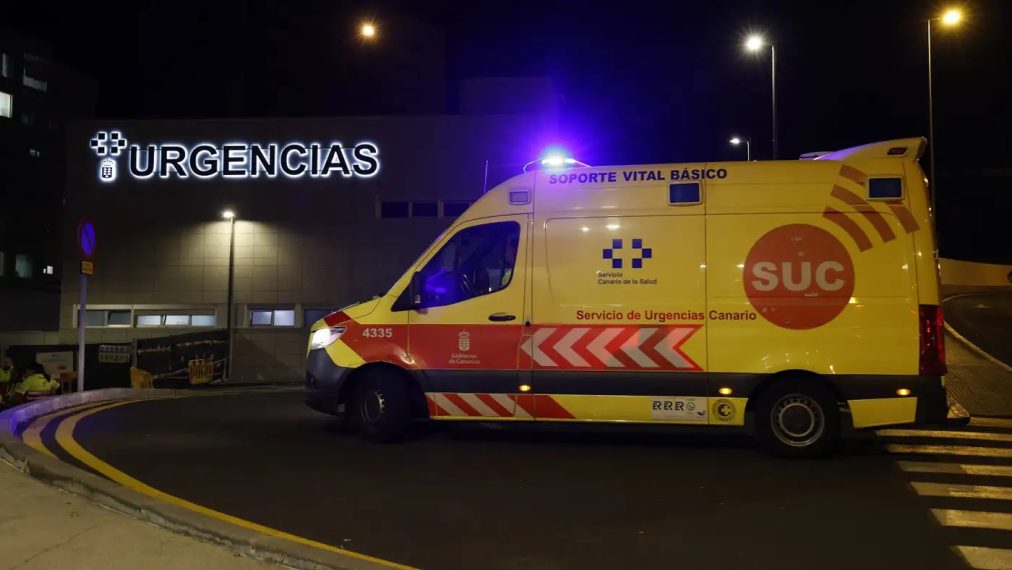
Tenerife’s medical protocol required Jesus de Miguel to be carried from the pitch to an ambulance waiting outside the playing area, rather than allowing the vehicle to drive directly on to the field.
The procedure has come under scrutiny following the death of the Tenerife striker, who suffered a serious collision during the club’s match against Andorra at the Heliodoro Rodriguez Lopez.
According to Spanish newspaper Marca, Tenerife’s established emergency arrangements specify that injured players should normally be placed on a stretcher and taken to a medically equipped ambulance stationed on La Motini street, close to the dressing-room area.
The system is based on the stadium’s layout and the distances involved. Under the protocol, taking the player to the ambulance is considered the quickest and most efficient way to complete the evacuation.
However, ambulances can enter the stadium in exceptional circumstances. A gate in the San Sebastian stand, close to the street of the same name, provides direct access from outside to the pitch.
That route is reserved for cases in which doctors decide the player must be fully immobilised. Such a decision would require the standard evacuation process to be changed.
What happened to Jesus de Miguel?
In de Miguel’s case, the full-immobilisation procedure was not activated. He was treated on the grass before being carried on a stretcher to the ambulance positioned outside the pitch.
Marca reported that the ambulance then entered the stadium perimeter through gate 17, reversing into position. Cardiopulmonary resuscitation was carried out there and successfully restored the player’s pulse before he was taken to Hospital Universitario Nuestra Senora de Candelaria.
The incident happened in the closing stages of Tenerife’s Segunda Division match against Andorra on Monday evening. De Miguel collided with goalkeeper Jesus Aono while competing for the ball and fell heavily.
He suffered a cardiac and respiratory arrest, prompting immediate treatment from the medical team and an urgent transfer to hospital. Tenerife later said resuscitation efforts inside the ambulance had restored his pulse and that he was breathing independently, although he remained unconscious and in a critical condition.
In the early hours of Tuesday, the club announced that his neurological condition had deteriorated. Tenerife subsequently confirmed his death at 08:00 local time. He was 30.
De Miguel’s death caused widespread shock across Spanish football, with clubs and sporting figures sending messages of condolence. Tenerife also asked for privacy for his family during the difficult period.
The details of the protocol explain why the ambulance did not initially drive directly on to the pitch. They do not, by themselves, establish whether the medical arrangements or the timing of their implementation were appropriate, nor do they prove any connection between the evacuation procedure and the player’s death.
-
 Al-Ittihad revive interest in Al Ahly star Emam Ashour ahead of January transfer window Nov 3, 2026
-
Mamelodi Sundowns v Golden Arrows: Confirmed line-ups for Carling Knockout quarter-final Nov 3, 2026
-
Elias Mokwana arrival set to intensify competition for Kaizer Chiefs attackers Nov 3, 2026
-
Sundowns begin domestic clean-sweep bid against Golden Arrows Nov 3, 2026




-
AFCON 2025: Fixtures, Results, Scores and Standings Jan 18, 2026
-
Match hero Taiwo Awoniyi reflects on team effort after Chelsea triumph May 5, 2026
-
Leadership and long-term vision key to rescuing Zamalek and inspiring Egyptian football – Hany Abou Rida Nov 5, 2025
-
South African giants Orlando Pirates set to lose influential forward Monnapule Saleng Mar 19, 2025




-
Barcelona host Aston Villa in Champions League meeting at Spotify Camp Nou Nov 2, 2026
-
AEK Athens v Real Madrid: Champions League date, kick-off time and viewing details Nov 2, 2026
-
Villarreal host unbeaten PSG in first European meeting Nov 2, 2026
-
Le Havre AC host Paris Saint-Germain as Ligue 1 leaders seek another win Oct 28, 2026