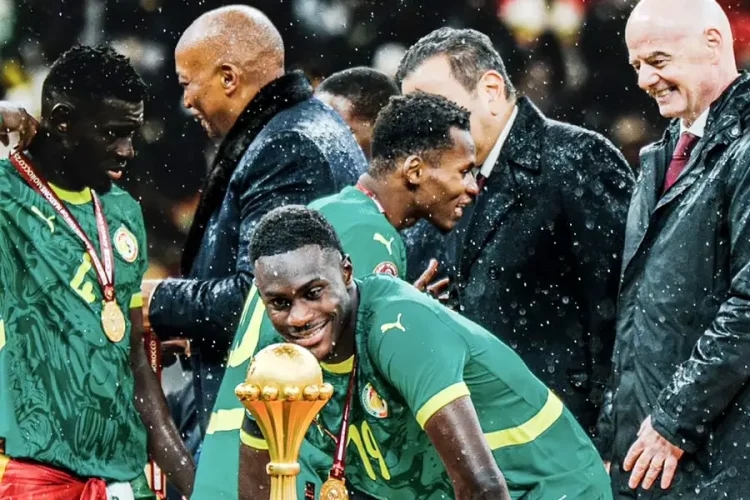
The Court of Arbitration for Sport (TAS) has overturned the Confederation of African Football’s decision to award Morocco victory by forfeit in the 2025 Africa Cup of Nations final, confirming Senegal’s 1-0 win.
The ruling, delivered on Tuesday, 24 November 2026, has reopened questions about how competition regulations should be interpreted and where the authority of match officials ends and the powers of disciplinary bodies begin.
Lotfi Rahmouni, a specialist in football disputes and international arbitration, said the case turned less on whether Senegal’s players had withdrawn from the match than on the legal consequences of what happened afterwards.
The final resumed following a decision by referee Jean-Jacques Ngambo Ndala and was eventually completed. That fact became central to the arguments presented by both sides.
The CAF Appeal Jury had relied on Articles 82 and 84 of the Africa Cup of Nations regulations when declaring Senegal to have forfeited the match. The Federation Senegalaise de Football, however, argued that the referee’s decision to restart the game had to be recognised as valid.
Rahmouni, who has represented clubs, players, coaches and intermediaries before FIFA’s judicial bodies and the TAS, said the referee’s decision played a decisive role in the tribunal’s assessment. The official had exercised his authority in determining how the match should continue, an element that influenced the legal analysis of the dispute.
The importance of the ‘field of play’ principle
The case also highlighted the so-called “field of play” principle, under which decisions made by referees during a match are generally protected from review by disciplinary or judicial authorities.
Rahmouni stressed that the principle does not give referees complete immunity. Its purpose is to preserve the division of responsibility: the referee oversees the conduct and continuation of the match, while disciplinary bodies deal with offences and impose sanctions.
The specialist also addressed proportionality, a principle frequently raised in sports disputes. In his view, proportionality remains an important part of disciplinary law, but it was not, by itself, the sole basis for the TAS decision.
He added that the absence of a forfeit should not be understood as approval of the Senegalese players’ conduct or as an exemption from responsibility for the incidents that affected the final. Those issues could still carry disciplinary implications even though Morocco was not awarded the match.
Morocco’s remaining legal option
The dispute has also exposed the need for clearer CAF regulations, particularly on match interruptions and situations in which players leave the field collectively.
The Federation Royale Marocaine de Football (FRMF) cannot make an ordinary appeal against the TAS sentence to obtain a fresh examination of the facts and arguments. Under Swiss law, it may bring an exceptional challenge before the Swiss Federal Tribunal.
That application must, in principle, be filed within 30 days of notification of the sentence. Rahmouni said a simple disagreement with the TAS’s legal interpretation would not be enough to have the ruling annulled.
He described the Morocco-Senegal dispute as an important case study for African football, particularly in defining the relationship between refereeing authority and disciplinary powers. The decision therefore extends beyond the allocation of the 2025 African title, raising wider questions about regulations, sporting results and the application of sanctions.
-
 TAS ruling confirms Senegal’s 2025 AFCON final win over Morocco Nov 25, 2026
-
Ncikazi says Pirates’ bench made the difference against Arrows Nov 25, 2026
-
Senegal FA calls for unity with Morocco following AFCON 2025 legal battle Nov 25, 2026
-
Mandla Ncikazi calls for respect for Pitso Mosimane after Abdeslam Ouaddou criticism Nov 25, 2026




-
AFCON 2025: Fixtures, Results, Scores and Standings Jan 18, 2026
-
Match hero Taiwo Awoniyi reflects on team effort after Chelsea triumph May 5, 2026
-
Leadership and long-term vision key to rescuing Zamalek and inspiring Egyptian football – Hany Abou Rida Nov 5, 2025
-
South African giants Orlando Pirates set to lose influential forward Monnapule Saleng Mar 19, 2025




-
U17 World Cup 2026: Full schedule for Morocco and where to watch Nov 19, 2026
-
Nice v Paris Saint-Germain: injury-hit champions face confident hosts in Ligue 1 Nov 19, 2026
-
Nice face formidable PSG as leaders chase eighth straight Ligue 1 win Nov 20, 2026
-
Chelsea v Leeds: Blues backed to edge tight Premier League contest at Stamford Bridge Nov 20, 2026