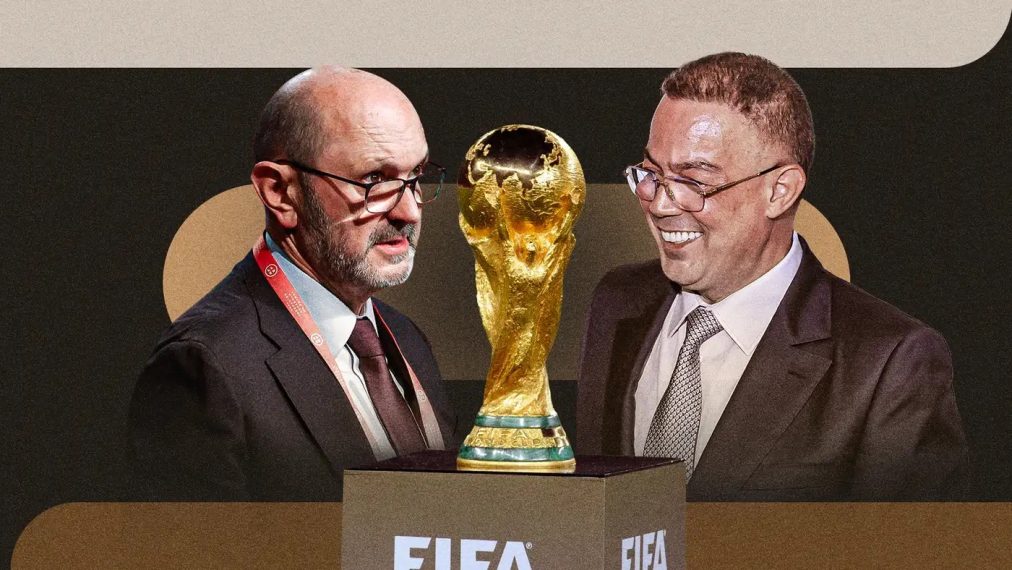
Spain and Morocco have intensified their contest to stage the 2030 World Cup final, with the dispute becoming increasingly political ahead of Spain’s general election on 29 November.
Morocco, Spain and Portugal will jointly host the tournament, but no decision has yet been made on where the final will take place. The proposed Hassan II Stadium in Morocco is a leading candidate. With a planned capacity of about 115,000, it would be the largest football stadium in the world when it is expected to open in 2029.
Spain is also pushing to host the final and can point to several major venues, including Santiago Bernabeu and Camp Nou.
FIFA said in September that the venue for the final would be confirmed “in due course”. It added that visits to candidate cities in Spain, Portugal and Morocco would begin during November to assess their suitability for hosting matches.
Spanish pressure grows
Spain’s campaign has become more forceful in recent months, with several senior figures insisting that the final belongs in the country.
Javier Tebas, president of La Liga, launched a strong attack on FIFA president Gianni Infantino, claiming that Morocco would host the final if Infantino remained in his position.
Tebas also criticised Fouzi Lekjaa, president of the Moroccan Football Federation, after he said the 2030 World Cup final would be held in Casablanca. Tebas argued that FIFA regularly denies media reports even when they are accurate.
“Lekjaa says the final will be held in Casablanca, while FIFA says that is not true. So who is lying?” Tebas said. “Is it the president of a federation organising the tournament and a member of the FIFA Council? Or should we once again believe the official denial issued by FIFA and Infantino?”
Rafael Louzan, president of the Royal Spanish Football Federation, said the organisation was doing everything possible to secure the final for Spain. He described that outcome as logical and beyond dispute.
The issue has also entered Spain’s political debate. Opposition leader Alberto Nunez Feijoo said he would be prepared to withdraw Spain from hosting the tournament if FIFA awarded the final to Morocco.
Feijoo, leader of the People’s Party, said it was self-evident that Spain should stage the match.
“Spain must host the World Cup final,” he said. “If that does not happen, then in my view Spain should not take part in organising the World Cup.”
Asked whether he would seek to withdraw Spain from the tournament’s organisation if he came to power, Feijoo replied: “Yes, the answer is yes.”
Prime Minister Pedro Sanchez, Feijoo’s leading political opponent, said in a September interview with Cadena SER that he was “working to ensure the final is held in Spain”. Spain manager Luis de la Fuente has also said publicly that the match “must be played in Spain”.
Morocco maintains its claim
Morocco remains determined to secure the final and is pressing ahead with preparations for the Hassan II Stadium.
Lekjaa previously said the Ben Slimane province would have “the honour of hosting the final” and expressed hope that Morocco would be one of the teams competing in the match.
Morocco’s position is that no partner should turn historical precedence or organisational experience into authority over the others. It is seeking what it considers a fair opportunity, based on its organisational capabilities and geographical position.
Reports in Morocco have also said Lekjaa is preparing to reorganise his responsibilities within African football. He is expected to resign as chairman of the Confederation of African Football finance committee while retaining his position as the continental body’s first vice-president.
The move is said to reflect a desire to focus more closely on his sporting and government responsibilities in Morocco, as well as preparations for hosting the 2030 World Cup.
-
 Ahmed Khaldi strengthens Algeria case after starring in USM Alger’s African triumph Nov 9, 2026
-
Ayoub Oufkir inspires AZ Alkmaar comeback after Morocco call-up Nov 9, 2026
-
TP Mazembe captain Magloire Ntambwe earns first DR Congo call-up Nov 9, 2026
-
Five African players who made the difference in Europe this weekend Nov 9, 2026



-
AFCON 2025: Fixtures, Results, Scores and Standings Jan 18, 2026
-
Match hero Taiwo Awoniyi reflects on team effort after Chelsea triumph May 5, 2026
-
Leadership and long-term vision key to rescuing Zamalek and inspiring Egyptian football – Hany Abou Rida Nov 5, 2025
-
South African giants Orlando Pirates set to lose influential forward Monnapule Saleng Mar 19, 2025




-
AEK Athens v Real Madrid: Champions League date, kick-off time and viewing details Nov 2, 2026
-
Manchester United host Aston Villa as both sides seek a Premier League lift Nov 6, 2026
-
Real Sociedad and Lyon name probable line-ups for Europa League meeting Nov 3, 2026
-
Atletico Madrid host Barcelona in Liga summit clash with history at stake Nov 6, 2026