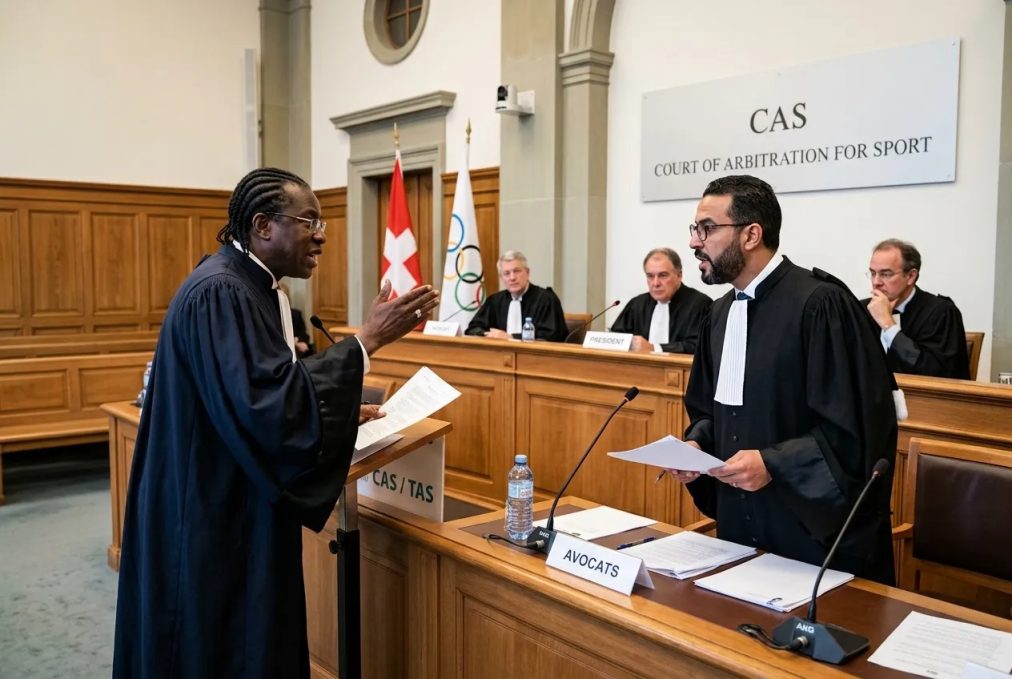
The Court of Arbitration for Sport (TAS) has heard arguments from Senegal, Morocco and the Confederation of African Football (CAF) in the dispute over the 2025 Africa Cup of Nations final, with reports from the closed hearing suggesting that the parties remain far apart.
The case was examined in Lausanne on Thursday, amid disagreement over the interpretation of the competition regulations, the referee’s role and alleged procedural irregularities.
However, caution is required when assessing information emerging from the proceedings, which were held behind closed doors.
According to reports published on Thursday, including by journalist Malang Sane, Morocco’s legal team reiterated its reliance on Articles 82 and 84 of the Africa Cup of Nations regulations. Those provisions relate in particular to abandoning the field of play and the sanctions that may follow.
The Moroccan representatives are also reported to have offered an explanation for why referee Jean-Jacques Ndala did not permanently stop the match after the Senegal players withdrew. They allegedly argued that the referee had been influenced by his compatriot Olivier Safari, the president of CAF’s referees’ commission.
Images said to show Safari giving instructions to Ndala were reportedly discussed during the hearing. At this stage, however, that remains an argument attributed to sources outside the proceedings and has not been established as fact.
Senegal’s defence is understood to have put the emphasis on the authority of the referee’s decisions, citing Law 5 of the International Football Association Board (IFAB) and Article 9 of the FIFA Disciplinary Code.
Its central argument is that the match resumed and was played through to its conclusion under the control of the match officials.
Senegal is also reported to have challenged the regularity of the procedure that led to the CAF appeals committee’s decision. The Senegalese side is further said to have raised suspicions of corruption, although those allegations have not been publicly confirmed.
The possible existence and significance of a second referee’s report was another contentious issue.
Malang Sane, citing a source who attended the hearing, reported that the possibility of a second report had been rejected after three hours of arguments. That account was qualified by the account “youssefamz13”, which said the document had not been mentioned during the hearing at all.
The distinction is significant: an item ruled out after being considered is not necessarily one that was never discussed.
More broadly, the reports should be treated carefully. Because the hearing was held in private, accounts of what took place may be incomplete, contradictory or influenced by the interests and views of the sources providing them.
One point is certain: TAS will not issue its verdict on Thursday, 8 October. The arbitrators must deliberate before reaching a decision in the sensitive case, and no date for the ruling has yet been announced.
-
 Senegal-Morocco CAN 2025 dispute: key arguments emerge from closed TAS hearing Oct 8, 2026
 -
Ghana star Antoine Semenyo marries longtime partner Jordeen Buckley Oct 8, 2026
-
Morocco: Ittihad Touarga and RS Berkane play out goalless draw Oct 8, 2026
-
Senegal midfielder Nampalys Mendy sidelined for several months Oct 8, 2026


-
AFCON 2025: Fixtures, Results, Scores and Standings Jan 18, 2026
-
Match hero Taiwo Awoniyi reflects on team effort after Chelsea triumph May 5, 2026
-
Leadership and long-term vision key to rescuing Zamalek and inspiring Egyptian football – Hany Abou Rida Nov 5, 2025
-
South African giants Orlando Pirates set to lose influential forward Monnapule Saleng Mar 19, 2025




-
Croatia face Spain with Nations League hopes on the line in Split Oct 5, 2026
-
France v Belgium: Probable line-ups for Nations League clash Oct 3, 2026
-
Morocco coach Mohamed Ouahbi refuses to single out player after Mali draw Oct 4, 2026
-
Noussair Mazraoui leaves Morocco squad early after injury Oct 2, 2026