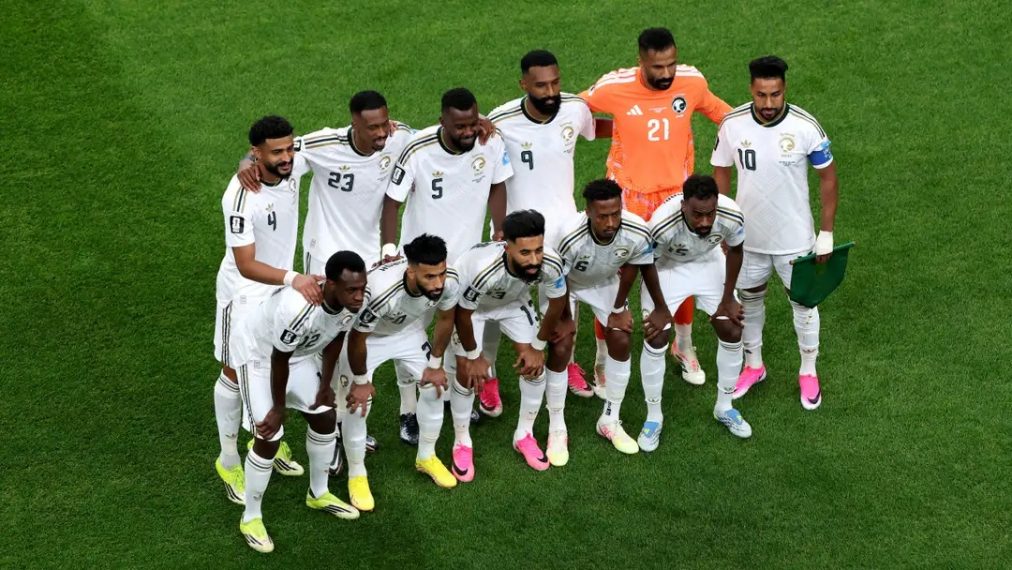
Saudi Arabia showed signs of progress in their friendly matches against South Korea and Uzbekistan, but former captain Sami Al-Jaber believes repeated individual errors must be corrected before they become a serious problem.
Speaking on the Nadina programme on MBC, Al-Jaber said the two matches had provided valuable benefits, particularly in terms of team understanding and giving more players an opportunity to establish themselves.
“The two experiments were very good in my view, regardless of the results,” he said. “The general situation with the national team is a continuation of what we saw in the Gulf Cup, although the opponents and competitors have changed.
“The match against South Korea was very good, with fewer mistakes. Our only criticism was related to receiving and passing the ball, along with a few minor individual errors.”
Al-Jaber said those mistakes had reappeared against Uzbekistan, including in defensive areas and from the goalkeeper.
“Today, the individual errors were repeated, whether in the defensive area or even by the goalkeeper, despite there not being much time between the two matches,” he said. “Nevertheless, I do not think Saudi Arabia were bad at all. On the contrary, they were good to very good during some periods and better than that in others.”
He pointed to the match statistics as evidence of a closely contested encounter. “When you talk about shots, it was nine against eight, while the dangerous chances were three against two,” he said.
Al-Jaber also praised Uzbekistan’s organisation and their ability to exploit Saudi Arabia’s strengths and weaknesses, but warned that the repeated mistakes could not be overlooked.
“Those errors are acceptable in a friendly, but when they are repeated across more than one match, that raises a question,” he added.
Different tactical approaches
Al-Jaber noted that Giorgos Donis used a markedly different approach against Uzbekistan from the one seen against South Korea.
“Donis’ method against South Korea was completely different from this match,” he said. “This game was almost similar to the meeting with the United Arab Emirates, as he relied on a high press.”
However, Saudi Arabia were unable to execute that strategy effectively because Uzbekistan were strong when playing the ball out from the back.
“That is not surprising, because Uzbek football has developed considerably,” Al-Jaber said.
He added that Uzbekistan had not fielded all of their leading players, with only one or two prominent names involved in defence or elsewhere. Even so, he said Saudi Arabia had gained several positives from the two friendlies, with improved cohesion among the most important.
Al-Jaber also welcomed the rotation used by Donis, saying it was difficult to play two matches with the same starting team. He highlighted the impact of Mohammed Kanno, who came on and created two chances during the final 10 minutes.
“If the match had continued with 11 against 11, I believe Saudi Arabia could have offered even more,” he said.
The former international said Donis needed time and strong competition to develop the team, with the Saudi Pro League providing that level of challenge. He also praised the changing mentality of Saudi players, saying the Gulf Cup had encouraged many to believe they could earn a place in the national team.
Al-Jaber concluded that the postponement of the Asian Cup could benefit both Donis and Saudi Arabia.
-
 Mosimane reveals tactical switch that unlocked Mofokeng for Bafana Bafana Nov 18, 2026
-
SAFCA calls for accredited chaplaincy after concerns over Kaizer Chiefs youngster Abrahams Nov 18, 2026
-
Adel Amrouche remains open to coaching move in South Africa Nov 18, 2026
-
Andre Zambo-Anguissa prioritises Marseille return as Sunderland and Juventus show interest Nov 18, 2026




-
AFCON 2025: Fixtures, Results, Scores and Standings Jan 18, 2026
-
Match hero Taiwo Awoniyi reflects on team effort after Chelsea triumph May 5, 2026
-
Leadership and long-term vision key to rescuing Zamalek and inspiring Egyptian football – Hany Abou Rida Nov 5, 2025
-
South African giants Orlando Pirates set to lose influential forward Monnapule Saleng Mar 19, 2025




-
AFCON 2027 Qualifiers: Benni McCarthy likens Kenya’s clash with South Africa to ‘David versus Goliath’ Nov 13, 2026
-
Morocco aim to extend lead against Niger in 2027 Africa Cup of Nations qualifier Nov 13, 2026
-
Serbia v Germany: Vlahovic absence adds to pressure on Klopp’s side Nov 12, 2026
-
AFCON 2027 Qualifiers: Pitso Mosimane warns South Africa against dangerous Kenya Nov 13, 2026