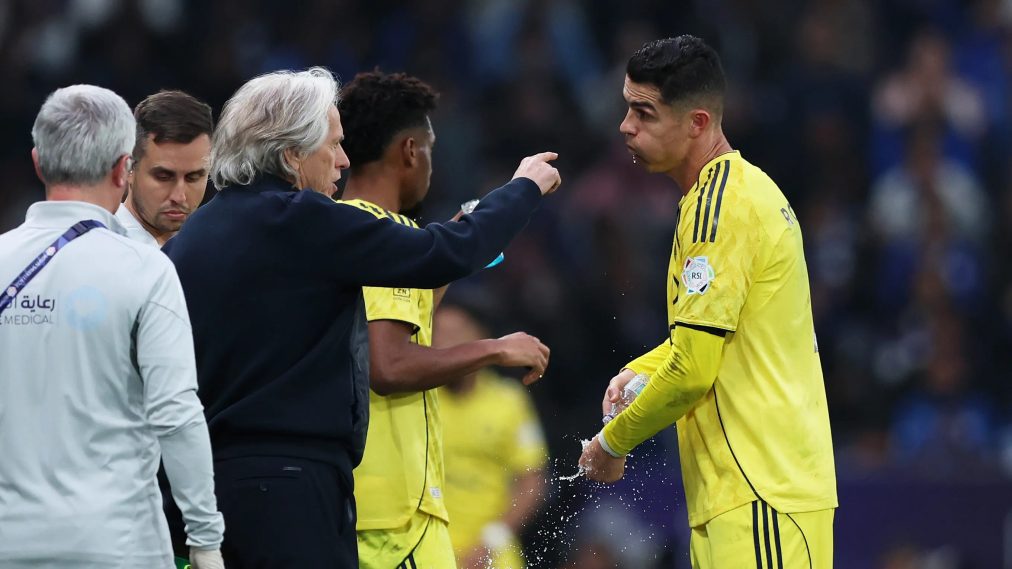
Jorge Jesus’ decision to leave Cristiano Ronaldo out of Portugal’s starting XI has raised questions that extend beyond the national team, with the episode potentially affecting the striker’s position at Al Nassr.
Ronaldo reacted angrily before leaving the Portugal camp, turning what might have been viewed as a tactical decision into a wider dispute. The development is particularly significant because Jesus is the same coach who shared one of Ronaldo’s most successful periods at Al Nassr, celebrating trophies and victories with him in Riyadh only months ago.
Jesus has since become the manager willing to place Ronaldo on the bench, while making clear that neither the player nor his reputation would alter his thinking or decisions.
A precedent for Al Nassr
Jesus did not treat Ronaldo as untouchable. Instead, he made a clear footballing choice and then stated that no player could change his ideas. That stance is notable given Ronaldo’s long-standing status as the central figure in many of the projects he has been involved in.
The decision demonstrated that the Portuguese forward’s name and standing do not guarantee him a place in the starting line-up if a manager believes another approach is better for the team.
That may have consequences at Al Nassr. Jesus’ choice has removed a psychological barrier surrounding the idea of leaving Ronaldo among the substitutes and shown that a coach can take such a step if he is prepared to deal with the consequences.
Ange Postecoglou has not appeared to be seeking a new confrontation with Ronaldo, but the season could eventually present him with a similar decision. Ronaldo has not yet produced the expected level of performances for Al Nassr, either domestically or in Asian competitions, making his automatic selection a matter for footballing debate.
If Postecoglou concludes that his team requires different solutions in certain matches, leaving Ronaldo out may no longer seem impossible. The Australian manager’s tactical ideas and the demands of his system could bring that issue into sharper focus.
However, a decision to bench Ronaldo at Al Nassr would carry greater repercussions than a comparable move in an international match. It would involve a global star, a substantial contract and an entire sporting and commercial project built around his presence.
If Ronaldo were left out repeatedly, the situation could quickly develop from a tactical decision into a serious crisis, particularly if he felt his influence within the team was declining. His reaction to the Portugal decision showed the tension that can arise when his wishes conflict with a manager’s judgement.
Contract complicates any exit
Even if Al Nassr eventually considered ending its relationship with Ronaldo, the financial implications would make such a move highly complicated. Reports cited by the source indicate that he earns an annual salary approaching 200 million euros.
Benching Ronaldo and terminating his contract are therefore entirely different matters. The first is a sporting decision for the manager; the second would require difficult financial, legal and administrative calculations.
Jesus may have opened the door to a new way of managing Ronaldo, but turning that precedent into the end of his Al Nassr career would require far more than a place on the substitutes’ bench. Ronaldo now faces the choice of responding on the pitch and reasserting his position, or becoming involved in a dispute that could create the biggest test of his future in Riyadh.
-
 Kaizer Chiefs move Stellenbosch fixture as CAF Confederation Cup schedule tightens Oct 1, 2026
 -
Guinea v Kenya: kick-off time, broadcast details and key Africa Cup of Nations qualifying storylines Oct 1, 2026
-
Morocco youngster Moncef Zekri returns to Sporting Lisbon training Oct 1, 2026
-
Lille dealt injury blow as Ethan Mbappé faces three-week lay-off Oct 1, 2026




-
AFCON 2025: Fixtures, Results, Scores and Standings Jan 18, 2026
-
Match hero Taiwo Awoniyi reflects on team effort after Chelsea triumph May 5, 2026
-
Leadership and long-term vision key to rescuing Zamalek and inspiring Egyptian football – Hany Abou Rida Nov 5, 2025
-
South African giants Orlando Pirates set to lose influential forward Monnapule Saleng Mar 19, 2025




-
AFCON 2027 Qualifiers: McCarthy warns South Africa to expect tough test against Eritrea Sep 29, 2026
-
AFCON 2027 qualifiers: Algeria, Morocco and Nigeria among winners on opening matchday Sep 26, 2026
-
AFCON 2027 qualifiers: Burkina Faso held by Benin in Group F Sep 25, 2026
-
South Sudan vs Egypt: Where to watch AFCON 2027 qualifier Sep 29, 2026