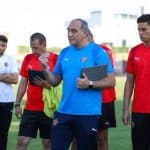
Real Madrid have dramatically reduced their injury problems through a comprehensive fitness programme led by conditioning specialist Antonio Dias, according to coach Jose Mourinho.
The club recorded 123 injuries and other physical problems over the previous two seasons, but Mourinho said Real Madrid reached the middle of October without a single new injury for the first time in a decade.
He made the comment after the 9 October victory over Villarreal, the first of eight consecutive wins.
“Do you want a story? I’ll tell you one,” Mourinho said. “This is the first time in the last 10 years that Real Madrid have reached the middle of October without having a player injured.”
He added that the players still listed as injured had carried their problems over from the previous season: Eder Militao, Rodrygo, Marco Asensio and Ferland Mendy. Asensio had undergone surgery during the current campaign for an injury suffered in January.
The situation has since improved further. Militao has returned to action and Mendy has been given medical clearance, although he has not yet been included in a matchday squad. Rodrygo and Asensio remain the only players still absent.
Mourinho said he did not want to criticise the work of previous coaching teams, but explained that the current system combined the players, sports scientists and medical department.
“We work according to a comprehensive, normal and professional plan, based on very good co-operation between everyone,” he said. “There are specialists who can prevent injuries, improve strength and introduce individual training when small warning signs are detected before they become problems. The medical department is also heavily involved and does a lot of invisible work.”
Dias’s role in the new approach
Dias, born in 1982, is regarded by Mourinho as the key figure in the change. He specialises in eccentric strength training, in which muscles lengthen while producing force.
His career began in a role similar to Mourinho’s early work under Bobby Robson at Barcelona. Dias worked as an Italian translator for Luigi Delneri, who succeeded Mourinho as Porto manager, having learned the language during a student exchange in Italy.
He later worked with Nuno Espirito Santo at Porto at the end of the Portuguese’s playing career and joined his coaching staff when Nuno became a manager. The pair worked together at Rio Ave, Valencia, Porto, Wolverhampton Wanderers, Tottenham, Al-Ittihad and Nottingham Forest.
Mourinho contacted Dias in 2025 to join him at Fenerbahce and later Benfica. When Mourinho negotiated with Real Madrid, the club already had Antonio Pintus involved in physical preparation, but Mourinho insisted on bringing Dias. He kept the door open to Pintus, who remains highly respected at the club, and the two share the workload, although Dias has the final say.
Real Madrid have scored 16 of their 44 goals this season after the 75th minute – 36.4% – and have used that late fitness to secure wins and comebacks against Roma, AEK and Barcelona.
Since pre-season began, the squad has suffered only 10 injuries. October brought two, including Thibaut Courtois’s flu-like illness.
Paulinho Granero, a Spanish conditioning coach who has worked with CSKA Moscow and the Russia national team and is now at Qatar’s Al-Shamal, said eccentric training was supported by research. He cited the Nordic hamstring exercise, in which a player controls a forward movement from a kneeling position, as one example.
A review of 108 studies published in the American Journal of Sports Medicine found eccentric programmes reduced hamstring injuries by between 56.8% and 70%. A separate study in the British Journal of Sports Medicine found the Nordic exercise could reduce such injuries by up to 51%.
-
 Morocco emerges as favourite to host 2028 Futsal World Cup Nov 14, 2026
-
Cote d’Ivoire’s attacking stars shine but defensive concerns remain against Gambia Nov 14, 2026
-
Mohamed Salah overtakes Hossam Hassan to become Egypt’s all-time leading scorer Nov 14, 2026
-
Gernot Rohr urges caution despite Benin’s strong start to AFCON 2027 qualifying Nov 14, 2026




-
AFCON 2025: Fixtures, Results, Scores and Standings Jan 18, 2026
-
Match hero Taiwo Awoniyi reflects on team effort after Chelsea triumph May 5, 2026
-
Leadership and long-term vision key to rescuing Zamalek and inspiring Egyptian football – Hany Abou Rida Nov 5, 2025
-
South African giants Orlando Pirates set to lose influential forward Monnapule Saleng Mar 19, 2025




-
Ali Maher names first Egypt squad for 2027 Africa Cup of Nations qualifiers Nov 9, 2026
-
Morocco v Niger: Lions of the Atlas seek another win in CAN 2027 qualifying Nov 11, 2026
-
CAN 2027 qualifying: Cote d’Ivoire-Gambia and Mali-Rwanda headline third round Nov 9, 2026
-
FIFA U17 World Cup 2026: TV channels, streaming and full match schedule Nov 8, 2026