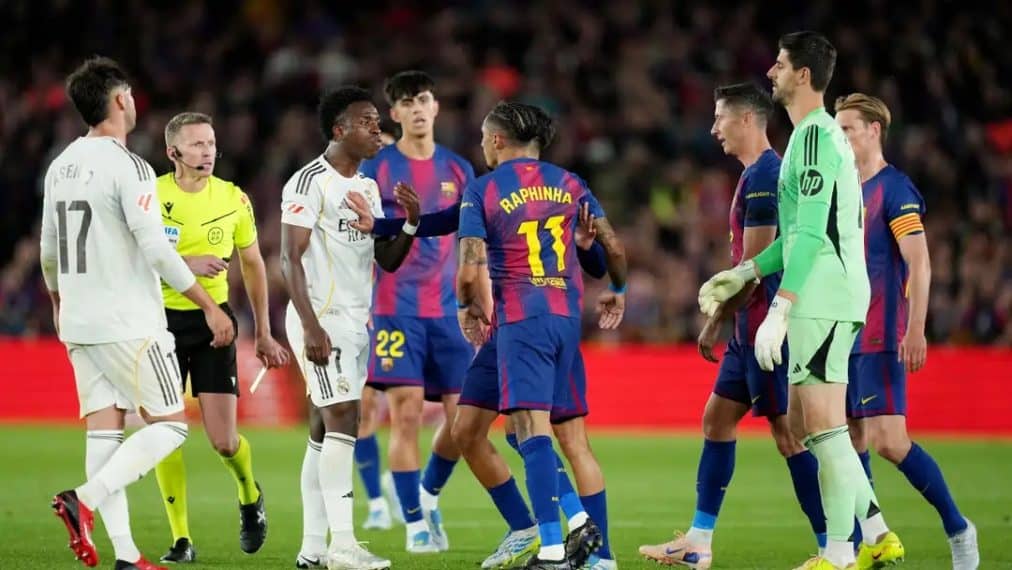
Raphinha returns to La Liga in a worse position than when he left, while Vinicius Junior comes back with greater confidence, highlighting the contrasting ways Brazil’s players can be viewed by supporters depending on their circumstances.
According to Spanish newspaper AS, Raphinha remains an unusual figure in Brazil. Some fans do not regard him as one of their own because he left the country at 18 without coming through the academy of one of its major clubs.
Raphinha grew up in Restinga, a poor neighbourhood of Porto Alegre, and did not play for either Internacional or Gremio. His football education came instead on the rough pitches of local communities, where matches were played on dirt with limited resources. Players could not always afford proper sportswear, and the simplest way to distinguish the teams was for one side to surrender its shirts.
He eventually reached Avai before moving to Portugal. Before joining Barcelona, he was one of hundreds of Brazilian players treated almost like commodities in the transfer market, many of whom later disappeared from football’s collective memory.
His status has since changed dramatically. Raphinha is now one of Barcelona’s leaders, while Carlo Ancelotti has also given him a leadership role within the Brazil national team. That progress, however, has not shielded him from criticism in his home country, particularly after comments he made following the renewal of his Barcelona contract.
His dismissal during Brazil’s match against Singapore was not necessarily viewed as an isolated incident. It came only days after a demanding news conference in which he faced considerable pressure.
Vinicius Junior’s relationship with Brazil is different. Although he also left at a young age after Real Madrid signed him as part of their long-term plans, he was already a recognised name in his home country.
He had also graduated from the Flamengo academy, giving him a stronger connection with supporters of one of Brazil’s most popular clubs, whose appeal extends around the world.
The Real Madrid forward is widely liked by Brazilian fans, although he has not reached legendary status or the level of Neymar, who did not lead Brazil to a World Cup title but provided supporters with years of joy and hope.
Like many Brazilian players since 2002, Vinicius has been affected by the national team’s repeated failures. His desire to represent Brazil and the positive moments he produced in the two matches against Singapore have been praised, but a country that has won the World Cup five times expects more.
Vinicius has taken steps to address his shortcomings and move beyond the criticism directed at him. Yet attention has shifted towards domestic football as Flamengo close in on the league title, while Corinthians, Gremio and Internacional face a serious threat of relegation.
Brazil’s friendlies in Asia have attracted far less interest. Many supporters view them as commercial fixtures designed to generate revenue rather than eagerly awaited football events.
For now, their only priority is Brazil winning a sixth World Cup and finally securing the sixth star.
-
 CAF records $31.2m profit as financial recovery gathers pace under Patrice Motsepe Nov 21, 2026
-
Stellenbosch FC and Orlando Pirates name teams for Carling Knockout semi-final Nov 21, 2026
-
Jackson Mabokgwane targets future Bafana Bafana coaching role Nov 21, 2026
-
Sixhaso family appeals for help after former Kaizer Chiefs goalkeeper dies aged 33 Nov 21, 2026



-
AFCON 2025: Fixtures, Results, Scores and Standings Jan 18, 2026
-
Match hero Taiwo Awoniyi reflects on team effort after Chelsea triumph May 5, 2026
-
Leadership and long-term vision key to rescuing Zamalek and inspiring Egyptian football – Hany Abou Rida Nov 5, 2025
-
South African giants Orlando Pirates set to lose influential forward Monnapule Saleng Mar 19, 2025