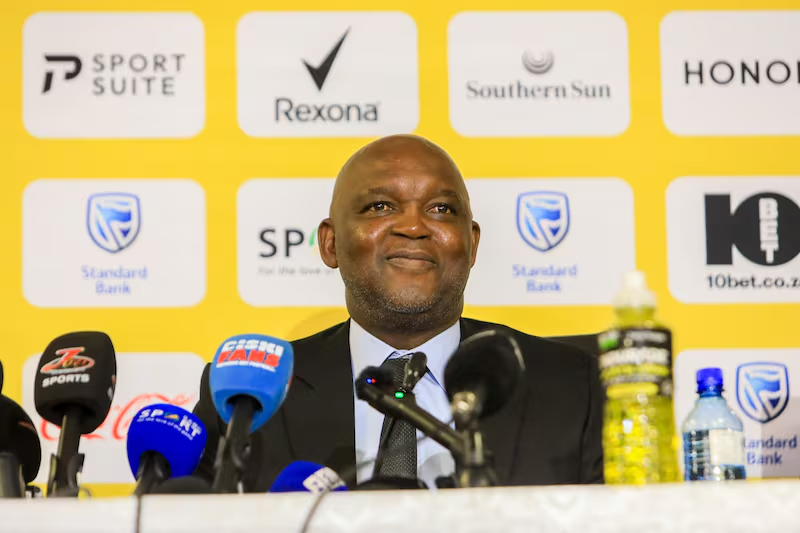
Pitso Mosimane’s return as South Africa coach gives him an opportunity to prove his critics wrong, with the former Bafana Bafana manager inheriting a stronger squad and a national team that has regained public support.
The South African Football Association (Safa) confirmed Mosimane’s appointment on Tuesday after lengthy negotiations between the organisation and his representatives. He succeeds Belgian coach Hugo Broos, whose work has provided a platform for further progress with the senior men’s national team.
Mosimane’s return comes 14 years after Safa ended his first spell in charge while the team was in camp in Rustenburg. He initially led Bafana between 2010 and 2012, having previously worked as an assistant to Brazilian World Cup-winning coach Carlos Alberto Parreira.
At that stage of his career, Mosimane was still developing as a manager. His main achievement had been his work with SuperSport United, the club that gave him his first opportunity in coaching. He showed promise by establishing a style of football that helped transform the club from also-rans into serious Premier Soccer League title contenders, with SuperSport United finishing runners-up twice.
However, the demands of the national-team job proved too great at the time. Mosimane was not yet equipped to deal with the intense scrutiny and pressure that comes with managing Bafana Bafana.
That early experience remains central to the argument made by those who believe his second appointment is a mistake. But such criticism fails to account for the progress Mosimane has made since his dismissal.
Rather than allowing the setback to define him, he continued his development through advanced coaching education and international qualifications. He also built Mamelodi Sundowns into one of Africa’s strongest clubs, winning a series of trophies during a period of sustained dominance in South African football.
Mosimane has since strengthened his reputation in continental competition. He has managed in four Confederation of African Football Champions League campaigns, winning the competition once with Mamelodi Sundowns and twice with Al Ahly of Egypt, known as Africa’s Club of the Century.
Those achievements have given him a record that, even his detractors must acknowledge, cannot be dismissed.
The Bafana Bafana side he inherits is also in a healthier position, both in terms of performances and the age profile of the squad, than the team he managed during his first spell.
South Africa have recently returned to the affections of supporters after making historic progress to the knockout stages of the FIFA World Cup in North America. That achievement has raised expectations that the team’s improvement will continue under Mosimane.
He will need to transfer the experience gained at club level to the international arena, with little time available to settle into the role. Mosimane and his technical team, Musi Matlaba and Kabelo Rangoaga, will begin preparations immediately, because Bafana Bafana start their qualifiers for the 2027 Africa Cup of Nations in two weeks.
Their opening Group D match is at home against Guinea. A victory would provide an ideal start and encourage hopes that South Africa can eventually win a second continental title, following their only Africa Cup of Nations triumph in 1996.
That trophy remains one of the few major prizes missing from Mosimane’s collection, while qualification for the 2030 FIFA World Cup is another target he will be expected to pursue.
Supporters across South Africa will demand significant results. Mosimane’s experience of sustained pressure and criticism, including during his time working under the demanding fanbase of Al Ahly, could help him manage the expectations surrounding his return.
But there will be little tolerance for mistakes during his second spell in charge of Bafana Bafana.
-
 Senegal take control as Mali stumble in Olympic qualifiers Oct 9, 2026
 -
Senegal take control as Mali stumble in Olympic qualifiers Oct 9, 2026
-
TAS hearing to examine Senegal appeal over 2025 Africa Cup of Nations final Oct 9, 2026
-
Burkina Faso take control against Equatorial Guinea in Los Angeles 2028 Olympic qualifying Oct 8, 2026

-
AFCON 2025: Fixtures, Results, Scores and Standings Jan 18, 2026
-
Match hero Taiwo Awoniyi reflects on team effort after Chelsea triumph May 5, 2026
-
Leadership and long-term vision key to rescuing Zamalek and inspiring Egyptian football – Hany Abou Rida Nov 5, 2025
-
South African giants Orlando Pirates set to lose influential forward Monnapule Saleng Mar 19, 2025




-
Croatia face Spain with Nations League hopes on the line in Split Oct 5, 2026
-
France v Belgium: Probable line-ups for Nations League clash Oct 3, 2026
-
Morocco coach Mohamed Ouahbi refuses to single out player after Mali draw Oct 4, 2026
-
Noussair Mazraoui leaves Morocco squad early after injury Oct 2, 2026