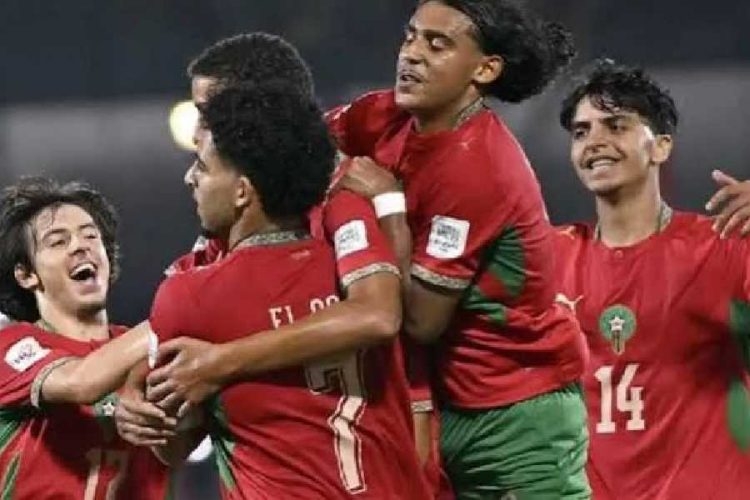
Morocco secured a place in the last 32 of the 2026 FIFA U-17 World Cup in Qatar despite losing 2-0 to Spain in Doha on Thursday.
The Lion Cubs of the Atlas conceded after 18 minutes and fell further behind in the 61st minute as Spain’s technical control and movement without the ball exposed weaknesses in the Moroccan side’s attacking play.
Ahmed Kantari’s team finished second in Group H with four points, behind Spain, who topped the section with nine. While the result confirmed Morocco’s progress to the knockout stage, the match raised concerns over their defensive coverage, midfield control, ability to play out under pressure and chance creation.
Rimi Zitouni, a former Raja Casablanca player and youth-development coach at the club’s academy, analysed the performance for Africafoot. Having worked with several age groups, Zitouni identified the main tactical problems and assessed the individual performances ahead of the last 32.
Defensive structure and midfield control
Zitouni said Morocco’s approach was coherent against an opponent superior in possession and off-the-ball movement, but their defensive plan did not contain Spain consistently.
The opening goal, in his view, illustrated problems in reading Spanish runs and sharing defensive responsibilities. Spain’s second goal later confirmed Morocco’s difficulty in adjusting to opponents capable of increasing the tempo and exploiting spaces between the lines.
The midfield was another major concern. Zitouni believes Morocco struggled to compete in that area and did not provide a reliable link between winning possession and building attacks.
He also felt the team’s attacking play relied too heavily on individual initiatives. The forwards did not make enough use of the space behind Spain’s defence, partly because their movements were not sufficiently coordinated with the midfielders and wide players.
The substitutions made by Kantari, including the introductions of Ibrahim Rabbaj, Mohamed-Amine Obakrim and Ali Saif Eddine Machfouk, did not produce the tactical response Morocco needed, according to Zitouni.
Three players earn praise
Despite the defeat, Zitouni singled out three players for positive performances.
Ilian Hadidi was regarded as Morocco’s most effective attacking player. Zitouni also praised Adam Mouak, the Paris Saint-Germain goalkeeper, despite the two goals conceded.
His third selection was Ziyad Baha of Olympique de Marseille. The forward’s movement and willingness to attack space impressed Zitouni, although he believed Baha’s overall attacking influence remained limited.
Zitouni felt Ayman Ezzarky, Ismail El Aoud of Valence CF and Wahib El Antary of Angers were below expectations in this particular match. He stressed that the assessment applied only to their display against Spain and was not a final judgement on their potential.
Ezzarky had too little influence during transitions, while El Aoud’s attacking contribution did not meet the demands of the game. El Antary, meanwhile, needed to have a greater impact on linking the lines and helping Morocco play out.
Three priorities before the knockout stage
Zitouni believes Kantari’s staff must focus on improving Morocco’s ability to build from the back against intense pressing, develop greater understanding between the attacking players, particularly Hadidi and Baha, and strengthen defensive cover.
He also called for better control of the spaces between the lines against teams that use quick passing and frequent positional rotations.
The defeat should serve as a reference point for the coaching staff, Zitouni said, while Morocco’s qualification remains a positive achievement. However, he believes the side must develop a more clearly defined attacking identity if it is to progress further.
-
 Morocco U17 through despite Spain defeat as Rimi Zitouni highlights key weaknesses Nov 27, 2026
-
Kaizer Chiefs urged to put Sundowns victory aside before Chippa test Nov 27, 2026
-
Patrick Agyemang credits Ghanaian mother for strength after devastating Achilles injury Nov 27, 2026
-
Morocco’s Maghreb de Fes name 22-man squad for crucial Pyramids Champions League clash Nov 27, 2026


-
AFCON 2025: Fixtures, Results, Scores and Standings Jan 18, 2026
-
Match hero Taiwo Awoniyi reflects on team effort after Chelsea triumph May 5, 2026
-
Leadership and long-term vision key to rescuing Zamalek and inspiring Egyptian football – Hany Abou Rida Nov 5, 2025
-
South African giants Orlando Pirates set to lose influential forward Monnapule Saleng Mar 19, 2025




-
Nice face formidable PSG as leaders chase eighth straight Ligue 1 win Nov 20, 2026
-
Liverpool v Manchester United: kick-off time, TV details and match preview Nov 20, 2026
-
Barcelona v Villarreal: Probable line-ups for Sunday’s La Liga clash Nov 21, 2026
-
African football leaders back Gianni Infantino with standing ovation for FIFA’s upcoming election Nov 21, 2026