Morocco eyes Real Madrid talent Thiago Pitarch for 2030 World Cup Project
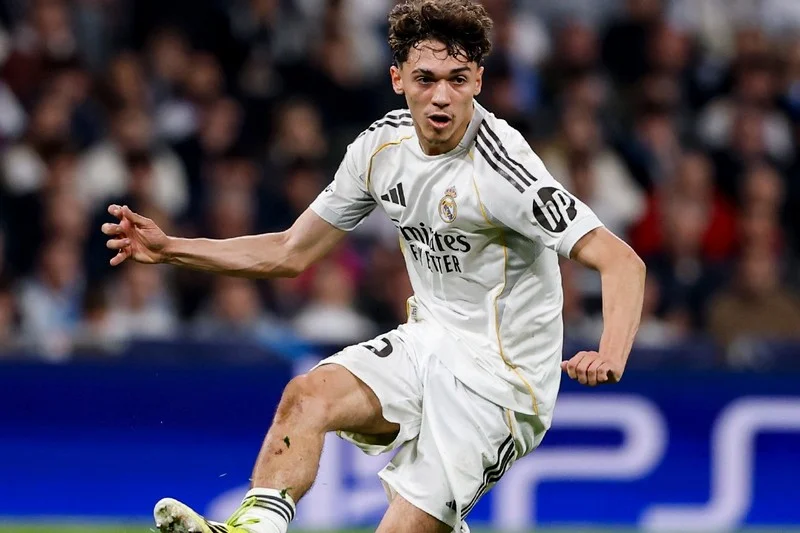
The Royal Moroccan Football Federation are keen on securing Real Madrid talent Thiago Pitarch for the 2030 World Cup tournament.
Pitarch, 18, has broken into Real Madrid’s first team under the guidance of coach Álvaro Arbeloa, swiftly emerging as a fan favourite.
The fast-rising midfielder will remain with Real Madrid’s senior squad until the end of the season, a period that has proven transformative for the teenager, who has already made his name resonate among fans and pundits alike. His technical ability, vision, and maturity on the pitch have marked him as one of the club’s most exciting prospects.
Off the pitch, Pitarch’s dual heritage has sparked significant interest from the Moroccan national team. With a grandmother of Moroccan descent, he is eligible to represent Morocco under Article 6 of FIFA’s eligibility rules, which allows players to play for a national team if one of their grandparents was born in that country.
Morocco has already been monitoring Pitarch’s progress for some time. His name appeared on the preliminary list for the Morocco under-20 national team, alongside players like Rachad Fattal, who shares a similar eligibility situation, according to the Spanish newspaper Marca.
Now, the Royal Moroccan Football Federation (FRMF) has taken its interest further, presenting Pitarch with a long-term plan linked to the 2030 World Cup, which Morocco will co-host with Spain and Portugal. The federation’s strategy aims to gradually integrate young talents who could play pivotal roles in the tournament, providing guidance and developmental opportunities over the next decade.
This approach is measured, as Morocco is also looking for more experienced players this summer, such as Ayoub Bouadi, the Lille midfielder of Moroccan descent, to strengthen the squad immediately while nurturing promising youth like Pitarch for the future.
This situation mirrors other notable cases in international football. Brahim Díaz, for example, was offered an immediate starring role with Spain but ultimately represents a template of how dual-nationality players navigate career decisions. From an organizational perspective, Munir El Haddadi remains the most illustrative case. Initially capped by Spain, Munir successfully petitioned FIFA to amend eligibility rules and ultimately represented Morocco. Crucially, youth international appearances do not permanently bind a player; only an official senior competitive match for one national team closes the door entirely. Friendly matches, even at senior level, do not count.
For Thiago Pitarch, this means that while his future with Real Madrid is blossoming, his international allegiance remains open, giving Morocco an opportunity to invest early in a young talent who could one day shine on the world stage at the 2030 World Cup.
As the season progresses, all eyes will remain on Pitarch—both for his performances on the pitch and for the international decision that could shape the trajectory of his career for years to come.
Popular News


-

AFCON 2025: Fixtures, Results, Scores and Standings
Jan 18, 2026 -

Leadership and long-term vision key to rescuing Zamalek and inspiring Egyptian football – Hany Abou Rida
Nov 5, 2025 -

South African giants Orlando Pirates set to lose influential forward Monnapule Saleng
Mar 19, 2025 -

Full schedule for 2025 Africa Cup of Nations in Morocco confirmed
Feb 12, 2025

-

LIVE UPDATES: D.R Congo 1-0 Jamaica – 2026 FIFA World Cup Playoffs
Mar 31, 2026 -

Cameroon defeat China 2-0 in FIFA Series clash
Mar 31, 2026 -

Africa’s 2026 World Cup Teams: Fixtures and Results for March friendly games
Apr 1, 2026 -

Zimbabwe defender Teenage Hadebe dropped after code of conduct breach
Mar 30, 2026