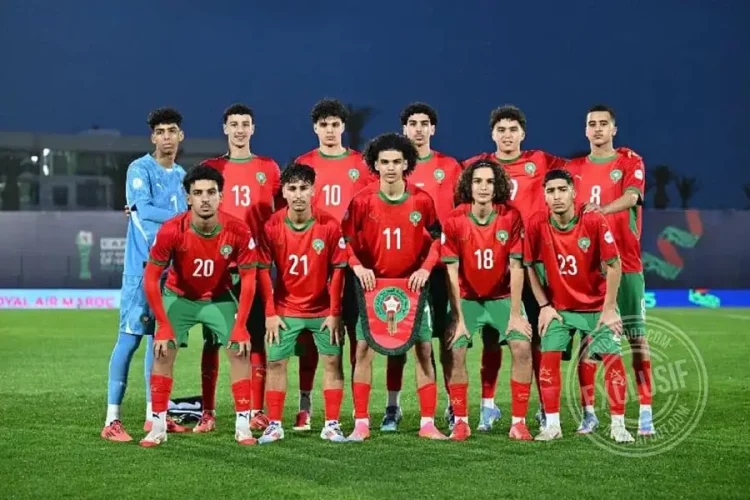
Morocco’s Under-17 side began their FIFA U-17 World Cup Qatar 2026 campaign with a convincing 6-0 victory over Fiji, with Youness Mankari highlighting the collective performance and selecting three players who particularly impressed him.
Ahmed Kantari’s team took control from the opening minutes, scoring twice inside the first five minutes. The result gave the Lionceaux de l’Atlas an ideal start, while their overall performance demonstrated both attacking efficiency and composure in possession.
Mankari, a former Wydad Casablanca player and current U16 coach, said the most significant aspect of the win was the team’s collective strength. He also pointed to the players’ ability to adapt quickly to the demands of a World Cup, building their performance around simple play, movement and accurate combinations.
Morocco’s early goals reflected their aggressive approach and ability to exploit space. With Fiji forced into a deep defensive shape, the Moroccan players kept possession, offered passing options and maintained pressure in the opposition half.
The same intensity continued after the interval, when Morocco added three more goals despite already holding a comfortable lead. Their performance showed they could vary their attacking routes, accelerate at the right moments and sustain pressure over the course of the match.
Mankari has nevertheless urged caution ahead of Morocco’s next fixture against China on Monday. The victory over Fiji has created momentum, but the team must maintain its focus if it is to continue its progress in the tournament.
Soudi controls the midfield
Mankari’s first selection was Adam Soudi of Toulouse FC, whose work helped provide balance and control in midfield.
Soudi completed 99 of his 102 passes, giving him a 97% success rate. His accuracy was particularly important in a match where Morocco enjoyed 77% possession, allowing the team to circulate the ball safely and retain its territorial dominance.
His contribution went beyond spectacular moments. By making himself available, choosing the right pass and helping Morocco keep the ball, Soudi played a central role in maintaining the team’s attacking structure.
Zinbi and Rabbaj provide the attacking edge
Mohamed Habib Zinbi, who plays for Atletico de Madrid, was Mankari’s second choice. Zinbi supplied the assist for Ismail El Aouddes’ third-minute opener, helping Morocco seize control almost immediately.
His delivery demonstrated the importance of decision-making in the final third. By finding the right pass so early in the match, Zinbi created the opening goal and forced Fiji to adjust its defensive organisation.
Mankari’s third selection was Chelsea forward Ibrahim Rabbaj. Rabbaj scored Morocco’s second goal in the fifth minute with a volley at the far post and later set up Imran Talai for the third goal in the 42nd minute.
He also contributed through his movement between the lines, technical quality in tight areas and ability to advance Morocco’s attacks. His goalscoring and creative impact underlined his importance to the team’s attacking play.
Together, Soudi, Zinbi and Rabbaj represent three complementary qualities: control and circulation, creativity and final-pass quality, and attacking efficiency. For Mankari, their performances also illustrated that this Morocco generation’s strength lies not only in individual ability but in how effectively those talents serve the collective.
-
 Mankari praises Morocco’s collective strength after U17 World Cup win Nov 21, 2026
-
Barcelona favourites to beat Villarreal in Liga clash as 1.89 shots market attracts attention Nov 21, 2026
-
Qatar U17 vs Egypt U17: World Cup kick-off time, TV channel and match preview Nov 21, 2026
-
Ismaila Sarr focused on Crystal Palace future after Liverpool interest Nov 21, 2026


-
AFCON 2025: Fixtures, Results, Scores and Standings Jan 18, 2026
-
Match hero Taiwo Awoniyi reflects on team effort after Chelsea triumph May 5, 2026
-
Leadership and long-term vision key to rescuing Zamalek and inspiring Egyptian football – Hany Abou Rida Nov 5, 2025
-
South African giants Orlando Pirates set to lose influential forward Monnapule Saleng Mar 19, 2025