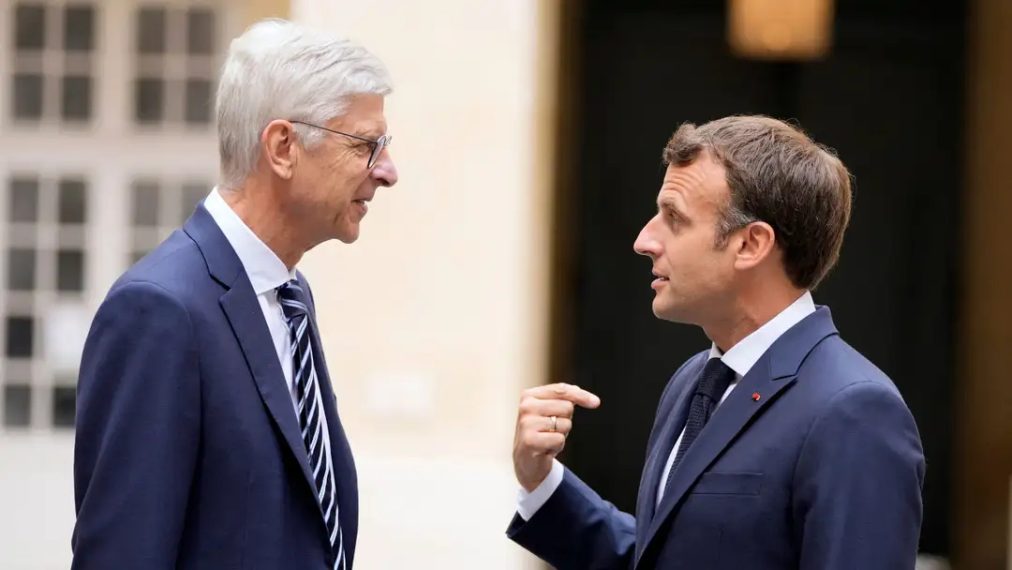
Reports in Britain say French President Emmanuel Macron is trying to persuade his compatriot Arsene Wenger to stand for the FIFA presidency against incumbent Gianni Infantino.
According to German newspaper Bild, Macron has promised Wenger his full backing if he enters the race and has offered to seek support from other heads of state and government. Such an alliance would give the election a significant political dimension alongside its sporting implications.
The deadline for submitting nominations is 18 November, with Wenger expected to make a decision this week. The FIFA presidential election will take place in March 2027, when Infantino will seek another term in office.
Wenger, the former Arsenal manager, is regarded as a highly respected figure in world football and would potentially enter the contest with strong political support from the Elysee Palace. Infantino, however, has an extensive network of relationships across the continental confederations.
The possible contest would also carry an element of personal history. Wenger was credited with bringing Infantino to FIFA in 2019, after spending more than 20 years in charge of Arsenal before retiring from coaching in 2018.
Since joining FIFA, Wenger has served as its chief of global football development and has become one of the organisation’s most influential figures. His contract is due to expire at the end of this year, and it remains unclear whether it would be renewed if he decided to stand for the presidency.
Tensions over FIFA’s direction
Relations between Wenger and Infantino have become strained in recent months. During the summer, Wenger publicly criticised Infantino’s controversial plan to attract private-sector investors to FIFA, warning that it could alter the identity of football and make the game subject to financial interests.
Wenger was also one of the leading supporters within FIFA of staging the World Cup every two years. He proposed ambitious plans for the European Championship to be played in odd-numbered years as part of an attempt to restructure the international calendar.
That project was abandoned in 2021 after strong opposition from UEFA, FIFPRO and the European leagues and clubs. Those organisations raised concerns about an overcrowded schedule and the pressure placed on players by the number of matches.
Despite that setback, Wenger took part in the decision to organise an expanded FIFA Club World Cup and supported Infantino’s proposal to increase the World Cup to 48 teams.
His record reflects a combination of reformist ideas and political pragmatism within FIFA. If he challenges Infantino, Wenger is expected to rely on his reputation, extensive experience and the potential backing of the French government.
Infantino would go into the campaign with established support among the continental confederations, leaving Wenger with a difficult task should he decide to enter the race. His decision could determine whether FIFA faces one of the most significant presidential contests in its recent history.
-
 Mali fight back to beat Rwanda and maintain perfect CAN 2027 qualifying record Nov 13, 2026
-
Algeria set to reject bids for Africa Cup of Nations hosting until 2033 Nov 13, 2026
-
Morocco strengthen position at top of 2027 Africa Cup of Nations qualifying group Nov 13, 2026
-
Algeria face Togo with top spot in sight in crucial AFCON qualifier Nov 13, 2026




-
AFCON 2025: Fixtures, Results, Scores and Standings Jan 18, 2026
-
Match hero Taiwo Awoniyi reflects on team effort after Chelsea triumph May 5, 2026
-
Leadership and long-term vision key to rescuing Zamalek and inspiring Egyptian football – Hany Abou Rida Nov 5, 2025
-
South African giants Orlando Pirates set to lose influential forward Monnapule Saleng Mar 19, 2025




-
Ali Maher names first Egypt squad for 2027 Africa Cup of Nations qualifiers Nov 9, 2026
-
Morocco v Niger: Lions of the Atlas seek another win in CAN 2027 qualifying Nov 11, 2026
-
CAN 2027 qualifying: Cote d’Ivoire-Gambia and Mali-Rwanda headline third round Nov 9, 2026
-
FIFA U17 World Cup 2026: TV channels, streaming and full match schedule Nov 8, 2026