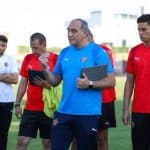
Luis de la Fuente has made it clear that Spain’s biggest names, clubs and outside voices will not dictate his decisions, with the latest dispute involving Barcelona forward Lamine Yamal offering a clear example of the manager’s authority.
De la Fuente appeared calm but firm in Prague when questioned about Yamal’s delayed arrival at the Spain camp. Addressing the speculation, he said: “Talking out of ignorance is the saddest and most regrettable thing in life.”
He insisted the decision to postpone Yamal’s arrival, as had also happened with Mikel Oyarzabal, was his own. He added that the Barcelona player had received no special treatment.
“He has no special privileges. We would have done it with anyone,” De la Fuente said, while criticising what he described as lies, fabrication, and a lack of accuracy and credibility, according to Spanish newspaper AS.
Dispute with Barcelona
It was not the first time De la Fuente had been required to defend a decision involving Yamal. In November 2025, Barcelona and their manager Hansi Flick were at the centre of a separate dispute.
The Spanish Football Federation said it was surprised and angered to learn on Monday 10 November, the first day of the international camp, that Yamal had undergone a minor radiofrequency procedure to treat pain in the pubic area without informing the federation beforehand.
Yamal had initially been named in the Spain squad before being withdrawn because of his condition. Speaking to Cadena SER, De la Fuente said Barcelona should have explained its intentions earlier, while retaining the right to make the decision it considered best for the player. He later repeated his criticism on RNE, saying he had never faced a similar situation.
De la Fuente was less confrontational when responding to Flick, who had accused Spain of using painkillers to enable Yamal, who had joined the camp injured, to play more than 70 minutes in each match despite Spain leading by three goals.
Flick said protecting young players should be a priority. De la Fuente criticised the comments but said: “I missed the empathy, because he had been a national-team coach himself.”
No protection for established names
De la Fuente’s approach has also affected senior players. Dani Carvajal and Alvaro Morata were left out of Spain’s World Cup squad following widespread debate about their possible returns.
The manager said Carvajal needed time to regain his best level and prove he could contribute, stressing that previous selection did not guarantee future inclusion. Both players ultimately missed out, reinforcing his view that readiness and value to the group come before reputation.
Sergio Ramos was another difficult omission. De la Fuente described leaving the former Real Madrid captain out of the Spain squad for UEFA Euro 2024 as one of the hardest decisions of his career. He had also resisted calls to select Ramos for the Olympic Games Tokyo 2021, despite Ramos being eligible as one of the permitted over-23 players.
“Sergio Ramos knows how much I value him; I greatly admire what he represents, but I am sure he understands why I made this decision, because he is a professional footballer and a great team-mate,” De la Fuente said.
In March 2025, Brahim Diaz chose Morocco after feeling he had not received enough support from the Spanish federation, despite Spain later selecting him. A similar situation arose with Assane Diao, who opted to represent Senegal.
De la Fuente said players must be available, willing and selected, with willingness the most important principle: “No-one is forced to play for Spain.” He cited Aymeric Laporte, Robin Le Normand, Yamal, Samu Omorodion and Dean Huijsen as players who chose Spain without conditions.
He has also defended Yamal against excessive expectations. During UEFA Euro 2024, when the player was 17, De la Fuente warned that the media could celebrate him one day before questioning him after two goalless matches.
In Spain’s quarter-final against Germany at UEFA Euro 2024, De la Fuente replaced Yamal after 61 minutes. He said the player had every right to want to continue, but added: “Complaining in that way is disrespectful to the player who will replace him.”
For De la Fuente, flexibility does not mean surrendering authority. From Yamal and Ramos to Brahim Diaz, Carvajal and Morata, his decisions have followed one principle: the team comes before the individual.
-
Luis de la Fuente’s Spain decisions show a manager unwilling to compromise Nov 14, 2026
-
 Yassine Bounou reaches 100 appearances for Morocco in Niger victory Nov 14, 2026
-
Senegal FA apologises after digital ticketing problems at Leopold Sedar Senghor Stadium Nov 14, 2026
-
Medhi Benatia accuses Pablo Longoria of lying over Marseille finances Nov 14, 2026


-
AFCON 2025: Fixtures, Results, Scores and Standings Jan 18, 2026
-
Match hero Taiwo Awoniyi reflects on team effort after Chelsea triumph May 5, 2026
-
Leadership and long-term vision key to rescuing Zamalek and inspiring Egyptian football – Hany Abou Rida Nov 5, 2025
-
South African giants Orlando Pirates set to lose influential forward Monnapule Saleng Mar 19, 2025




-
Ali Maher names first Egypt squad for 2027 Africa Cup of Nations qualifiers Nov 9, 2026
-
Morocco v Niger: Lions of the Atlas seek another win in CAN 2027 qualifying Nov 11, 2026
-
CAN 2027 qualifying: Cote d’Ivoire-Gambia and Mali-Rwanda headline third round Nov 9, 2026
-
FIFA U17 World Cup 2026: TV channels, streaming and full match schedule Nov 8, 2026