Lionel Messi’s Argentina farewell follows a final World Cup of records and heartbreak
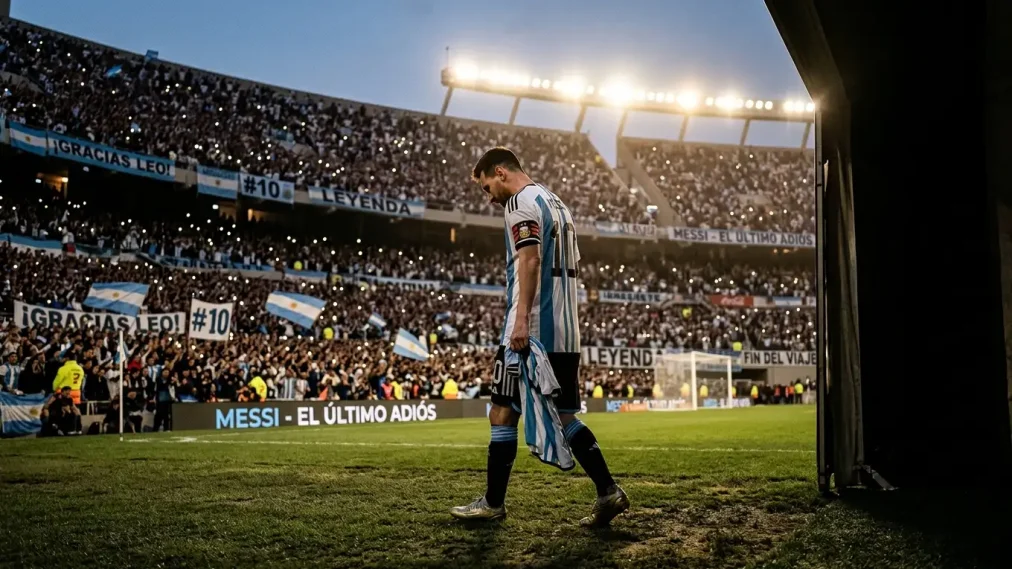
Lionel Messi has announced his retirement from international football with Argentina, bringing an end to a career spanning more than 20 years and featuring a World Cup triumph, two Copa America titles, Olympic gold and a Finalissima victory.
Messi made the announcement on Monday through a post on Instagram, sharing an image of a handwritten page from his notebook. He said he had decided to step away two days after Argentina’s 1-0 defeat by Spain in the 2026 World Cup final, while the death of his father, Jorge Messi, on 8 August later reaffirmed his decision.
The 39-year-old now closes one of the most significant chapters in Argentina’s football history. Since making his international debut in 2005, he has given supporters countless moments of celebration and helped create a legacy closely tied to both the national team’s shirt and its history.
His defining achievement came at the 2022 World Cup, when Argentina ended a 36-year wait for the trophy by beating France in a dramatic final.
Messi scored twice during normal time and converted Argentina’s first penalty in the shootout. When Gonzalo Montiel scored the decisive kick, Messi dropped to his knees as Argentina secured the world title.
After more than 15 years with the national team, he had finally won the game’s biggest prize.
A final tournament full of records
There had been widespread discussion about what Messi could produce at the 2026 World Cup at the age of 39. Having set an exceptionally high standard by winning the tournament four years earlier, he responded with one outstanding performance after another in the United States.
Messi broke the World Cup scoring record when he scored against Austria in Argentina’s group-stage match, taking his total to 18 goals. He had entered the game on 16 goals after scoring a hat-trick in the opening match against Algeria and needed one goal to move clear of Germany great Miroslav Klose.
Although he missed an early penalty, Messi recovered to score twice. France forward Kylian Mbappe eventually overtook him and finished his World Cup career with 22 goals, but the match against Austria remained the occasion on which Messi entered the record books again.
Messi’s final tournament also included a memorable semi-final victory over England. Argentina came from behind to win 2-1, with Messi providing two assists to send his side into another World Cup final.
“Although it was only one match, we experienced some special moments. The fans wanted this victory more than any other because of what it meant to face England in the semi-final and reach another World Cup final,” Messi said.
The result also saw him equal Diego Maradona’s record for overcoming England on the international stage, 40 years after Argentina’s 1986 World Cup quarter-final victory, remembered for Maradona’s “Hand of God” and “Goal of the Century”.
Spain’s 1-0 win in the 2026 final ended Messi’s international career on a painful note. He battled through more than 120 minutes despite the physical and emotional strain, but Argentina narrowly missed the chance to become world champions for a second successive tournament.
Even in defeat, the 2026 World Cup will be remembered for Messi’s record-breaking performances and his ability to make history at 39. Until the final whistle, in his last tournament with Argentina, he remained determined to give everything to the millions watching.
From despair to redemption
Monday’s announcement was not Messi’s first retirement declaration. After Argentina lost the 2016 Copa America final to Chile, he told reporters in the mixed zone that he was stepping away from international football.
“My thinking now, and after thinking about it in the dressing room, I’m done playing for the national team,” Messi said.
“I gave it everything I had. This is the fourth final I’ve played in and I haven’t been able to win. I tried everything possible. It hurts me more than anyone else, but clearly this isn’t for me. I want, more than anyone, to win a title with the national team, but unfortunately it didn’t happen.”
He later returned and went on to win back-to-back Copa America titles and the World Cup, while also setting a series of individual records.
His first major international trophy arrived at the 2021 Copa America, after Argentina defeated Brazil 1-0 at the historic Maracana in Rio de Janeiro. The victory ended the country’s 28-year wait for a major title.
Six years earlier, Messi had suffered defeats in the 2015 and 2016 Copa America finals, having also lost the 2007 final. He eventually lifted the trophy that had once contributed to his decision to retire from international football.
Argentina’s route to the 2022 World Cup title had also looked vulnerable. Against Mexico in the group stage, the teams were level at half-time and Argentina faced the danger of an early exit. In the 64th minute, Messi broke the deadlock with a powerful left-footed shot before Argentina went on to win 2-0, a result that helped set up their eventual run to the trophy.
A career that began with a red card
Messi made his first appearance for Argentina on 17 August 2005, in a friendly against Hungary in Budapest. The 18-year-old came on as a second-half substitute but was sent off directly only seconds after entering the pitch.
It was an inauspicious beginning, but he would more than make up for that dismissal over the following two decades.
His first World Cup appearance came on 16 June 2006, when he replaced a player in the 74th minute against Serbia and Montenegro in the group stage. Messi scored only a few minutes after coming on and finished the match with a goal and an assist as Argentina won 6-0.
It was the first of many occasions on which he would bring joy to Argentina supporters.
Messi reached his first World Cup final in 2014, when Argentina faced Germany. Argentina resisted for long periods, but Mario Gotze scored in extra time to settle the match. Despite the defeat, Messi received the Golden Ball for his performances, having scored four goals and supplied one assist in seven matches.
He vowed to return stronger and win the World Cup for Argentina, fulfilling that ambition eight years later.
The early stages of his international career also brought a unique link with one of Argentina’s greatest football figures. In 2010, Diego Maradona coached the young Messi at the World Cup in South Africa. Argentina were eliminated by Germany in the quarter-finals, but the tournament gave supporters the rare opportunity to see two players so closely associated with the national team working together in some capacity.
ESPN highlighted these defining moments in reviewing Messi’s Argentina career, while supporters can discuss the events and wider football news in the Kooora forums.
-
 Ghana’s Black Maidens ready to take on Norway as Joe Nana Adarkwa targets winning World Cup start Oct 18, 2026
 -
Lamine Yamal hailed as world’s best player after Barcelona win Oct 17, 2026
-
Malawi thrash Seychelles 10-1 to seal third beach soccer AFCON appearance Oct 17, 2026
-
Bafana Bafana set for November double-header against Kenya in 2027 AFCON qualifiers Oct 17, 2026



-
AFCON 2025: Fixtures, Results, Scores and Standings Jan 18, 2026
-
Match hero Taiwo Awoniyi reflects on team effort after Chelsea triumph May 5, 2026
-
Leadership and long-term vision key to rescuing Zamalek and inspiring Egyptian football – Hany Abou Rida Nov 5, 2025
-
South African giants Orlando Pirates set to lose influential forward Monnapule Saleng Mar 19, 2025




-
Real Betis v Barcelona: kick-off time, TV details and match preview Oct 16, 2026
-
Morocco to face New Zealand as FIFA U-17 Women’s World Cup kicks off in Rabat Oct 16, 2026
-
Roma v Real Madrid: home side tipped to score first in Champions League clash Oct 12, 2026
-
Atletico Madrid v Manchester United: probable line-ups for Champions League clash Oct 12, 2026