Kenya FA vice-president Mariga rejects dismissal of seven NEC members after Meru meeting

Football Kenya Federation (FKF) vice-president Macdonald Mariga has rejected the purported dismissal of seven elected National Executive Committee (NEC) members, describing the process as unconstitutional and calling on FIFA and the Confederation of African Football (CAF) to investigate the events surrounding the federation’s Special General Meeting (SGM) in Meru.
The other officials expelled are Women’s Representative Kerubo Momanyi, Nairobi NEC member Dan Shikanda, Coast representative Gabriel Mghendi, Nyanza representative Collins Opiyo Kalee, Central representative Robert Macharia and Upper Rift Valley representative Bernard Lagat.
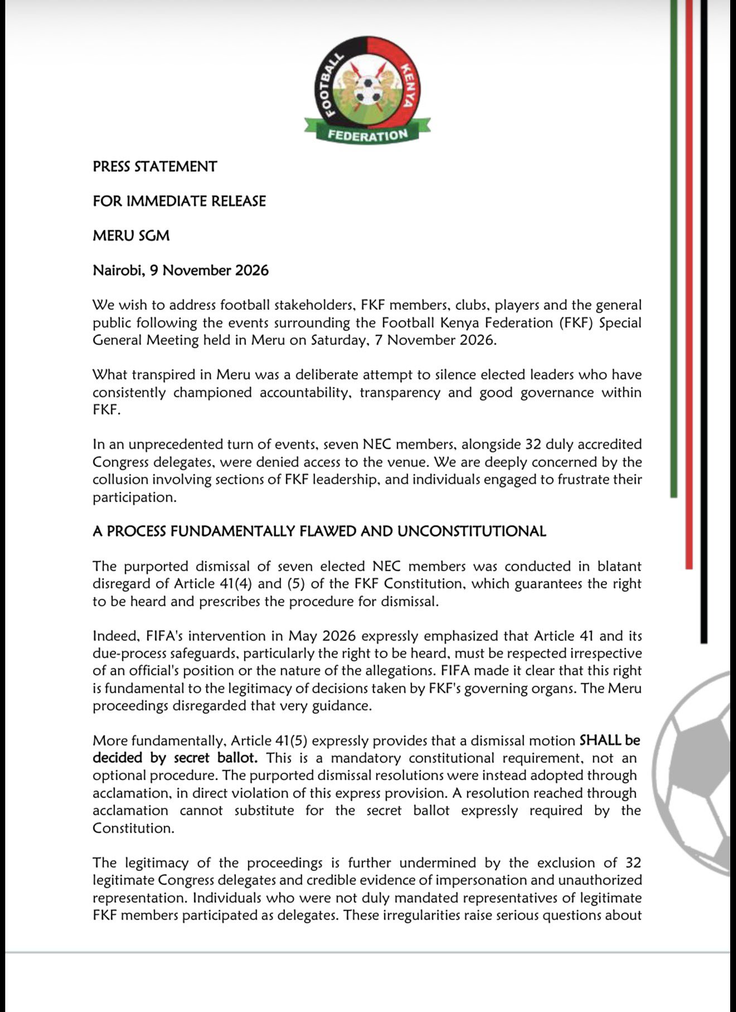
However, Mariga, speaking on behalf of the affected NEC members, issued a strongly worded statement on Monday, November 9, following the meeting held in Meru on Saturday, November 7, which reportedly resulted in resolutions to remove the seven officials.
The affected members have challenged the legitimacy of the proceedings, accusing sections of the FKF leadership of deliberately preventing elected officials and accredited delegates from participating in the meeting.
According to the statement, seven NEC members and 32 duly accredited Congress delegates were denied access to the venue, raising questions about the credibility of the meeting and the decisions taken.
The group described the events in Meru as an attempt to silence elected leaders who have consistently advocated accountability, transparency and good governance within Kenyan football.
At the centre of their objections is the alleged failure to follow the procedures outlined in the FKF Constitution for removing elected NEC members.
Mariga argued that the purported dismissals were conducted in violation of Article 41(4) and (5) of the federation’s constitution, which guarantees affected officials the right to be heard and establishes the procedure for their removal.
The statement also referenced FIFA’s intervention in May 2026, which reportedly emphasised the importance of respecting Article 41 and its due-process provisions, particularly the right of officials to be heard regardless of their positions or the nature of allegations against them.
FIFA had made it clear, according to the statement, that adherence to these constitutional safeguards was fundamental to the legitimacy of decisions taken by the FKF’s governing bodies.
The affected officials further argued that the manner in which the dismissal resolutions were adopted directly contradicted the federation’s constitution.
Article 41(5), they maintained, expressly requires any motion seeking the dismissal of an elected NEC member to be decided through a secret ballot.
However, the group alleged that the resolutions at the Meru meeting were instead adopted through acclamation, describing the approach as a direct violation of the constitutional requirement.
They insist that a show of hands or acclamation cannot replace a secret ballot where the constitution specifically prescribes that method of voting.
The legitimacy of the meeting was also questioned over the exclusion of 32 accredited Congress delegates and alleged cases of impersonation and unauthorised representation.
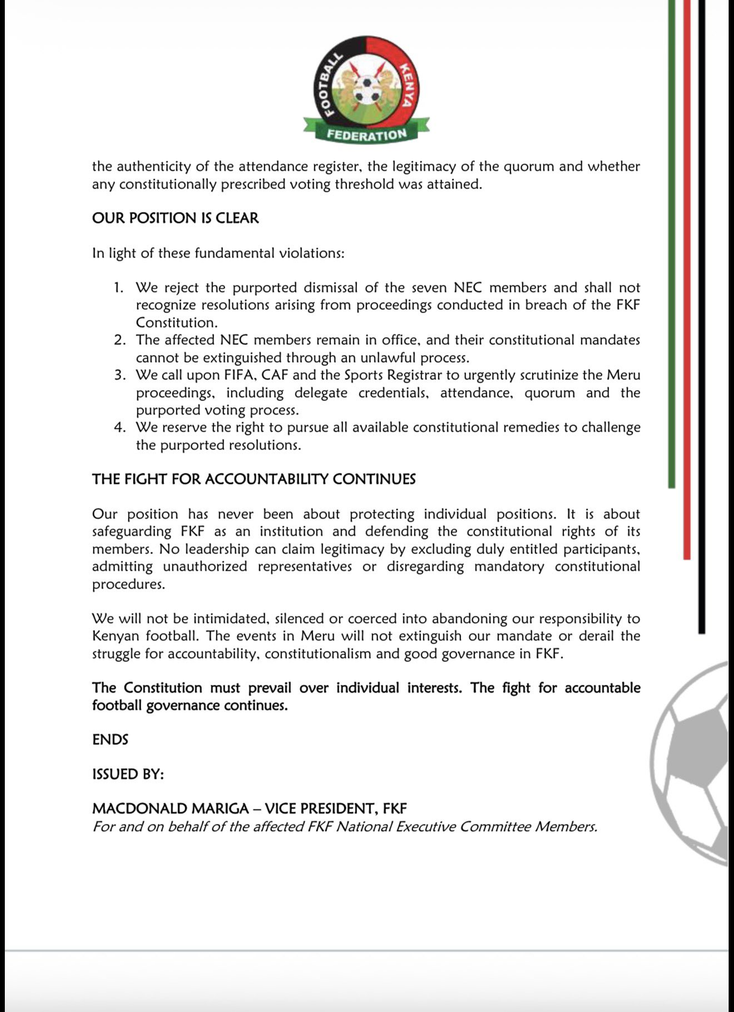
The statement raised concerns about the authenticity of the attendance register, whether the meeting had the required quorum and whether the constitutionally prescribed voting threshold had been achieved.
In outlining their position, the affected NEC members said they would not recognise the purported dismissal resolutions, insisting that the seven officials remain in office because their constitutional mandates cannot be terminated through what they consider an unlawful process.
They also called on FIFA, CAF and Kenya’s Sports Registrar to urgently examine the proceedings, including delegate credentials, attendance records, quorum requirements and the voting process.
The group added that it reserves the right to pursue all available constitutional remedies to challenge the resolutions.
Despite the growing dispute, Mariga insisted that their opposition was not about protecting individual positions but about safeguarding the integrity of Kenyan football and ensuring that the federation operates within its governing rules.
He warned that no football leadership should claim legitimacy while excluding duly accredited participants, admitting unauthorised representatives or disregarding mandatory constitutional procedures.
“We will not be intimidated, silenced or coerced into abandoning our responsibility to Kenyan football,” the statement said.
Full statement below:
The dispute represents another significant governance challenge for the FKF, with the affected officials maintaining that the events in Meru will not end their push for accountability and constitutionalism within the federation.
Mariga concluded by insisting that the FKF Constitution must take precedence over individual interests, reaffirming the group’s determination to continue fighting for transparent and accountable football administration in Kenya.
-
 Kenya FA vice-president Mariga rejects dismissal of seven NEC members after Meru meeting Nov 9, 2026
-
Ali Maher names first Egypt squad with Salah leading Malawi qualifiers Nov 9, 2026
-
AFCON 2027 Qualifiers: Check out full Matchday 3 and 4 fixtures Nov 9, 2026
-
Feutmba backs Sundowns’ decision to retain Cardoso despite Champions League exit Nov 9, 2026




-
AFCON 2025: Fixtures, Results, Scores and Standings Jan 18, 2026
-
Match hero Taiwo Awoniyi reflects on team effort after Chelsea triumph May 5, 2026
-
Leadership and long-term vision key to rescuing Zamalek and inspiring Egyptian football – Hany Abou Rida Nov 5, 2025
-
South African giants Orlando Pirates set to lose influential forward Monnapule Saleng Mar 19, 2025




-
Barcelona host Aston Villa in Champions League meeting at Spotify Camp Nou Nov 2, 2026
-
AEK Athens v Real Madrid: Champions League date, kick-off time and viewing details Nov 2, 2026
-
Manchester United host Aston Villa as both sides seek a Premier League lift Nov 6, 2026
-
Villarreal host unbeaten PSG in first European meeting Nov 2, 2026