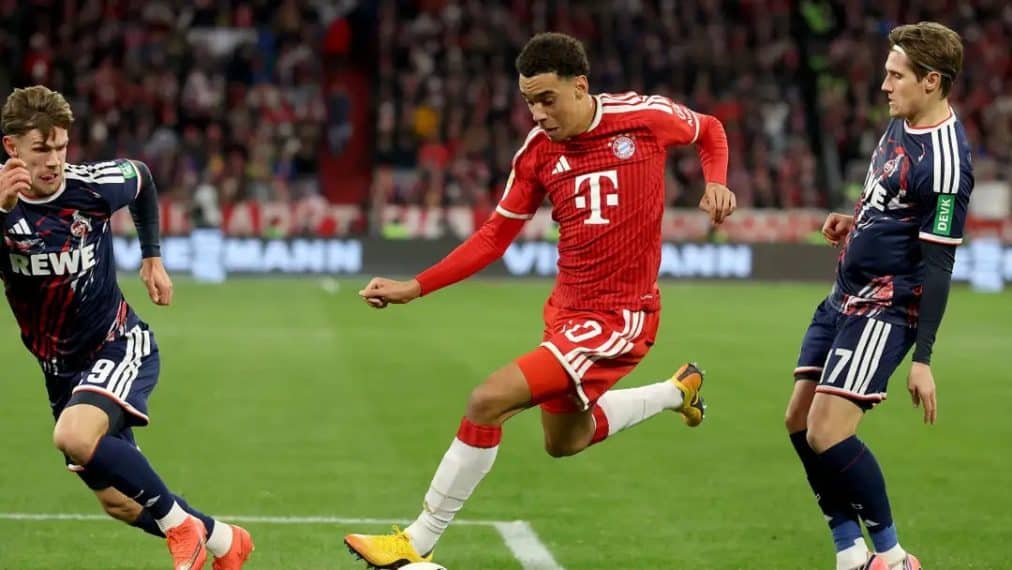
Bayern Munich sporting director Max Eberl has held what he described as “constructive” talks with Jamal Musiala’s representatives, raising hopes that the recent tension between the player and the club can be resolved in the coming days.
Eberl met Musiala’s advisers, Christian Schmid and Tobias Altschaffl, without honorary president Uli Hoeneß or former chief executive Karl-Heinz Rummenigge present.
According to Sky Germany, the meeting was conducted calmly and focused on the next steps. The issue of Musiala’s salary was not discussed.
All parties are understood to want the Germany international to return to his best form. Musiala’s contract with Bayern Munich runs until 2030 and is worth 25m euros per year.
The dispute has generated considerable debate in Germany after a series of public comments from Bayern officials about the midfielder’s contract. Those remarks centred on whether the player’s salary was justified given his repeated absences because of his health condition.
Musiala has been suffering from a neurological condition for several months. The situation has caused him significant difficulty and has also created problems for Bayern, who have faced strong criticism after suggestions that his wages could be reduced because of his underwhelming performances.
According to Bild, Musiala suffered another setback on Monday. The report indicated that he is unlikely to recover from the condition in the near future.
FIFPRO criticises Bayern comments
FIFPRO criticised Bayern Munich’s repeated public statements about Musiala’s contract on Saturday.
In a statement, the global players’ union said: “Bayern Munich’s honorary president, CEO and former CEO have successively questioned Musiala’s contract. According to the union, this is a coordinated strategy to put pressure on Musiala and his agents before any negotiations. A club of Bayern Munich’s size should show more wisdom. Bayern Munich has a duty to protect Musiala.”
FIFPRO said the comments represented a coordinated attempt to pressure the player and his representatives ahead of any potential negotiations. It called on Bayern to respect its contractual commitments and not turn Musiala’s health and future into matters for public discussion.
The union added that Bayern had a responsibility to care for its player. It warned that uncertainty over the future could have a negative effect on professional players’ mental health, particularly while they are recovering from injury.
FIFPRO also said that making Musiala’s future and medical situation a subject of public debate increased the pressure on him. Any concerns about his contract, it said, should be addressed privately with the player and his representatives rather than through media statements.
The union stressed that contracts must be honoured. It said a player’s injury or decline in form did not give a club the right to reopen terms it had previously accepted, just as a run of exceptional performances did not automatically give a player the right to demand a pay rise.
-
 Bayern Munich target Liverpool teenager Rio Ngumoha as future attacking star Nov 25, 2026
-
Ndiaye reaches Champions League assist milestone as Manchester City avoid Napoli defeat Nov 25, 2026
-
Mali aim to finish top of U17 World Cup group against Vietnam Nov 25, 2026
-
AC Milan and Inter Milan track Senegal newcomers Massire Sylla and Paul Mendy Nov 25, 2026



-
AFCON 2025: Fixtures, Results, Scores and Standings Jan 18, 2026
-
Match hero Taiwo Awoniyi reflects on team effort after Chelsea triumph May 5, 2026
-
Leadership and long-term vision key to rescuing Zamalek and inspiring Egyptian football – Hany Abou Rida Nov 5, 2025
-
South African giants Orlando Pirates set to lose influential forward Monnapule Saleng Mar 19, 2025




-
U17 World Cup 2026: Full schedule for Morocco and where to watch Nov 19, 2026
-
Nice v Paris Saint-Germain: injury-hit champions face confident hosts in Ligue 1 Nov 19, 2026
-
Nice face formidable PSG as leaders chase eighth straight Ligue 1 win Nov 20, 2026
-
Chelsea v Leeds: Blues backed to edge tight Premier League contest at Stamford Bridge Nov 20, 2026