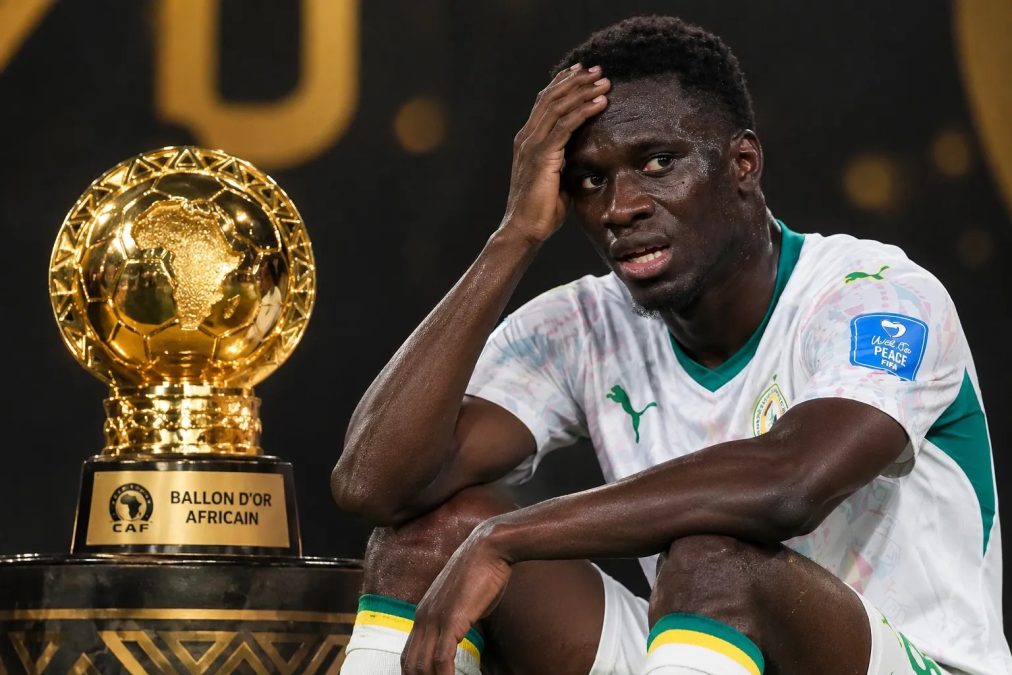
Ismaila Sarr’s omission from the five finalists for the 2026 African Ballon d’Or has caused widespread disbelief after a season in which he won the Africa Cup of Nations with Senegal and the UEFA Conference League with Crystal Palace.
The winger was named player of the tournament and finished as its leading scorer, while his four goals at the 2026 World Cup saw him equal Roger Milla’s African record. Afrik-Foot had ranked him second among its favourites for the award, making his absence from the shortlist particularly unexpected.
Sarr’s agent, former Senegal international Diomansy Kamara, criticised the Confederation of African Football (CAF) on social media on Wednesday.
“Where will CAF go next in this scandal and discredit? […] Ismaila Sarr, African champion, Conference League winner, the best player and top scorer in that competition, and the scorer of four goals at the World Cup, has been left out of the five finalists for the African Ballon d’Or. Who are they taking for fools? We demand transparency, clear criteria and the publication of the detailed voting results. At times, we are ashamed to see how our football is run. Africa deserves better than this.”
The anger reflects a wider sense of injustice, but the voting process makes it difficult to establish a deliberate attempt by CAF to exclude Sarr. Once the candidates have been selected, the winner is chosen by an electoral college made up of national-team coaches and captains, representatives of CAF member associations, coaches and captains of eligible clubs, technical experts and specialist journalists.
CAF says the composition of the voting groups can vary depending on the award. It also says the count is independently overseen by PwC.
That does not make the outcome beyond criticism, nor does it invalidate Kamara’s call for greater transparency. Several factors may explain why Sarr failed to reach the final five.
The timing of the court ruling
Voting ended on 20 November, four days before the Court of Arbitration for Sport (CAS) ruled in the dispute between Senegal and Morocco. The decision, delivered on 24 November, restored Senegal’s status as 2025 African champions and strengthened Sarr’s case, giving him the most extensive honours list among the leading candidates ahead of Achraf Hakimi.
The votes, however, had already been cast. CAF may have made a scheduling error by failing to allow for the anticipated ruling. The organisation’s difficulties were also highlighted by the late rescheduling of the CAF Awards to 2 December, one week before the date originally set.
Did Senegal’s candidates split the vote?
Senegal had three credible contenders in Sadio Mane, Pape Gueye and Sarr. Voters impressed by Mane’s Africa Cup of Nations performances may have chosen him, while others may have favoured Gueye, who scored the winning goal in the final against Morocco.
Morocco also had three finalists Hakimi, Brahim Diaz and Ismael Saibari but Hakimi was widely viewed as the leading candidate, meaning the presence of his compatriots may not have weakened his position to the same extent.
The published 2026 figures show Mane with 11 goals and 10 assists in 34 appearances for Al Nassr, Hakimi with seven goals and 15 assists in 46 for Paris Saint-Germain, Saibari with 12 goals and five assists in 26 for PSV, Gueye with 10 goals and three assists in 45 for Villarreal, and Brahim Diaz with four goals and 15 assists in 46 for Real Madrid.
Sarr’s case was built on sustained excellence: nine goals in 13 Conference League matches, the player-of-the-tournament award, the top-scorer prize and four World Cup goals. Yet individual awards can also be shaped by memorable moments. Mane stood out at the Africa Cup of Nations, Gueye scored the goal celebrated across Senegal, Brahim Diaz scored in five successive matches at the tournament and Saibari in three consecutive World Cup games.
Sarr’s best work came over a longer period, particularly in Europe, but in a competition and club sometimes regarded as secondary and away from the biggest spotlight. He made only three starts at the Africa Cup of Nations and may also have been affected by Senegal’s disappointing World Cup campaign.
Those points may explain why he did not win the award. They do not, however, easily explain why he was not among the final five.
-
 Ismaila Sarr’s Ballon d’Or snub raises questions over African football awards Nov 27, 2026
-
Brighton boss Fabian Hurzeler hails Ibrahim Osman after explosive display against Univ. Craiova Nov 27, 2026
-
Primeiro de Agosto under investigation ahead of Al Ahly clash after violence in Angola Nov 27, 2026
-
Zamalek coach Moataz Gamal eyes major silverwares this season Nov 27, 2026


-
AFCON 2025: Fixtures, Results, Scores and Standings Jan 18, 2026
-
Match hero Taiwo Awoniyi reflects on team effort after Chelsea triumph May 5, 2026
-
Leadership and long-term vision key to rescuing Zamalek and inspiring Egyptian football – Hany Abou Rida Nov 5, 2025
-
South African giants Orlando Pirates set to lose influential forward Monnapule Saleng Mar 19, 2025




-
Nice face formidable PSG as leaders chase eighth straight Ligue 1 win Nov 20, 2026
-
Liverpool v Manchester United: kick-off time, TV details and match preview Nov 20, 2026
-
Barcelona v Villarreal: Probable line-ups for Sunday’s La Liga clash Nov 21, 2026
-
African football leaders back Gianni Infantino with standing ovation for FIFA’s upcoming election Nov 21, 2026