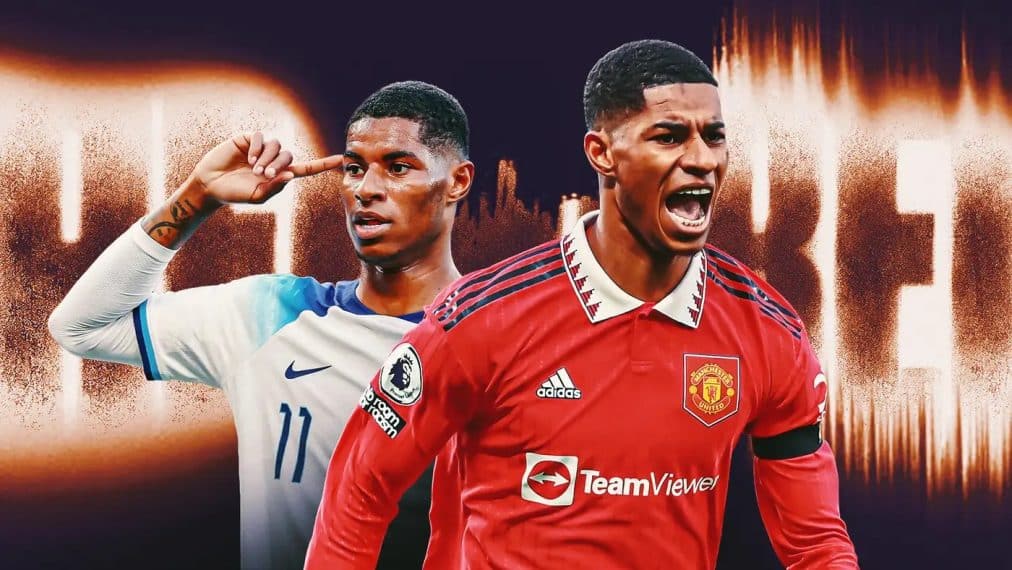
Marcus Rashford’s influence has extended well beyond Manchester United and England, with the forward using his own experience of poverty to force the UK government to change policy on free school meals and support for disadvantaged children.
Rashford grew up in Wythenshawe, a socially deprived area of Manchester. His mother, Melanie, largely raised five children alone and worked several jobs to support the family. Free school meals and food assistance were not abstract ideas to them but part of everyday life. “There were times when we had nothing to eat. We would just go to sleep,” he told the BBC.
After emerging with Manchester United in 2016, Rashford could have left that past behind. Instead, he used it as the foundation for a campaign that reached far beyond his own circumstances.
When schools across the UK closed during the Covid-19 pandemic in 2020, many children from low-income households risked losing free school meals. The government initially resisted continuing the provision during the summer holidays, but Rashford opposed the decision because he understood personally how important the meals could be.
Working with food charity FareShare, he helped provide food for children in need before publishing an open letter to the government in June 2020. His message was clear: “This is not about politics, this is about humanity.”
The pressure worked. Prime Minister Boris Johnson reversed the government’s position and announced a summer food fund for vulnerable children, expected to benefit about 1.3 million youngsters.
Rashford continued his campaign when the government initially rejected an extension of the support. A petition he launched attracted more than one million signatures. In November, the government followed with a £400m support package, worth about 450m euros at the time.
The 22-year-old footballer had prompted a political debate and made the government reconsider its position. His intervention went beyond charitable work: he had turned his popularity into political pressure.
He then focused on the causes of inequality, not only its immediate effects. With businesses, supermarket chains and charities, he helped establish the Child Food Poverty Taskforce to lobby politicians and encourage practical action.
Rashford also campaigned for an expansion of the government’s Healthy Start scheme, which provides eligible families with vouchers for items including milk, fruit and vegetables. He worked with television chef Tom Kerridge to raise awareness of healthy nutrition.
His activism also included access to books. In 2020, he established a book club with Macmillan Children’s Books to help children from disadvantaged backgrounds discover literature. Books had often seemed unaffordable during his own childhood. “There were times when escaping into the world of books would really have helped me. I hope every child can have that escape, not just those who can afford it,” he said.
Rashford has also spoken firmly against racism. After England’s defeat in the 2021 European Championship final, he, Jadon Sancho and Bukayo Saka were subjected to racist abuse after all three missed penalties. Rashford apologised for his performance but drew a clear line between legitimate criticism and racist exclusion: “I can take criticism of my performance all day. The penalty I took was not good enough; it should have gone in. But I will never apologise for who I am and where I come from.”
In modern football, players are also brands, advertising vehicles and financial assets, while public statements are often carefully managed to avoid upsetting sponsors. Rashford accepted those risks to speak for people with little public voice.
His activism has not ended child poverty in Britain, and financial packages cannot resolve structural problems overnight. But his example shows that football rebellion need not mean breaking rules for spectacle. It can mean challenging assumptions long treated as untouchable and using influence to pursue a specific, constructive purpose.
-
 Algeria decide against replacing injured Bachir Belloumi Nov 10, 2026
-
Ayoub Oufkir chooses Morocco as Netherlands boss Xavi is left disappointed Nov 10, 2026
-
Algeria edge past Morocco in opening UNAF U17 qualifier Nov 10, 2026
-
Mali v Rwanda: Probable line-ups for 2027 Africa Cup of Nations qualifier Nov 10, 2026




-
AFCON 2025: Fixtures, Results, Scores and Standings Jan 18, 2026
-
Match hero Taiwo Awoniyi reflects on team effort after Chelsea triumph May 5, 2026
-
Leadership and long-term vision key to rescuing Zamalek and inspiring Egyptian football – Hany Abou Rida Nov 5, 2025
-
South African giants Orlando Pirates set to lose influential forward Monnapule Saleng Mar 19, 2025




-
Manchester United host Aston Villa as both sides seek a Premier League lift Nov 6, 2026
-
Real Sociedad and Lyon name probable line-ups for Europa League meeting Nov 3, 2026
-
Atletico Madrid host Barcelona in Liga summit clash with history at stake Nov 6, 2026
-
Nottingham Forest v Manchester City: City Ground hosts clash at opposite ends of the table Nov 6, 2026