How Algeria’s World Cup welcome turned into an unlikely friendship with Kansas
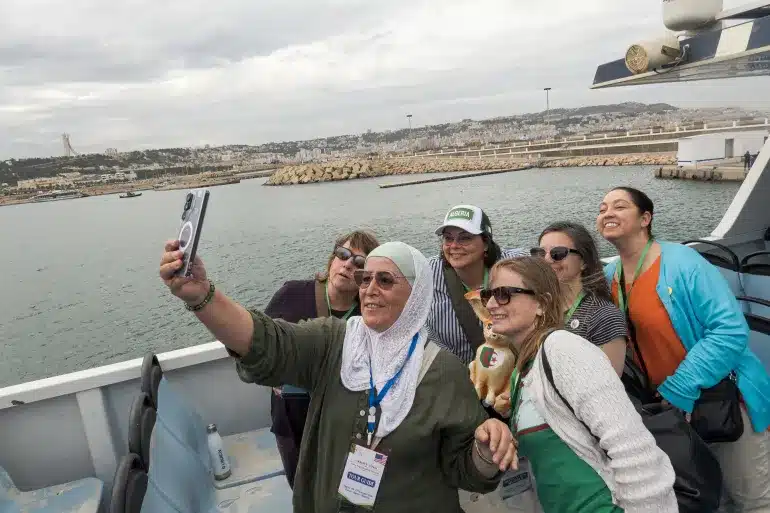
A week-long visit to Algeria has strengthened an extraordinary friendship between residents of Lawrence, Kansas, and the North African country, five months after the city hosted Algeria’s national team during the World Cup.
Among the 38 residents who travelled to Algeria from November 9 to 15 was 70-year-old Tommee Sherwood, a retired university custodian, musician and volunteer English teacher who never imagined that football would open the door to such a meaningful cultural connection.
The trip, funded by the Algerian government, was organised as a gesture of appreciation by President Abdelmadjid Tebboune for the hospitality Lawrence extended to the Algerian national team and its supporters during the tournament.
For Sherwood, who had never visited North Africa before, the experience went far beyond football, offering an opportunity to discover a country whose history and culture had unexpectedly become intertwined with his own community.
He was particularly struck by the historical relationship between Algeria and Kansas City, including the country’s decision to provide refuge to members of the Black Panther Party in the 1970s.
“That connection between Algerians and Kansas City goes way further than most people realise,” he told Al Jazeera.
Music and football bring two communities together
One of Sherwood’s most memorable experiences came during a boat trip in the Bay of Algiers, where a DJ played old jazz recordings featuring musicians from Kansas City.
The familiar sounds immediately struck a personal chord with the American visitor, who approached the DJ, presented him with a small gift and took photographs.
Their encounter continued the following day at another event when the DJ recognised Sherwood and presented him with three vintage 45rpm records featuring Algerian singers.
One of the recordings particularly fascinated him. The DJ explained that the song, titled We Stay, You Go, was directed at the French during Algeria’s struggle against colonial rule.
“I really loved that,” Sherwood said, adding that the records had become priceless possessions.
“These records, if they were made of gold, they wouldn’t be any more valuable to me.”
He described the exchange as representative of the warmth and generosity shown to the visiting delegation throughout their stay.
“I never imagined that the World Cup would open such possibilities for cultural exchange and communication and I’m kind of astounded by it,” he added.
How Lawrence became Algeria’s home away from home
The friendship between the two communities began taking shape when Lawrence welcomed Algeria’s national team as its official base during the World Cup.
The city embraced the visitors, with Algerian flags displayed along Massachusetts Street and large outdoor screenings organised for matches involving Algeria and the United States.
The Kansas University band also performed Algeria’s national anthem before one of the team’s training sessions, creating an atmosphere that resonated with players and supporters.
Although Algeria faced significant challenges in getting supporters to the tournament because of a $10,000 visa bond requirement imposed on applicants from the country, members of its diaspora in the United States travelled to Lawrence in considerable numbers.
Saajida Andalsi, a 24-year-old Algerian who had not returned to her homeland in 15 years, played an important role in connecting the communities during the tournament.
Her mother, who has lived in Kansas for more than 36 years, captured the extraordinary atmosphere with a remark that stayed with her daughter.
“My mum kept saying: ‘I didn’t go to Algeria. Algeria came to me’. Lawrence was like a city in Algeria,” Andalsi recalled.
Algeria visit creates lasting cultural connections
The relationship has since extended beyond the football pitch, with music, history and shared experiences providing fresh opportunities for engagement.
During the November visit, members of the delegation witnessed a memorable performance in Algiers’ historic Casbah, where the Kansas University band joined an Algerian musical group.
The two ensembles performed the American and Algerian national anthems under the direction of each other’s conductors before inviting members of the audience to dance together.
Ruth DuWitt, director of community engagement at Explore Lawrence, said the occasion was particularly emotional because of the Casbah’s significance in Algeria’s independence struggle.
“It felt like a movie. Nobody could have imagined that happening,” Andalsi said.
The growing relationship has also influenced everyday interactions in Kansas. Algerians living in the state say Americans have become increasingly interested in their background since the World Cup.
Madjid Khettar, who has lived in Kansas with his family for 13 years, said identifying himself as Algerian now regularly sparks conversations about the tournament.
He also recalled how Americans offered assistance and donated money when wildfires affected parts of Algeria in August.
Former US ambassador to Algeria Elizabeth Moore Aubin believes the growing friendship demonstrates the potential of cultural and sporting exchanges to strengthen international relations.
She said institutional support would be necessary to sustain the relationship and translate it into wider academic, cultural and economic opportunities.
President Tebboune had earlier announced plans for a twinning agreement between Tipaza and Kansas City, alongside invitations for 100 visitors to travel at Algeria’s expense.
For Sherwood, however, the experience has already inspired plans for another visit next spring, when he hopes to travel with his wife to refugee camps near Tindouf in Western Sahara to draw attention to a humanitarian situation that receives limited coverage in the United States.
Reflecting on the unlikely friendship, he said:
“It’s saddening that kindness has become such a big news story.”
He added: “I understand why that is, though, and hope there will be a day when that kindness and mutual respect between peoples is an everyday occurrence. I know we’re a long way from that.”
-
 Lille v Lyon: Ancelotti’s side aim to strengthen Ligue 1 title challenge Nov 20, 2026
-
How Algeria’s World Cup welcome turned into an unlikely friendship with Kansas Nov 20, 2026
-
Nice face formidable PSG as leaders chase eighth straight Ligue 1 win Nov 20, 2026
-
Calvin Bassey is one of the best centre-backs in the world – Alvaro Arbeloa Nov 20, 2026




-
AFCON 2025: Fixtures, Results, Scores and Standings Jan 18, 2026
-
Match hero Taiwo Awoniyi reflects on team effort after Chelsea triumph May 5, 2026
-
Leadership and long-term vision key to rescuing Zamalek and inspiring Egyptian football – Hany Abou Rida Nov 5, 2025
-
South African giants Orlando Pirates set to lose influential forward Monnapule Saleng Mar 19, 2025




-
AFCON 2027 Qualifiers: Check out full group standings Nov 15, 2026
-
AFCON 2027 qualifiers matchday 3 & 4: All fixtures and results Nov 17, 2026
-
AFCON 2027 Qualifiers: Cape Verde beat Liberia 4-2 to claim first Group K victory Nov 13, 2026
-
Mali fight back to beat Rwanda and maintain perfect CAN 2027 qualifying record Nov 13, 2026