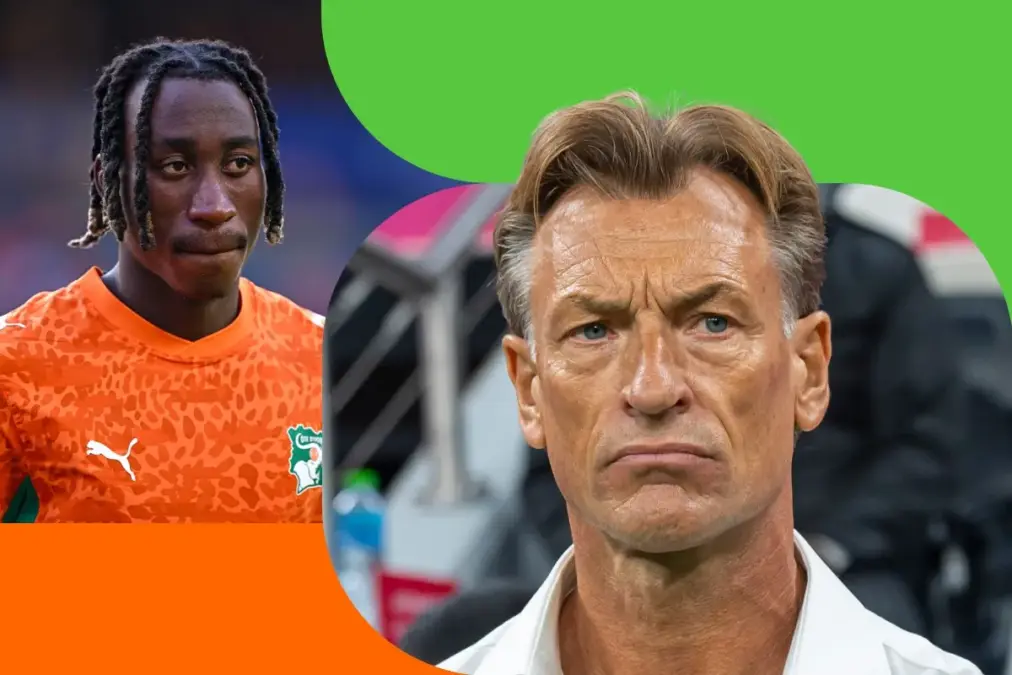
Herve Renard returns to lead Cote d’Ivoire 11 years after guiding the Elephants to their second continental title, but his latest challenge will be to develop a new generation rather than recreate the success of 2015.
The French coach, who will be presented on Thursday, succeeds Emerse Fae and takes charge of a squad that is younger, highly talented and already looking beyond the Africa Cup of Nations 2027 towards the 2030 World Cup.
On paper, the appointment appears an obvious fit. Yet returning to a place where a manager enjoyed the greatest success of his career does not guarantee the same outcome.
Renard achieved in 2015 what several coaches before him had failed to do: turn Cote d’Ivoire’s considerable potential into a continental championship.
With Yaya Toure, Kolo Toure, Gervinho, Wilfried Bony, Serge Aurier, Salomon Kalou and Max-Alain Gradel among his key players, the manager known for his white shirt built a side with the mental strength to end a 23-year wait for the Africa Cup of Nations.
The final against Ghana was decided by penalties, as had been Renard’s triumph with Zambia in 2012. Cote d’Ivoire survived an extraordinary shootout to win 9-8, but the achievement was about more than tactics. Renard persuaded a talented group that it could overcome the frustrations that had repeatedly held it back.
His charisma and ability to create an emotional bond within a squad matched the needs of a team that had often impressed before faltering at the decisive moment.
This time, however, Renard is not arriving at a troubled national side searching for direction.
Fae leaves behind a team in strong condition. After winning the Africa Cup of Nations on home soil, he also led Cote d’Ivoire through the group stage of a World Cup for the first time in the country’s history.
The Elephants were narrowly beaten by Norway in the last 16, having earlier defeated Ecuador and Curacao. They had also beaten France in a friendly a few weeks before the tournament.
Fae’s reign was not without criticism. Some of his decisions were questioned, the team occasionally lacked attacking sharpness and Cote d’Ivoire did not always appear to be reaching its full potential. Even so, Renard inherits a structured, ambitious and competitive squad.
His task is therefore not to repair the team, but to take it to another level.
Cote d’Ivoire had the youngest squad at the World Cup, with an average age of only a little over 25. Just four players were aged 30 or above.
Yan Diomande represents the next wave. At 19, the winger is on the verge of making history as an African player by signing for Real Madrid, and he confirmed during the World Cup that he possesses the qualities of a player capable of changing a match on his own.
That makes the squad particularly appealing to a coach who has traditionally sought to free attacking players through a simple structure and strong collective belief.
Renard will also reunite with Franck Kessie, whom he gave his international debut to in 2014, although he did not take him to the 2015 Africa Cup of Nations.
The narrow defeat by Norway suggested Cote d’Ivoire still lacked a degree of mental toughness: the conviction that a knockout match can be turned around until the final second. That is an area in which Renard retains considerable credibility.
His reputation in Africa remains strong. His titles with Zambia and Cote d’Ivoire, together with taking Morocco to the 2018 World Cup, have given him a distinctive status on the continent.
Compared with the sometimes more reserved Fae, the 57-year-old brings direct communication, a prominent media presence and a proven ability to unite a dressing room around a common objective. Those qualities could suit a young squad facing significant expectations.
The biggest uncertainty is Renard’s own past.
A manager returning to a place where he achieved major success will inevitably be compared with his earlier version. Football in 2026 is different from the game of 2015, perhaps more so in Africa than in many other regions. Players, expectations, media relationships and tactical demands have all changed, while this generation knows Renard mainly through his record and reputation.
He has also experienced the risks of a comeback. Following a successful first spell in Saudi Arabia, highlighted by the victory over Argentina at the 2022 World Cup, he returned to manage the Green Falcons in 2024. The second spell never produced the same momentum and ended with his dismissal two months before the 2026 World Cup.
In Tunisia, Renard was unable to put out the fire surrounding the Carthage Eagles during the World Cup. That assignment was accepted in deeply difficult circumstances, however, with problems extending well beyond the identity of the head coach.
Renard has since managed Morocco, Saudi Arabia, the France women’s team and Lille, with mixed results. He brings greater experience than he had in 2015, but also a number of setbacks.
His leadership, intensity and emphasis on psychology must now be adapted to a technically gifted, versatile and youthful squad.
His Morocco spell showed that he could manage strong personalities, including during the reconciliation with Hakim Ziyech. He also ended a 20-year wait to take the Atlas Lions back to the World Cup. But Morocco’s elimination by Benin at the 2019 Africa Cup of Nations exposed limitations against a deep defensive block and hastened his departure.
With the current Cote d’Ivoire side, Renard will need to provide more than renewed spirit. He must manage competition for places, develop relationships on the pitch and continue the progress made under Fae.
Renard is understood to have favoured the Ivorian project despite interest from Senegal and Algeria. That decision appears to reflect the strength of the bond he still has with the Elephants.
His first match will come during the international window from 21 September to 6 October, when Cote d’Ivoire begin their Africa Cup of Nations 2027 qualifying campaign. His first squad announcement will be closely scrutinised.
Eleven years on, Renard has the experience, authority and knowledge of the country required for the job. More importantly, he inherits a generation that appears built to win.
His success will depend on whether he can resist the temptation to reproduce 2015. This Cote d’Ivoire side does not need to relive its past; it needs a coach who understands its present and can guide its promising future.
-
 CAF Champions League: RS Berkane among first 10 clubs through to group stage Oct 25, 2026
 -
CAF Champions League: RS Berkane reach 2026-27 group stage after Star Sport Academy win Oct 25, 2026
-
CAF Confederation Cup: ASKO de Kara target home victory against FC Diarra Oct 25, 2026
-
CAF Champions League: RS Berkane and Esperance reach group stage as AFAD Plateau exit Oct 25, 2026




-
AFCON 2025: Fixtures, Results, Scores and Standings Jan 18, 2026
-
Match hero Taiwo Awoniyi reflects on team effort after Chelsea triumph May 5, 2026
-
Leadership and long-term vision key to rescuing Zamalek and inspiring Egyptian football – Hany Abou Rida Nov 5, 2025
-
South African giants Orlando Pirates set to lose influential forward Monnapule Saleng Mar 19, 2025




-
Barcelona v Real Madrid: Catalans backed at 1.65 to win October Clasico Oct 23, 2026
-
Barcelona and Real Madrid meet in pivotal 265th Clasico Oct 23, 2026
-
PSG v Barcelona: fiery attacks set up Champions League classic at Parc des Princes Oct 18, 2026
-
Champions League: PSG beat Barcelona as Liverpool complete comeback against Villarreal Oct 20, 2026