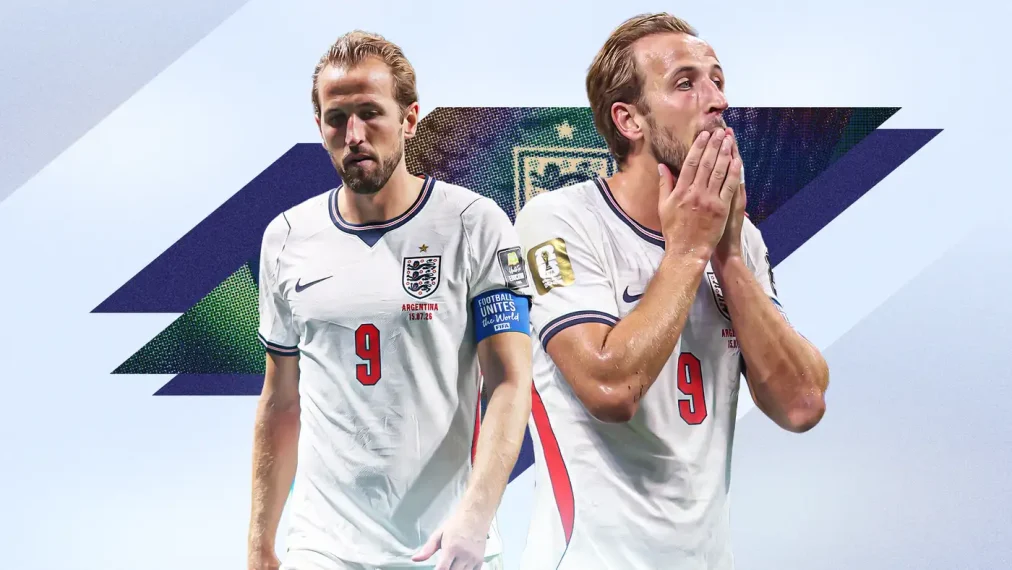
Harry Kane enters the Ballon d’Or race as the bookmakers’ leading candidate after scoring 73 goals for club and country during an outstanding 2025-26 season.
The shortlist for the award is due to be announced on Tuesday, but Kane’s challenge is likely to be judged on more than his remarkable scoring figures. The history of the Ballon d’Or suggests that individual brilliance alone is often not enough, with major international and club trophies carrying significant weight in the votes.
A new contest will begin once the nominees are confirmed. The winner will be chosen by an international jury of specialist journalists, with one representative from each country whose men’s national team is ranked among the world’s top 100.
The central question is whether Kane can defy one of the award’s strongest historical trends. The England captain has never finished higher than 10th in the Ballon d’Or standings.
Readers can discuss the subject and other football news in greater depth on the Kooora forums.
A history shaped by major tournaments
France Football introduced the Ballon d’Or in 1956 on the initiative of journalist Gabriel Hanot. Eligibility was initially restricted to European players, before the rules were expanded in 1995 to include footballers of all nationalities.
England’s Sir Stanley Matthews was the first winner. However, the influence of the World Cup on the award quickly became clear, according to BBC Sport.
Raymond Kopa became the first player to win the Ballon d’Or in a World Cup year in 1958, after helping France reach the semi-finals. In a retrospective review carried out by France Football in 2016 to mark the award’s 60th anniversary, Pele was judged to have been the rightful winner that year after leading Brazil to their first World Cup at the age of 17.
Four years later, Josef Masopust officially won the award after guiding Czechoslovakia to the World Cup final. France Football’s historical reassessment concluded that Garrincha should instead have received it after helping Brazil retain the trophy. Pele was also identified as the deserving winner in 1970 after playing a key role in Brazil’s third World Cup triumph.
The pattern continued. Bobby Charlton won in 1966, Paolo Rossi in 1982, Lothar Matthaus in 1990, Zinedine Zidane in 1998, Ronaldo in 2002 and Fabio Cannavaro in 2006. Each was a World Cup winner in the same year.
The exceptions were still closely connected to international success. Johan Cruyff won in 1974 after taking the Netherlands to the final, while Luka Modric received the award in 2018 after leading Croatia to the deciding match.
Winning the World Cup has never been an absolute requirement. Kevin Keegan won in 1978 despite England not lifting the trophy, although France Football later concluded that Argentina’s Mario Kempes had been the more deserving candidate after leading his country to the title and finishing as the tournament’s top scorer.
The magazine’s retrospective reviews also named Diego Maradona as the rightful winner in 1986 and Romario in 1994 because of their decisive World Cup performances.
France Football ultimately concluded that, had the Ballon d’Or been open to players of every nationality from the beginning, a footballer from one of South America’s World Cup-winning nations would have won every edition between 1958 and 1994.
Kane’s case
The influence of major competitions extends beyond the World Cup. In the modern era, a winner’s record has included the Champions League, World Cup, European Championship or Copa America in all but four of the previous 19 editions.
Those exceptions also underline the extraordinary dominance of Lionel Messi and Cristiano Ronaldo. Messi won in 2010 despite Argentina going out in the World Cup quarter-finals, and again in 2012 and 2019 without winning a major international or continental competition.
Cristiano Ronaldo received the award in 2013 even though Portugal failed to progress through the World Cup qualifying play-off. His individual season with Real Madrid was considered outstanding.
Other remarkable campaigns did not produce victory. Wesley Sneijder won the treble with Inter Milan and reached the 2010 World Cup final, Franck Ribery played a central role in Bayern Munich’s treble in 2013, and Mohamed Salah enjoyed a record-breaking season with Liverpool in 2017-18. None won the Ballon d’Or.
That tradition presents a challenge for Kane. Unlike Cristiano Ronaldo in 2014 or Luka Modric in 2018, he cannot point to a Champions League triumph as an additional argument. Bayern Munich’s European campaign ended in the semi-finals, where they were eliminated by Paris Saint-Germain, who went on to win the competition.
Kane’s domestic achievements are substantial. He scored 61 goals for Bayern Munich and 12 for England, while Bayern won the German league and German Cup. England finished third at the World Cup.
Among players representing clubs in Europe’s five major leagues, only Messi has scored more goals for club and country in a single season. Messi managed 82 for Barcelona and Argentina in 2011-12.
Kane’s 73-goal total puts him ahead of several leading figures in the modern game, including Gerd Muller, who scored 72 in 1972-73; Cristiano Ronaldo, who scored 66 in both 2011-12 and 2014-15; Ronaldo Nazario, who scored 66 in 1996-97; Erling Haaland, who reached 64 in 2022-23; and Luis Suarez, who scored 64 in 2015-16.
A strong field
Kane is not the only leading contender without the perfect combination of individual and collective honours. Erling Haaland, Kylian Mbappe, Michael Olise, Declan Rice and Jude Bellingham are also expected to be in contention, each seeking to overcome the same powerful trend in the award.
Rodri is among Kane’s most significant rivals after an impressive World Cup with Spain. He won the tournament’s best-player award and helped Spain secure their second world title.
Lamine Yamal also enters the race strongly. He added a World Cup medal to an excellent season with Barcelona, contributing to the club’s return to the Spanish league title. His young team-mate Pau Cubarsi received FIFA’s best young player award after a series of notable performances.
Mbappe and Messi are also expected to attract considerable support. Mbappe finished the World Cup as its leading scorer with 10 goals, won the Champions League golden boot and topped the Spanish league scoring charts. France did not reach the World Cup final, while Real Madrid ended the campaign without a major trophy.
Messi continued to make history with Argentina by taking them to a second successive World Cup final and scoring eight goals in the tournament, despite being 39.
The decision facing voters is therefore complex. Should the award go to the most prolific scorer, the player with the greatest team achievements, or the candidate who offers the strongest balance of both?
A victory would make Kane only the fifth Englishman to win the Ballon d’Or, following Stanley Matthews, Bobby Charlton, Kevin Keegan and Michael Owen. He would also become the first player representing a German league club to claim the award since Matthias Sammer in 1996.
More significantly, Kane would challenge a pattern that has shaped the Ballon d’Or for decades. History does not clearly favour him, but few players have entered the race with a stronger individual scoring record.
The voters must now decide whether one of the most prolific seasons of the modern era is enough to change the award’s established logic, or whether the Ballon d’Or will again favour major-trophy winners.
Their verdict will determine whether Kane is remembered simply as the author of a historic scoring season, or as the latest name to enter the select list of Ballon d’Or legends.
-
 Champions League: Napoli edge Bodø/Glimt 4-3 in thrilling contest Oct 20, 2026
 -
Champions League: PSG beat Barcelona as Liverpool complete comeback against Villarreal Oct 20, 2026
-
Liverpool fight back from two-goal deficit to beat Villarreal 4-3 in Champions League thriller Oct 20, 2026
-
Roma claim first Champions League win with 4-0 victory over Yaya Toure’s Slovan Bratislava Oct 20, 2026



-
AFCON 2025: Fixtures, Results, Scores and Standings Jan 18, 2026
-
Match hero Taiwo Awoniyi reflects on team effort after Chelsea triumph May 5, 2026
-
Leadership and long-term vision key to rescuing Zamalek and inspiring Egyptian football – Hany Abou Rida Nov 5, 2025
-
South African giants Orlando Pirates set to lose influential forward Monnapule Saleng Mar 19, 2025




-
PSG v Barcelona: fiery attacks set up Champions League classic at Parc des Princes Oct 18, 2026
-
Real Betis v Barcelona: kick-off time, TV details and match preview Oct 16, 2026
-
Porto v PSV: predicted line-ups for Champions League league-phase clash Oct 19, 2026
-
Morocco face Germany with top spot in Women’s Under-17 World Cup Group A at stake Oct 20, 2026