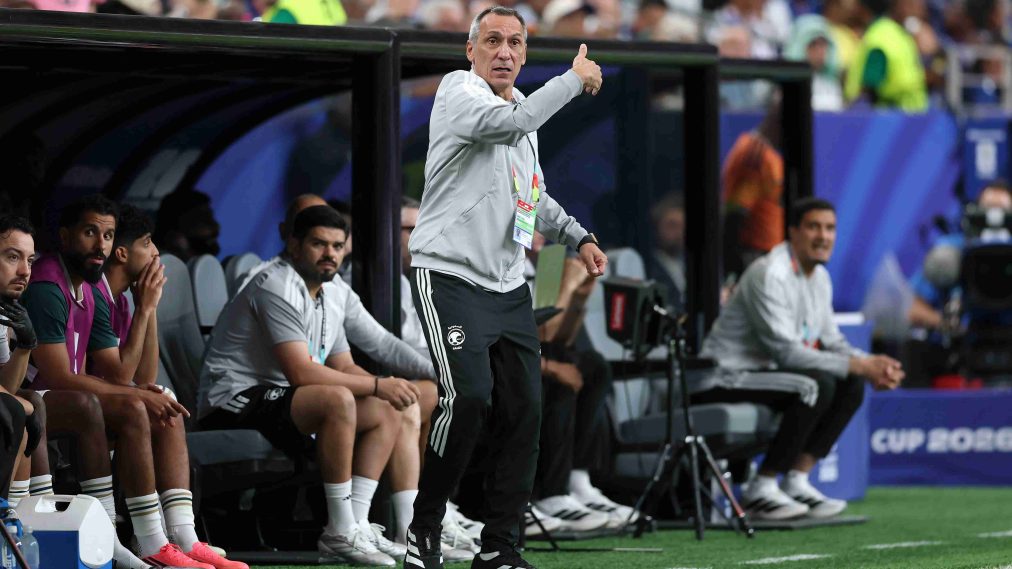
Georgios Donis has given Saudi Arabia a clearer identity in a short time, but the Gulf Cup 27 final against United Arab Emirates will provide an important test of whether the Greek coach has done enough to secure his long-term future.
Saudi Arabia reached the final without conceding in any of their four matches, including a semi-final against Qatar that remained goalless after 120 minutes before being decided on penalties. The run has raised a question that was less prominent when Donis took charge: does he now have a strong enough case to continue building the national team?
Donis replaced Frenchman Herve Renard in April, leaving him with very limited time to prepare Saudi Arabia for the 2026 World Cup before attention turned to Gulf Cup 27. The Saudi Football Federation gave him a contract until July 2027, indicating that his appointment was intended to extend beyond a single tournament.
The clearest progress under Donis has come in defence. Saudi Arabia topped their group after beating Kuwait, Oman and Iraq without conceding a goal, then maintained that record throughout the semi-final against Qatar. They go into the final with the strongest defensive record in the competition.
Those statistics do not suggest the team is complete, but they do point to a clear identity in an area that previously required greater stability. After reaching the final, Donis described the clean sheets as evidence of collective work and tactical discipline.
Before facing United Arab Emirates, he said preparations had focused on pressing high up the pitch, defensive organisation, building play and controlling possession in midfield. The performances have therefore reflected a set of ideas that the coach is trying to establish, rather than a series of isolated results.
Saudi Arabia’s attacking play remains less convincing. Their goalless draw with Qatar highlighted the difficulty of creating a decisive opening against opponents who defend deep and restrict space. The team produced chances, but neither side scored in normal or extra time.
Donis partly attributed that limitation to fatigue and a demanding schedule. Before the final, he said Saudi Arabia had played five matches in 14 days.
The meeting with United Arab Emirates will offer a different challenge. Donis recognises that his opponents are well organised and has stressed the need for concentration, discipline and adherence to instructions. He also warned that small details could decide the match.
Finding attacking solutions against an organised United Arab Emirates defence would add another significant element to the picture Donis has begun to create. Winning the trophy would turn Saudi Arabia’s defensive solidity and tactical discipline into a tangible achievement, as well as give the coach his first title with the national team.
However, the final will not be the only measure of his work. Even without the trophy, reaching the final while keeping a clean sheet in every match and overcoming Qatar on penalties would give Donis a substantial record to present when his tenure is assessed.
The bigger question will be whether Saudi Arabia believe this team can retain the same identity after Gulf Cup 27. That assessment will begin in earnest once the final whistle has been blown.
-
 Riyad Mahrez: Rais M’Bolhi played key role in Al-Shamal transfer Oct 5, 2026
 -
Filipe Luís hails Senegal midfielder Lamine Camara as ‘the future of football’ Oct 5, 2026
-
Badou Zaki hopes to see Jordan at 2030 World Cup in Morocco Oct 5, 2026
-
Argentina vs Benin: Kick-off time, TV channel and how to watch online Oct 5, 2026




-
AFCON 2025: Fixtures, Results, Scores and Standings Jan 18, 2026
-
Match hero Taiwo Awoniyi reflects on team effort after Chelsea triumph May 5, 2026
-
Leadership and long-term vision key to rescuing Zamalek and inspiring Egyptian football – Hany Abou Rida Nov 5, 2025
-
South African giants Orlando Pirates set to lose influential forward Monnapule Saleng Mar 19, 2025




-
AFCON 2027 Qualifiers: McCarthy warns South Africa to expect tough test against Eritrea Sep 29, 2026
-
Denmark v Portugal: Nations League kick-off time, TV channel and match prediction Sep 29, 2026
-
South Sudan vs Egypt: Where to watch AFCON 2027 qualifier Sep 29, 2026
-
France v Belgium: Probable line-ups for Nations League clash Oct 3, 2026