From unstoppable to uncertain: Bukayo Saka’s injuries test his Arsenal influence
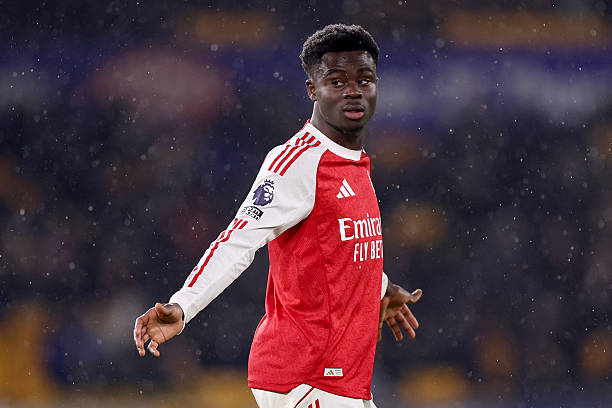
For much of the past decade, Bukayo Saka has symbolised the present and future of Arsenal. The winger emerged from the academy with fearless energy and quickly became indispensable to manager Mikel Arteta’s system.
Yet midway through the current campaign, questions are beginning to surface. Injuries have interrupted his rhythm while his output has dipped to levels not seen in several seasons. For a player long celebrated as the club’s star boy, the numbers now invite scrutiny. Is Saka simply enduring a temporary slump, or are the physical demands of elite football beginning to slow.
A rise built on consistency and productivity
Seven years have passed since Saka first stepped into Arsenal’s senior side during the 2018/19 season. What began with a solitary league appearance quickly evolved into a regular role the following year when he featured 26 times and contributed one goal and five assists.
From there his influence grew steadily. Goals arrived more frequently, assists multiplied and his versatility made him central to Arteta’s attacking structure.
Across 245 Premier League matches he has produced 69 goals and 48 assists while additional contributions in domestic and European competitions underline his reputation as one of England’s most.
Injuries disrupt rhythm this season
This season however has been far less straightforward. In the Premier League he has managed six goals and three assists, his lowest return since the 2020/21 campaign. For a forward accustomed to double digit influence in both categories, the decline is noticeable.
Injuries have played a role sidelining him for roughly two months through three separate setbacks. Each interruption has disrupted his momentum and forced Arsenal to adapt without their most reliable right sided attacker.
When Saka is fully fit the team’s attacking balance improves instantly but availability has become an increasing concern recently too.
Growing concerns about long term workload
Fitness concerns are not entirely new in Saka’s career. Since establishing himself in the first team he has reportedly dealt with around 30 different injuries or illnesses, an unusually high number for a player still in his early twenties.
Modern football’s relentless schedule offers little mercy particularly for performers expected to start nearly every match for club and country. The cumulative strain raises an uncomfortable possibility: burnout.
For Arteta and Arsenal’s medical staff protecting their prized winger may now be just as important as maximising his minutes on the pitch going forward this season perhaps.
Arsenal proving resilient without him
Interestingly Arsenal have not collapsed during his absence. The club remains firmly in the Premier League title race and has progressed to the knockout stage of the UEFA Champions League, evidence of a squad growing in depth and resilience.
Such stability inevitably alters perceptions of individual importance. If the team continues to collect results without its most recognisable academy graduate debate over his current impact will intensify. For a player once viewed as irreplaceable the reality that Arsenal can function effectively without him represents a subtle but meaningful shift in narrative around him this season alone.
Numbers underline a worrying dip
The statistical drop is also striking. Saka has required more than 318 minutes on average to score a Premier League goal this season, a rate significantly worse than in recent years. His shot conversion sits around 10 percent while his total attempts have declined compared with previous campaigns.
Even his touches inside the opposition penalty area are only marginally higher than the figures recorded earlier in his career when he was still adapting to senior football. For a player expected to define Arsenal’s attacking edge those metrics underline a noticeable decline in efficiency this season.
Careful management may be required
None of this diminishes Saka’s quality or long term importance to Arsenal. At 24 he still possesses time to rediscover the sharpness that made him one of England’s most admired young players. Yet careful management may be essential.
Allowing him brief spells away from the relentless match cycle could restore both physical freshness and mental clarity. Rushing him back too quickly after injury risks creating a stop start pattern that could damage his development during what should be the prime years of his career if handled wisely by Arsenal and England coaches alike going forward.
A defining period ahead
With Arsenal chasing their first Premier League crown in more than two decades the temptation to rely heavily on Saka remains strong. The winger himself will also be eager to influence decisive matches while keeping an eye on the upcoming World Cup with England. Balancing those ambitions will require maturity from both player and manager.
If his workload is handled carefully and his body allowed the recovery it clearly needs Saka can still reclaim the explosive form that earned him the star boy tag in the first place again if managed wisely this season ahead.
Popular News




-

AFCON 2025: Fixtures, Results, Scores and Standings
Jan 18, 2026 -

Leadership and long-term vision key to rescuing Zamalek and inspiring Egyptian football – Hany Abou Rida
Nov 5, 2025 -

South African giants Orlando Pirates set to lose influential forward Monnapule Saleng
Mar 19, 2025 -

Full schedule for 2025 Africa Cup of Nations in Morocco confirmed
Feb 12, 2025

-

LIVE UPDATES: D.R Congo 1-0 Jamaica – 2026 FIFA World Cup Playoffs
Mar 31, 2026 -
Cameroon defeat China 2-0 in FIFA Series clash
Mar 31, 2026 -

Africa’s 2026 World Cup Teams: Fixtures and Results for March friendly games
Apr 1, 2026 -

Zimbabwe defender Teenage Hadebe dropped after code of conduct breach
Mar 30, 2026