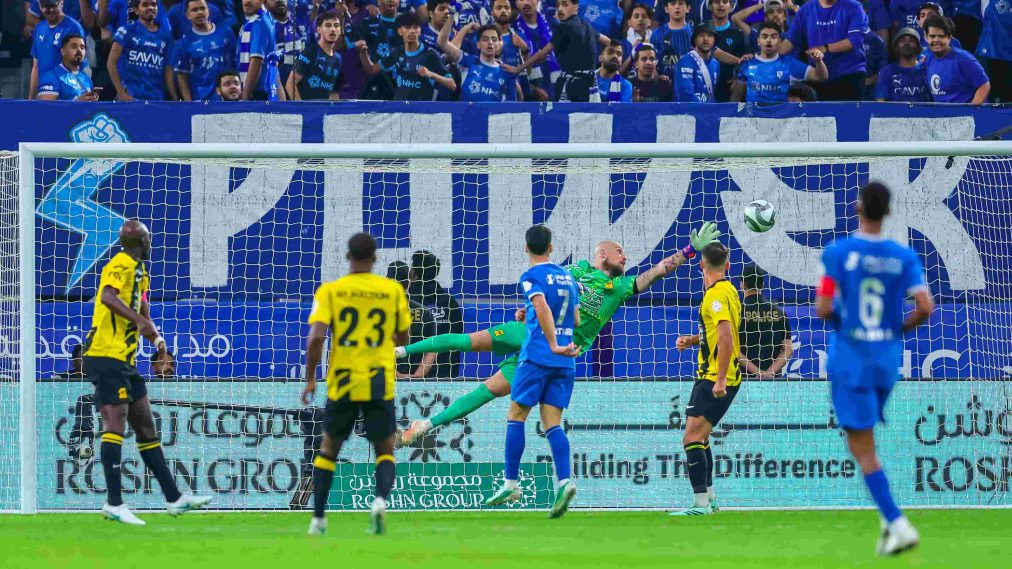
Football supporters in Egypt and Saudi Arabia experienced two major derbies within 24 hours, with Al Ahly beating Zamalek 2-0 at Cairo Stadium before Al Hilal defeated Al Ittihad 3-2 at Kingdom Arena.
Both matches carried significance beyond the three points, representing tests of reputation, quality and ambition. Yet the contrasting contests highlighted four clear differences: attendances and atmosphere, playing styles, goalscoring and the market value of the clubs.
Different crowds, shared identity
The Al Ahly-Zamalek match was declared a sell-out, with 40,000 tickets allocated equally between the two clubs. Supporters unveiled displays carrying historical and national messages, with Al Ahly fans celebrating the club’s status as “Club of the Century” and Zamalek followers remembering the heroes of the October War.
In Riyadh, 22,808 supporters attended the meeting between Al Hilal and Al Ittihad, according to published reports. The atmosphere was also intense, with both sets of fans competing through chants and songs.
The fixture included a ceremony before kick-off. Mohammed Al Owais entered carrying the Gulf Cup 27 trophy, while players from both teams formed a guard of honour to celebrate Saudi Arabia’s victory in the competition.
The published attendance figures gave the Cairo derby the numerical advantage, but both occasions demonstrated how deeply football is connected to club history and identity.
Premier League arrivals influence Riyadh classic
Al Hilal-Al Ittihad was an open, attacking match shaped by the quality of the forwards and their ability to exploit space. Al Hilal’s three goals came from players who arrived from the Premier League: Gabriel Martinelli, Ollie Watkins and Crysencio Summerville.
Al Ahly’s victory followed a more controlled pattern. Mohamed Hany opened the scoring in the 39th minute before Monsef Bakrar doubled the lead in the 80th minute with an excellent effort from outside the penalty area.
The Cairo match did not produce the same attacking volume, but Al Ahly made its decisive moments count. The contrast was not simply about one game having greater quality than the other: the Riyadh match showcased individual talent in open areas, while the Cairo derby underlined the importance of concentration, efficiency and discipline under pressure.
Five goals in Riyadh, two in Cairo
The Saudi encounter produced five goals. Martinelli put Al Hilal ahead before Youssef En-Nesyri equalised for Al Ittihad. Watkins restored the home side’s lead, Summerville added a third and Steven Bergwijn reduced the deficit from the penalty spot in the 89th minute.
In Cairo, Al Ahly’s two goals were enough to secure a clean sheet and victory. The five-goal total in Riyadh provided greater attacking drama and kept the possibility of a comeback alive until the closing stages, while the Egyptian derby was settled more narrowly through Al Ahly’s control and late second goal.
A major financial gap
Transfermarkt estimates for the 2026-2027 season place Al Hilal’s squad value at about 193.3m euros and Al Ittihad’s at 142.55m euros a combined 335.85m euros.
Al Ahly are valued at about 36.2m euros and Zamalek at 16.93m euros, giving the Egyptian clubs a combined figure of 53.13m euros. The Saudi pair therefore exceed them by about 282.72m euros, or roughly 6.3 times their total value.
Those figures reflect the presence of high-profile players from major European leagues, but market value is not a direct measurement of one performance or a guarantee of success. Together, the two derbies showed that investment and star names matter, while atmosphere and effectiveness remain decisive on the pitch.
-
 Nicolas Pepe backs Pape Gueye for 2026 African Ballon d’Or Oct 11, 2026
 -
Karim Matmour proposed for Algeria coaching staff by Antar Yahia Oct 11, 2026
-
Atletico Madrid face Manchester United in Champions League test as 1.92 market attracts attention Oct 11, 2026
-
Kaizer Chiefs missing four players for Stellenbosch meeting Oct 11, 2026




-
AFCON 2025: Fixtures, Results, Scores and Standings Jan 18, 2026
-
Match hero Taiwo Awoniyi reflects on team effort after Chelsea triumph May 5, 2026
-
Leadership and long-term vision key to rescuing Zamalek and inspiring Egyptian football – Hany Abou Rida Nov 5, 2025
-
South African giants Orlando Pirates set to lose influential forward Monnapule Saleng Mar 19, 2025




-
Croatia face Spain with Nations League hopes on the line in Split Oct 5, 2026
-
Manchester United host winless Tottenham in Premier League clash Oct 7, 2026
-
Morocco coach Mohamed Ouahbi refuses to single out player after Mali draw Oct 4, 2026
-
Lens v Lyon: Can the in-form visitors extend their unbeaten Ligue 1 run? Oct 6, 2026