Africa’s 54 FIFA member associations are at the centre of the campaign for the next president of world football’s governing body, with the election due to take place in Rabat, Morocco, on 18 March 2027.
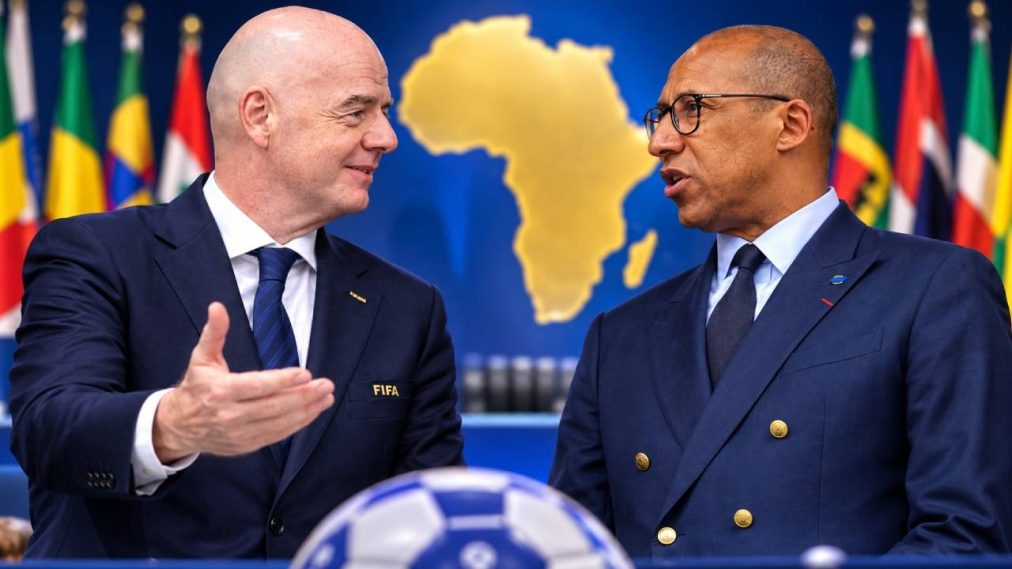
The continent accounts for more than a quarter of FIFA’s 211 members, making its support crucial to candidates seeking to win or retain control of the organisation. The importance of the African vote was underlined by the presence of FIFA president Gianni Infantino and French Football Federation president Philippe Diallo at the Confederation of African Football’s 48th Ordinary General Assembly in Abuja, Nigeria.
Both men used the gathering as an opportunity to engage with the African football leaders who will help determine the next FIFA president. Infantino is seeking another term, while Diallo has formally entered the race to succeed him.
Why Africa matters
Every FIFA member association has one vote, regardless of its economic strength, population or football record. Only Europe has more voting members than Africa, with 55 compared with the CAF’s 54.
That gives African federations considerable collective influence, although the 54 associations do not formally vote as a single bloc. Each national federation casts its own ballot, meaning a position announced by CAF does not automatically guarantee that every African vote will follow the same direction.
The continent’s importance also extends beyond the numbers. African federations form a significant network of political relationships and institutional influence within world football. Winning their backing can strengthen a candidate’s legitimacy and help build alliances across the game’s governing bodies.
At Abuja, CAF president Patrice Motsepe made the organisation’s stated position clear, saying all 54 African associations backed Infantino’s bid for a further mandate.
“I have a report from the 54 member associations in Africa indicating that we unanimously support Gianni,” he told delegates gathered in Nigeria, before asking them to give the FIFA president an ovation.
Infantino has also announced that funding for FIFA member associations is expected to rise to $25m per federation during the next development cycle, beginning in January 2027. That commitment could make his leadership particularly attractive to federations with limited resources.
Infrastructure, coaching, youth football and support for national associations have been central to Infantino’s relationship with Africa since he became FIFA president in 2016.
Diallo, supported by UEFA, attended the Abuja meeting to argue that the contest is not already decided. His route to victory depends on building support beyond Europe, making African federations a key target for his campaign.
His French background may appeal to some francophone associations, but he will need to offer more than linguistic and institutional links to persuade federations that currently appear largely supportive of Infantino.
The third declared candidate is Kohzo Tashima, the former president of the Japan Football Association. He was not central to the political discussions in Abuja, but his candidacy adds an Asian element to the contest.
The election will be held at the 77th FIFA Congress in Rabat. The candidacies of Infantino, Diallo and Tashima have been received by FIFA and remain subject to review by the electoral committee. Until then, Africa’s 54 federations will remain a central focus of the campaign.
-
 FIFA election: Africa’s 54 votes become key battleground for Infantino and rivals Nov 22, 2026
-
African football news: Bryan Zamble extended by San Diego FC as Oliver Kamdem leaves Levski Sofia Nov 22, 2026
-
Pitso Mosimane warned Bafana Bafana still have ‘a lot of work’ despite Kenya win Nov 22, 2026
-
Duba aiming to fill Du Preez’s role in Chiefs’ Sundowns rivalry Nov 22, 2026




-
AFCON 2025: Fixtures, Results, Scores and Standings Jan 18, 2026
-
Match hero Taiwo Awoniyi reflects on team effort after Chelsea triumph May 5, 2026
-
Leadership and long-term vision key to rescuing Zamalek and inspiring Egyptian football – Hany Abou Rida Nov 5, 2025
-
South African giants Orlando Pirates set to lose influential forward Monnapule Saleng Mar 19, 2025




-
AFCON 2027 qualifiers matchday 3 & 4: All fixtures and results Nov 17, 2026
-
Cameroon can seal AFCON 2027 place with victory over Namibia Nov 15, 2026
-
Cote d’Ivoire close in on AFCON 2027 qualification against Gambia Nov 16, 2026
-
AFCON 2027 Qualifiers: South Africa bounce back with win over Kenya Nov 17, 2026