Breaking News: Powerful Morocco FA chief Fouzi Lekjaa quits as CAF Finance Committee chairman

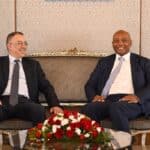
Morocco Football Federation president Fouzi Lekjaa has lost his position as chairman of the Confederation of African Football (CAF) Finance Committee following a major reshuffle of the continental body’s standing committees.
The development was confirmed at CAF’s 48th Ordinary General Assembly in Abuja, Nigeria, on Saturday, November 21, with Zambia’s Andrew Kamanga appointed interim chairman of the Finance Committee.
Lekjaa, who previously headed the influential committee, was left out of its new composition as CAF unveiled changes affecting several key administrative structures.
However, the Moroccan football chief has retained his position as CAF’s first vice-president, meaning his departure from the Finance Committee does not represent a reduction in his standing within the continental governing body.
The possibility of Lekjaa relinquishing the chairmanship had emerged earlier this month during a November 9 meeting of the Royal Moroccan Football Federation (FRMF) Executive Committee in Rabat.
According to a statement released after the meeting, Lekjaa indicated that stepping aside from the Finance Committee could create opportunities for Morocco to secure stronger representation across other important CAF committees.
The move was therefore viewed as part of a broader strategy to redistribute Morocco’s administrative responsibilities within African football rather than an indication of Lekjaa’s intention to withdraw from CAF’s leadership.
Morocco secures four positions on CAF standing committees
Despite Lekjaa’s exit from the Finance Committee, Morocco will maintain a presence across four of CAF’s eight standing committees under the newly announced structure.
One of the prominent appointments is that of Taha Mansouri, president of the National Diversified Football League (LNFD), who has been named chairman of the committee responsible for the development of futsal and beach soccer.
Mansouri will work alongside Guinea-Bissau’s Virginia da Cruz, who has been appointed vice-chairperson.
The appointment comes as Morocco continues to strengthen its reputation as one of Africa’s leading nations in futsal, both through its performances on the pitch and its organisation of major competitions.
Another Moroccan representative, Abdelatif Mouktarid, president of Difaâ Hassani d’El Jadida, has secured a place on the Interclub Competitions Organising Committee.
The committee is chaired by Ghana Football Association president Kurt Okraku, with Nigeria’s Shehu Dikko also included in its membership.
Meanwhile, Azzeddine Yaâcoubi, president of COD Meknès, has been appointed to the Youth Competitions Organising Committee, which oversees CAF’s under-17, under-20 and under-23 competitions.
The committee is headed by Mozambique’s Feizal Sidat, while Uganda’s Moses Magogo serves as vice-chairman.
Morocco’s fourth representative is Fathi Jamal, the FRMF’s national technical director, who has been named a member of the Technical Development Committee.
The committee is chaired by former Cameroon international Samuel Eto’o, with Ghanaian football administrator Anthony Baffoe occupying the vice-chairmanship.
Two Moroccan officials eye further CAF appointments
Morocco’s influence within CAF’s administrative structures could expand further when appointments to the continental body’s judicial committees are finalised.
The composition of the Disciplinary and Appeal Committees is expected to be approved in July 2027 at a CAF Executive Committee meeting scheduled to take place on the sidelines of the Africa Cup of Nations, which will be jointly hosted by Kenya, Tanzania and Uganda.
Two Moroccan candidates are reportedly in contention for positions on the judicial bodies, although their appointments will depend on decisions by CAF’s Executive Committee.
The latest committee reshuffle represents a significant redistribution of responsibilities within CAF, with Lekjaa’s departure from the Finance Committee marking the most notable change for Morocco while preserving his influential position as the organisation’s first vice-president.
-
 Breaking News: Powerful Morocco FA chief Fouzi Lekjaa quits as CAF Finance Committee chairman Nov 21, 2026
-
 Adama Kenema 1-2 Sidama Bunna: A. Yalew scores late winner in Ethiopia Premier League Nov 21, 2026
-
 Bayern Munich consider Amine Gouiri move amid injury crisis at the club Nov 21, 2026
-
 Philippe Diallo takes FIFA presidential campaign to Abuja to court African votes Nov 21, 2026


-
 AFCON 2025: Fixtures, Results, Scores and Standings Jan 18, 2026
-
 Match hero Taiwo Awoniyi reflects on team effort after Chelsea triumph May 5, 2026
-
 Leadership and long-term vision key to rescuing Zamalek and inspiring Egyptian football – Hany Abou Rida Nov 5, 2025
-
 South African giants Orlando Pirates set to lose influential forward Monnapule Saleng Mar 19, 2025