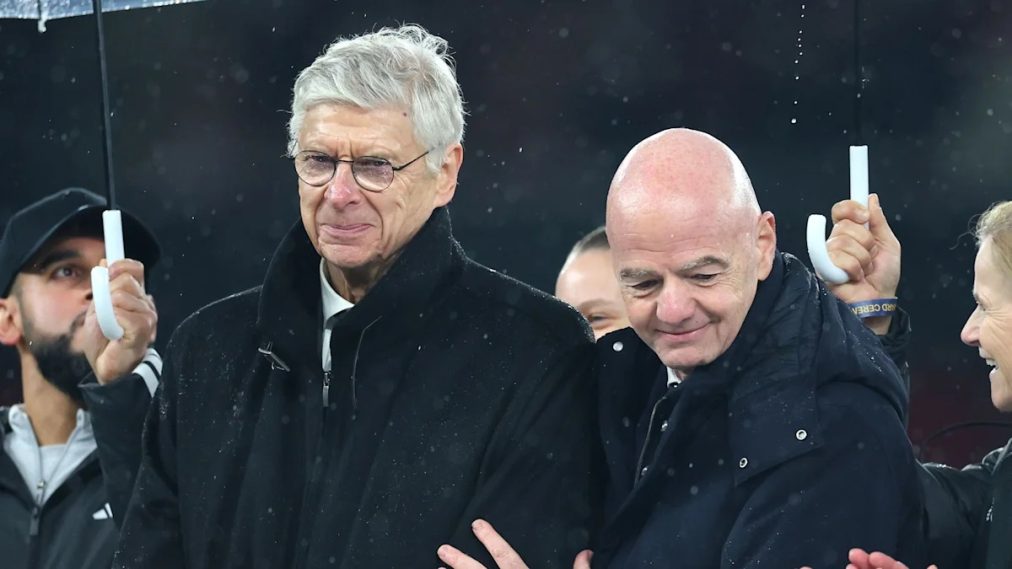
Arsene Wenger’s proposed change to the offside law is unlikely to be adopted after trials in Canada failed to produce the expected results, according to The Times.
The International Football Association Board (IFAB) is not expected to approve the proposal at its annual general meeting, scheduled for early 2021.
Wenger, FIFA’s director of global football development, had called for a greater margin to be allowed between attacking and defending players when judging offside.
Since the introduction of the video assistant referee (VAR), goals have occasionally been disallowed because a player was offside by just one centimetre. That has frustrated Wenger, the former Arsenal manager, and other figures within the game.
Under his proposal, an attacker would only be penalised if there was a visible gap between the two players. The intention was to give attacking teams more benefit from the law and reduce the number of marginal decisions.
However, trials of the system in Canada did not produce sufficiently positive results. The BBC reported last month that the IFAB had decided not to continue testing it because the change had caused defensive lines to drop by as much as three metres.
The number of offside situations fell significantly during the trials, decreasing by 54%. Despite that reduction, the change resulted in only 13 additional goals across the 112 matches involved.
The Times reports that those findings mean the IFAB will not introduce the revised law.
Sources within the organisation said the matches had not become more attractive and that teams had shown less attacking ambition under the proposed system. Wenger himself is also understood to have expressed reservations about the impact of the change.
The former Arsenal manager has not abandoned the search for a different approach to offside, however. According to The Times, he is currently examining other possible amendments to the law.
One option being considered would be to determine offside positions using only the upper body rather than the players’ legs and feet.
-
 GTA 6 launch keeps Manchester United’s Bryan Mbeumo and Thibaut Courtois up late Nov 21, 2026
-
Arsene Wenger’s offside reform set to be rejected after Canada trials Nov 21, 2026
-
French clubs showed concrete interest in Mohamed Ihattaren, says Brahim Darri Nov 21, 2026
-
Oumarou Sawadogo appointed president of UFOA-B Nov 21, 2026


-
AFCON 2025: Fixtures, Results, Scores and Standings Jan 18, 2026
-
Match hero Taiwo Awoniyi reflects on team effort after Chelsea triumph May 5, 2026
-
Leadership and long-term vision key to rescuing Zamalek and inspiring Egyptian football – Hany Abou Rida Nov 5, 2025
-
South African giants Orlando Pirates set to lose influential forward Monnapule Saleng Mar 19, 2025