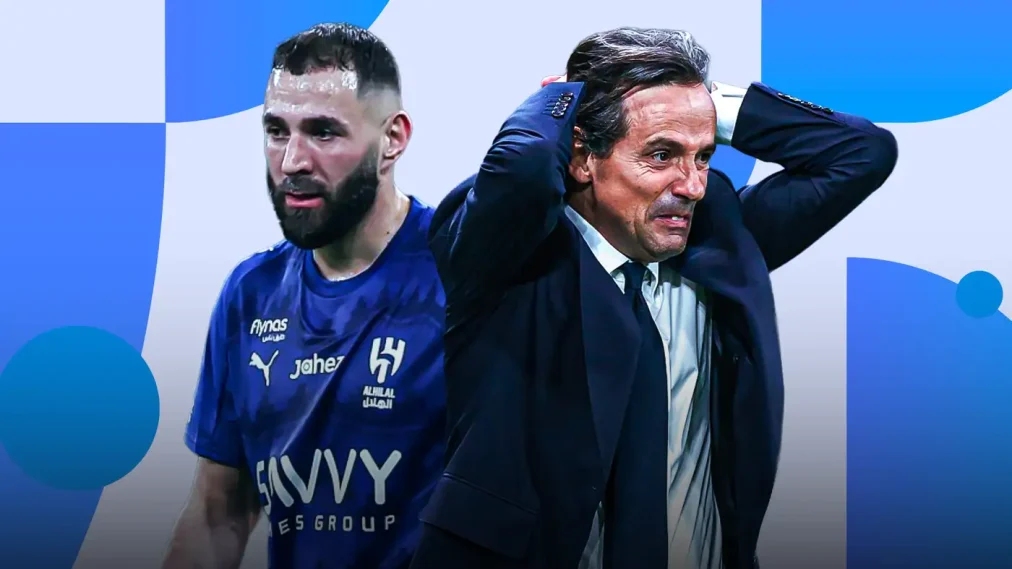
Al Hilal’s relentless spending and rapid squad turnover have raised fresh questions about the club’s long-term strategy, with the reported early departure of Ballon d’Or winner Karim Benzema and the arrival of a new attacking trio sharpening the scrutiny.
The Saudi club’s transfer activity has increasingly appeared to reopen the market just as it seems to be closing. High-profile players have arrived, others have left, and expensive contracts have been followed by settlements and loan moves in one of the most debated squad rebuilds in recent Saudi football.
Since January, Al Hilal’s recruitment has become a regular subject of discussion among supporters and the media, not only because of the scale of the fees involved but also because of how quickly the team’s structure has changed.
The club has signed prominent players before moving on from some of them, then bringing in new names for broadly similar positions. That cycle has created the impression that Al Hilal is moving from one project to another without giving a single plan enough time to develop.
As spending has grown, calls for financial fair play rules to be applied to Al Hilal have also become louder. The club has a purchasing power that gives it advantages not available to many of its rivals.
However, substantial spending does not automatically amount to a financial regulations breach. Any formal accusation would require the relevant regulations and official financial data. The more immediate sporting question is whether the investment is being converted into sustained success in the Saudi Pro League and Asia.
A constantly changing attack
The scale of Al Hilal’s activity can be seen in the number of players linked with the squad since January. The club’s dealings have included Karim Benzema, Rayan Al-Dawsari, Pablo Mari, Murad Hawsawi, Sultan Mandash, Simon Bouabre and Mohamed Kader Meite.
The current transfer window has also brought Abdullah Al-Anzi, Sabri Dahl, Nawaf Al-Habashi, Mohammed Al-Sarnoukh and Mohammed Mahzari into the picture.
Attention then turned to established international players. The Netherlands international Crysencio Summerville arrived before England forward Ollie Watkins and Brazil forward Gabriel Martinelli, transforming Al Hilal’s attack into an apparently permanent work in progress.
That is the central paradox. Al Hilal was not short of attacking quality before this latest spending spree. The club already had players capable of influencing matches, yet the decision was made to add further elite names, apparently with the ambition of creating a forward line that could compete with any side in the world on reputation alone.
Football, though, does not award trophies simply to the team with the most recognisable names. Every player needs a defined role, leading individuals need regular minutes and a team needs time to build an understanding.
Benzema’s situation has become the most striking example. Al Hilal signed the former Ballon d’Or winner, but reports of his departure emerged only a short time later. The settlement connected with the move has been reported at about 25m euros.
The issue is not merely that the transfer may not have worked. It is that the agreement appears to have lasted only around six months before Al Hilal had to consider another solution. Watkins subsequently emerged as a possible replacement.
Failed transfers are part of football. The greater concern comes when the same pattern is repeated: a major signing, doubts over the player’s suitability, a contract termination or loan, and then another expensive arrival. At that point, the debate is no longer limited to tactics. It also concerns the cost of mistakes and the speed at which decisions are made.
Benzema has therefore become a symbol of a wider phase at Al Hilal, in which a global star can join the project one day and be outside the plans soon afterwards if he does not quickly fit the manager’s vision.
The cost of constant change
Benzema is not the only high-profile player involved in the turnover. Al Hilal have also cleared space through settlements involving Joao Cancelo, Matheus Batouieh and Malcom, while Darwin Nunez has left on loan after failing to make the expected impact during his first spell.
Nunez’s case is particularly revealing. The forward arrived from Liverpool in a deal that carried considerable expectations, yet he has now moved out on loan at the same time as Al Hilal searched for a new centre-forward and turned to Watkins.
With Summerville, Martinelli and Watkins added to the movement, Al Hilal’s transfer policy appears to involve a continuous flow of significant financial commitments, particularly in attack. High-profile names arrive, other high-profile names depart, and the bill continues to rise.
Al Hilal cannot rely on the argument that a rebuild simply requires several years. The club competes every season for the Saudi Pro League title and the AFC Champions League, while supporters judge an expensive squad by the trophies it delivers rather than by the names on the team sheet.
The club may now possess one of the most exciting attacks in the league on paper. That does not necessarily make it the strongest team on the pitch.
Watkins, Martinelli and Summerville all have the quality to change matches, but their success will depend on Al Hilal ending the cycle of frequent alterations and allowing a settled structure to develop.
The club’s financial strength is therefore both an advantage and a potential weakness. It allows Al Hilal to correct mistakes quickly, but it may also encourage swift changes whenever a player or project encounters difficulties.
So far, the scale of the attacking investment has not produced the complete dominance supporters might expect from such an expensive squad. Winning the league requires consistency, while success in Asia demands resilience. Major trophies can be decided by a defensive detail rather than another celebrated attacking signing.
The key question for Al Hilal is no longer simply who will arrive next. It is whether the club can stop repeatedly buying solutions and instead build a team that does not require constant change.
If the club can turn its spending power into a coherent side, its new attacking trio could form a golden generation capable of competing for honours for years. If the arrivals, departures, settlements and loans continue at the same pace, the billions creating headlines in the transfer market may instead become the heavy cost of a project that has yet to find stability.
-
 Liverpool suffer Jeremie Frimpong injury blow against Brentford Oct 17, 2026
 -
Ansu Fati credits Paul Pogba for easing his transition at Monaco Oct 17, 2026
-
Alexander Isak delighted after scoring Liverpool winner against Brentford Oct 17, 2026
-
Uganda Premier League champions to earn $1.5m as FUFA increases prize money Oct 17, 2026


-
AFCON 2025: Fixtures, Results, Scores and Standings Jan 18, 2026
-
Match hero Taiwo Awoniyi reflects on team effort after Chelsea triumph May 5, 2026
-
Leadership and long-term vision key to rescuing Zamalek and inspiring Egyptian football – Hany Abou Rida Nov 5, 2025
-
South African giants Orlando Pirates set to lose influential forward Monnapule Saleng Mar 19, 2025




-
Real Betis v Barcelona: kick-off time, TV details and match preview Oct 16, 2026
-
Roma v Real Madrid: home side tipped to score first in Champions League clash Oct 12, 2026
-
Atletico Madrid v Manchester United: probable line-ups for Champions League clash Oct 12, 2026
-
Celta Vigo v Juventus: Probable line-ups for Europa League encounter Oct 14, 2026