AFCON Articles 82 and 84 explained: Can a team lose a final after returning to finish the match?

The controversy surrounding the 2025 Africa Cup of Nations (AFCON) final between Senegal and Morocco has raised an important question about football regulations: can a team lose a match through forfeiture even after returning to the pitch and completing the game?
At the centre of the dispute are Articles 82 and 84 of the Confederation of African Football (CAF) regulations, which outline the consequences of teams refusing to play or leaving the field without the referee’s permission.
Understanding these provisions requires looking beyond the final score and examining what the regulations actually say about a team’s conduct during a match.
What does Article 82 say?
Article 82 addresses situations involving withdrawal, refusal to play and unauthorised departures from the field.
It states that a team which withdraws from the competition, fails to report for a match, refuses to play or leaves the ground before the regular end of a match without the referee’s authorisation shall be considered the loser and eliminated from the competition.
The wording is particularly important because it does not expressly distinguish between a permanent walk-off and a temporary departure followed by a return.
In other words, the provision does not establish a minimum period a team must remain off the pitch before its actions can constitute an infringement.
The central issue is therefore whether the circumstances surrounding a team’s departure satisfy the conditions outlined in Article 82, particularly whether the players left without the referee’s authorisation.
How does Article 84 determine the punishment?
While Article 82 establishes the infringement, Article 84 outlines its consequences.
The provision states that a team contravening Articles 82 and 83 shall be eliminated from the competition and lose the match 3-0, unless its opponent had already achieved a more advantageous score when the match was interrupted.
This distinction matters because forfeiture is not simply another disciplinary punishment. It changes the official result of a match.
Article 84 also gives the organising committee authority to adopt additional measures.
Consequently, once an infringement under Article 82 is legally established, Article 84 provides the mechanism for imposing the sporting consequence.
Does returning to finish the match cancel the infringement?
This is arguably the most important question arising from the Senegal-Morocco controversy.
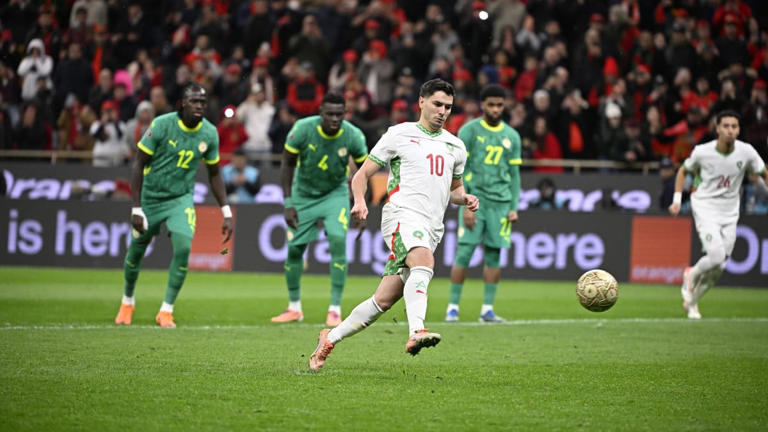
Senegal’s players temporarily left the pitch following the controversial penalty awarded to Morocco during stoppage time in the final. After approximately 14 minutes, they returned, play resumed and the match was completed.
Senegal subsequently won 1-0 after extra time through Pape Gueye’s decisive goal.
However, completing the match does not automatically establish that an earlier breach has been erased.
Equally, a temporary interruption should not automatically be treated as a permanent withdrawal without examining the circumstances.
The regulations do not expressly provide that returning to the pitch cures an infringement. They also do not specifically explain how a temporary walk-off should be treated when the match subsequently resumes.
That interpretative gap is central to the dispute.
What role does CAS play?
The Court of Arbitration for Sport (CAS) examines whether CAF correctly applied its regulations and whether the decision to declare Senegal guilty of forfeiture can stand under the applicable rules.
The panel must consider the actual conduct of the Senegalese team, the referee’s authority, the circumstances of the interruption and the relationship between the Laws of the Game and CAF’s competition regulations.
Under Law 5.2 of IFAB’s Laws of the Game, the referee’s decisions regarding facts connected with play, including the result of a match, are final. However, the question of whether a separate competition regulation has been breached is not necessarily identical to reviewing an ordinary refereeing decision.
CAS must therefore address whether the referee’s decision to resume and complete the match prevents CAF from subsequently imposing forfeiture under Article 84.
The distinction that ultimately matters
The argument is not simply whether Senegal returned to play. It is whether the team’s initial departure independently triggered Article 82 and whether that infringement justified the consequences prescribed by Article 84.
A match being completed on the pitch and a team complying with competition regulations are two separate legal considerations.
Ultimately, the interpretation of those provisions determines whether a temporary walk-off can carry the same consequences as an outright refusal to continue playing.
-
 AFCON Articles 82 and 84 explained: Can a team lose a final after returning to finish the match? Nov 24, 2026
-
 Who keeps the AFCON 2025 trophy? The medals, $10 million prize and financial consequences of CAS ruling Nov 24, 2026
-
 Bryan Lasme suffers fresh injury setback at Schalke 04 Nov 24, 2026
-
 Brahim Diaz and the missed Panenka: How one penalty became central to the AFCON 2025 title saga Nov 24, 2026



-
 AFCON 2025: Fixtures, Results, Scores and Standings Jan 18, 2026
-
 Match hero Taiwo Awoniyi reflects on team effort after Chelsea triumph May 5, 2026
-
 Leadership and long-term vision key to rescuing Zamalek and inspiring Egyptian football – Hany Abou Rida Nov 5, 2025
-
 South African giants Orlando Pirates set to lose influential forward Monnapule Saleng Mar 19, 2025

-
 AFCON 2027 qualifiers matchday 3 & 4: All fixtures and results Nov 17, 2026
-
 U17 World Cup 2026: Full schedule for Morocco and where to watch Nov 19, 2026
-
 AFCON 2027 Qualifiers: South Africa bounce back with win over Kenya Nov 17, 2026
-
 AFCON 2027 qualifiers: Morocco edge Niger in 1-0 victory to secure qualification Nov 17, 2026