AFCON 2025 final dispute: Legal expert dismisses Senegal’s appeal chances; insist replay is unlikely

A legal expert has cast serious doubt over the possibility of the 2025 Africa Cup of Nations final between Morocco and Senegal being replayed, insisting that Senegal’s chances of overturning the decision remain extremely low.
Roman Bezzini stated that the Senegalese national team is unlikely to succeed in its appeal against the Confederation of African Football’s ruling at the Court of Arbitration for Sport.
His remarks follow CAF’s decision to declare Morocco champions, a verdict that prompted Senegal to lodge a formal protest. Speaking to Marca, Bizini explained that ” Senegal’s chances of success are very low.”
Addressing the legal framework behind the ruling, he pointed to Articles 82 and 84 of the AFCON regulations, which stipulate that any team that refuses to continue a match or leaves the field without the referee’s permission is deemed to have lost, with a 3-0 scoreline awarded against them, alongside expulsion from the competition.
He further revealed that the Appeals Committee determined that Senegal had refused to resume play and/or left the pitch during the final without the referee’s approval. However, he noted that the full details of the case and the reasoning behind the verdict have not been made public.
On the delay in announcing the decision, despite two months passing since the final, Bizini explained that CAF regulations do not impose a strict deadline for rulings, apart from allowing up to six months for the preliminary investigation phase under Article 44 of the Disciplinary Code. He added that the complexity and sensitivity of the case required ample time for all parties to be heard.
Looking ahead to the Court of Arbitration for Sport, Bizini maintained that a strict interpretation of the rules is likely to favour CAF’s position. While Articles 82 and 84 do not explicitly cover every aspect of a team leaving the field without permission, they do not exclude such a scenario, leaving room for interpretation.
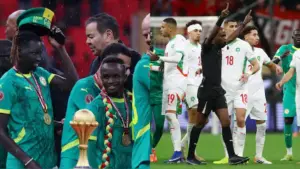
Senegal is expected to base its defence on the “spirit of the law,” arguing that the intent of the regulations is to punish teams that refuse to resume play, which they may claim does not fully apply in this case since the match could have been completed.
They may also question the definition of a “team,” particularly as only three players were reportedly on the pitch, whereas IFAB rules require a minimum of seven players for a match to continue.
Despite these arguments, Bizini emphasised that the Court of Arbitration for Sport typically applies a strict reading of legal texts, making Senegal’s chances of overturning the decision “very slim”.
On whether the final could be replayed, he indicated that although the court holds broad authority, such an outcome appears unlikely as it is not предусмотрed within CAF regulations. Article 82 clearly outlines the sanction as a 3-0 forfeiture.
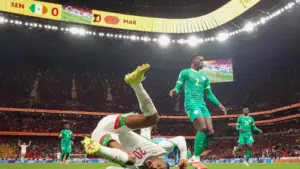
He added that Morocco’s crowning as champions would stand if Senegal’s appeal fails, with the decision potentially leading to a redistribution of medals, despite the unusual nature of the situation.
Bizini concluded by noting that the case could establish a significant legal precedent, reinforcing that no team can leave the field without the referee’s permission. He also suggested that CAF may be prompted to revise its regulations to provide clearer guidelines on match abandonment and define team requirements in line with the Laws of the Game.
Popular News




-

AFCON 2025: Fixtures, Results, Scores and Standings
Jan 18, 2026 -

Leadership and long-term vision key to rescuing Zamalek and inspiring Egyptian football – Hany Abou Rida
Nov 5, 2025 -

South African giants Orlando Pirates set to lose influential forward Monnapule Saleng
Mar 19, 2025 -

Full schedule for 2025 Africa Cup of Nations in Morocco confirmed
Feb 12, 2025

-

2025/26 CAF Confederation Cup: Fixtures, Results, Tables and Standings
Mar 21, 2026 -

2025/26 CAF Champions League: Fixtures, Results, Tables and Standings
Mar 21, 2026 -

World Cup 2026: South Africa fixtures and squad timeline revealed
Mar 21, 2026 -

Guinea seeks review of 1976 AFCON title after CAF’s decision to strip Senegal of title
Mar 20, 2026