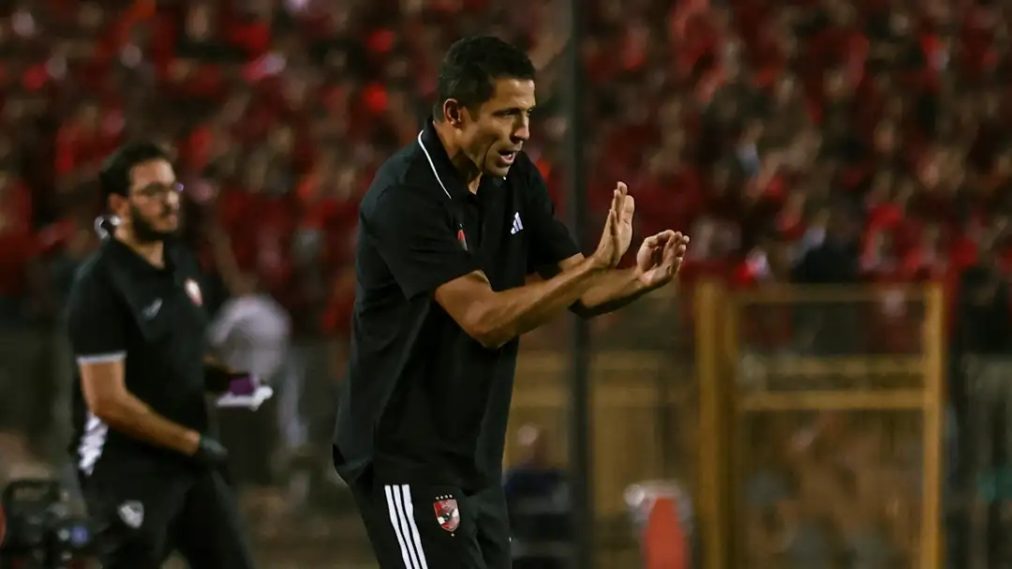
Al Ahly’s 2-0 loss to Pyramids has intensified scrutiny of Hussein Ammouta and the club’s approach to appointing managers, after the Egyptian giants failed to impose themselves in a match against a direct title rival.
Pyramids looked clearer in their ideas and more capable of carrying them out, while Al Ahly struggled to control the tempo. The result has revived questions over whether Ammouta’s methods suit a team whose supporters expect it to take the initiative and dominate major matches.
The issue is not simply Ammouta’s performance in one game, but whether Al Ahly appointed the right coach for the team they want to build. The Moroccan has an impressive record, having led Wydad to the 2017 CAF Champions League and the Moroccan league title. He also won the 2021 African Nations Championship with Morocco’s local-based side and guided Jordan to the 2023 AFC Asian Cup final, the best result in the history of the national team.
However, those achievements do not automatically mean his approach is right for Al Ahly. Ammouta is neither clearly a defensive coach nor someone whose football is built around constant possession and pressing. His teams tend to rely on organisation, tactical discipline, adjustments based on the opposition and the use of transitions and space.
That flexibility can be valuable in knockout football, but Al Ahly require a manager capable of establishing a clear identity and imposing it on opponents.
Against Pyramids, Al Ahly were slow in moving the ball and struggled to build from the back. Their possession produced little danger, while defensive transitions exposed gaps between midfield and defence, delayed recovery runs and insufficient cover behind advancing players. The pattern suggested problems with distances and responsibilities across the team rather than isolated individual errors.
Ammouta is not solely responsible. Al Ahly still need a striker who can finish chances and move between opposing centre-backs, a strong and quick defender able to deal with space, and a holding midfielder capable of protecting the centre, covering advancing full-backs and helping the team play under pressure. Those needs became more pressing after the club failed to retain Wessam Abou Ali.
The team have also been affected by injuries and the absence of key players. Emam Ashour, who can carry the ball forward and break defensive lines, missed the four matches before the Pyramids game for technical reasons before returning to the squad and making a subdued substitute appearance.
Since Pitso Mosimane’s departure, Al Ahly have employed Ricardo Soares, Marcel Koller, Jose Riveiro, Youssef Torop and Ammouta, with Emad El Nahhas taking temporary charge on more than one occasion. The succession of different philosophies has not been matched by a clear explanation of the club’s desired identity or its criteria for selecting coaches.
A comparison with Koller shows that early results alone cannot settle the argument. Ammouta’s first 14 official matches brought 11 wins, two draws and one defeat, with 30 goals scored and seven conceded. Koller recorded 11 wins and two draws in his first 13 games.
Koller remained for about 960 days and managed 161 matches, according to Transfermarkt. Against Pyramids, he recorded five wins, two draws and one defeat in eight meetings, with Al Ahly scoring 13 and conceding nine. Ammouta has lost his only meeting with them 2-0, an early test rather than a meaningful historical comparison.
The greater concern for Al Ahly supporters is the team’s shape, defensive weakness and lack of connection between the lines. The problem is not only the number of victories, but whether Al Ahly can control important games and re-establish the feeling that “Al Ahly are no longer frightening”.
Mammouta must show he can produce football worthy of the club’s size and history. Mahmoud El Khatib and the board, meanwhile, must demonstrate that he was chosen for a defined project and provide the players required to deliver it. The central question is no longer only whether Ammouta suits Al Ahly, but whether the club knows what kind of manager and team it wants.
-
Riyad Mahrez says Algeria’s future belongs to a new generation Nov 24, 2026
-
 Mahrez calls on Algeria to ‘raise their level’ after Togo defeat Nov 24, 2026
-
Joseph Peter signs first professional contract with Rennes Nov 24, 2026
-
Hicham Boudaoui emerges as transfer option for Monaco and Olympiacos Nov 24, 2026



-
AFCON 2025: Fixtures, Results, Scores and Standings Jan 18, 2026
-
Match hero Taiwo Awoniyi reflects on team effort after Chelsea triumph May 5, 2026
-
Leadership and long-term vision key to rescuing Zamalek and inspiring Egyptian football – Hany Abou Rida Nov 5, 2025
-
South African giants Orlando Pirates set to lose influential forward Monnapule Saleng Mar 19, 2025




-
AFCON 2027 qualifiers matchday 3 & 4: All fixtures and results Nov 17, 2026
-
U17 World Cup 2026: Full schedule for Morocco and where to watch Nov 19, 2026
-
AFCON 2027 Qualifiers: South Africa bounce back with win over Kenya Nov 17, 2026
-
AFCON 2027 Qualifiers: Benni McCarthy promises attacking Kenya display against South Africa Nov 17, 2026