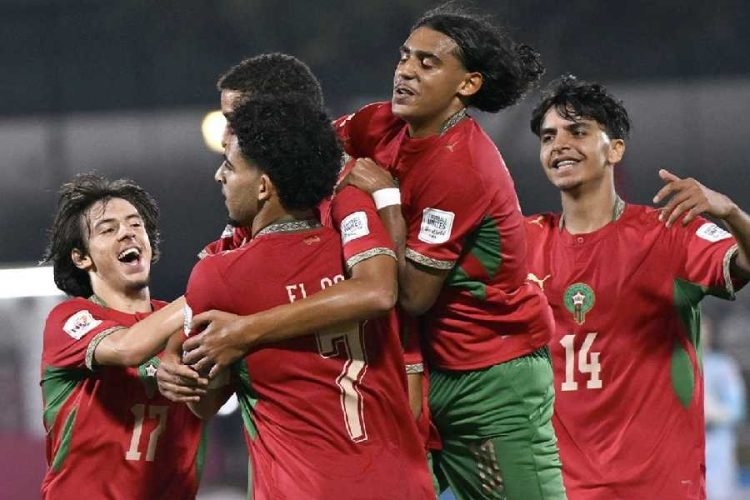
Morocco U17 will look to make it two wins from two at the FIFA U17 World Cup Qatar 2026 when they meet China on Monday at Pitch 2 of the Aspire Zone in Doha.
The Atlas Lions began Group H with a 6-0 victory over Fiji, while China were beaten 5-0 by Spain. That contrast gives Ahmed Kantari’s side a psychological advantage, but former Raja Casablanca player, coach and academy director Rimi Zitouni believes the match could be far more demanding than the opening results suggest.
Morocco made an ideal start against Fiji, scoring twice inside the first five minutes. Ismail El Aouda opened the scoring in the third minute before Ibrahim Rabbaj added a second two minutes later, underlining the team’s ability to impose its tempo immediately and take early chances.
Zitouni expects China to adopt a more cautious approach after their defeat by Spain. The Asian side could defend with tighter distances between the lines and protect the area in front of goal more carefully to avoid another heavy loss.
That is likely to require greater patience from Morocco. Rather than relying on sideways possession, the young Moroccan players will need to use movement away from the ball, rotations in the final third and passes that break defensive lines.
Control of midfield is expected to be central to Morocco’s plan. Zitouni says possession will only be valuable if it produces clear attacking opportunities, including numerical and positional advantages in key areas. Against a medium or low defensive block, Morocco’s midfielders will need to vary the pace of their build-up and accelerate at the right moments to draw China out of position.
The half-spaces between the centre and the wings could provide an important route forward. Attacking movements may pull Chinese defenders away and create opportunities in behind, while advances from the full-backs could stretch the defence across the pitch. Those forward runs will, however, need to be balanced to prevent China exploiting space during quick counter-attacks.
Zitouni also identifies counter-pressing as a major factor. Morocco’s reaction immediately after losing the ball could stop China from attacking the spaces behind the full-backs or between midfield and defence. Midfielders will have to provide cover, while the centre-backs must maintain their distances and avoid rushed challenges.
Winning the ball back in China’s half could allow Morocco to attack before the opposition has reorganised.
China face a difficult tactical choice. They need a result to keep their qualification hopes alive, but taking too many risks could expose them to Morocco’s pace in transition. Zitouni expects them to narrow the midfield, direct Moroccan attacks towards the wings and look for fast breaks, while warning that their loss to Spain should not be treated as a complete measure of their ability.
The match will also test Morocco’s maturity and control of tempo. A quick goal must not lead to unnecessary risks, while frustration in a close game cannot result in rushed decisions. With fewer chances likely against a compact defence, finishing will be especially important.
Victory would take Morocco to six points before their final group match against Spain, placing them in a strong position to reach the last 16. At a 48-team World Cup, the top two in each group and the eight best third-placed teams qualify. A second win would give Kantari greater flexibility in managing workloads and planning for the meeting with Spain.
-
 Morocco U17 face tactical test against China after Fiji rout Nov 22, 2026
-
Manchester City demand permanent transfer for Juventus target Rayan Ait-Nouri Nov 22, 2026
-
Algeria’s defensive collapse against Chile analysed after U17 World Cup defeat Nov 22, 2026
-
Kaizer Chiefs extend perfect DStv Diski Challenge run to nine wins Nov 22, 2026


-
AFCON 2025: Fixtures, Results, Scores and Standings Jan 18, 2026
-
Match hero Taiwo Awoniyi reflects on team effort after Chelsea triumph May 5, 2026
-
Leadership and long-term vision key to rescuing Zamalek and inspiring Egyptian football – Hany Abou Rida Nov 5, 2025
-
South African giants Orlando Pirates set to lose influential forward Monnapule Saleng Mar 19, 2025




-
AFCON 2027 qualifiers matchday 3 & 4: All fixtures and results Nov 17, 2026
-
Cote d’Ivoire close in on AFCON 2027 qualification against Gambia Nov 16, 2026
-
AFCON 2027 Qualifiers: South Africa bounce back with win over Kenya Nov 17, 2026
-
Ex-Liberia President George Weah emerges as a potential successor to Patrice Motsepe at CAF Nov 15, 2026