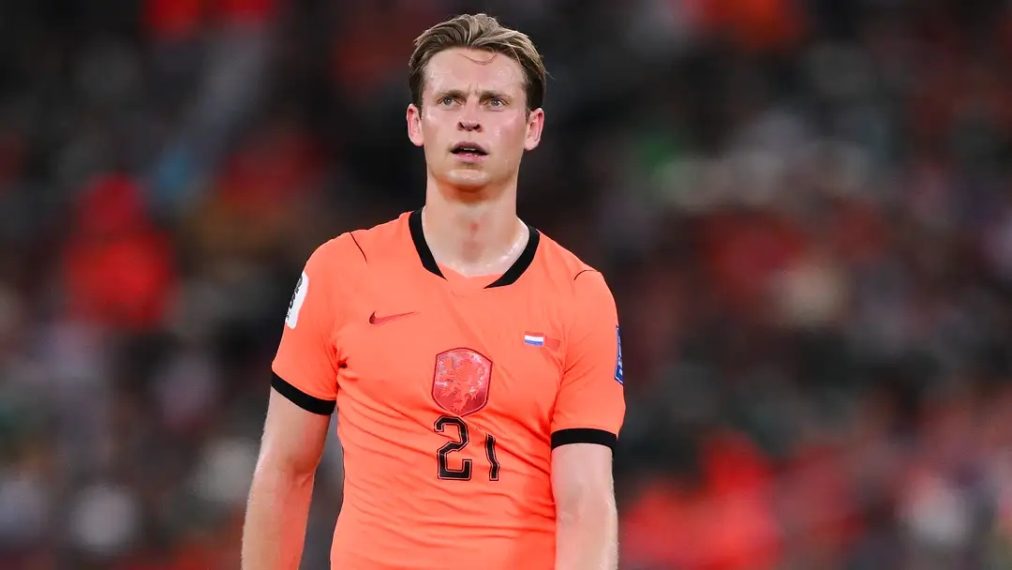
Frenkie de Jong has reassured Barcelona supporters that his half-time substitution during the Netherlands’ 7-0 Nations League victory over Greece was a precautionary decision rather than the result of a serious problem.
Netherlands manager Xavi Hernandez said after the match that De Jong had been feeling an issue with his back. However, the 29-year-old midfielder explained that there had been little reason to keep him on the pitch after his side had taken a 5-0 lead into the interval.
“I had just returned from injury and the score was 5-0 at half-time, so it was the right decision,” De Jong told Dutch broadcaster NOS. “There was no problem with it.”
The Barcelona player had only recently returned to action following a lengthy absence caused by a knee injury. With international football involving significant travel and a demanding schedule, De Jong said it would have been unnecessary to expose himself to further risk.
“I had just come back from injury and I was not yet fully ready to play a lot of matches,” he added. “With all the travelling and international games, as well as my injury history, there was no need to take risks.”
De Jong was also pleased with the Netherlands’ collective display against Greece, highlighting the team’s positioning, attacking efficiency and ability to make the most of its opportunities. Scoring the opening goal early had also helped the side settle into the match, he said.
“I think we simply did things well in terms of our positioning on the pitch,” De Jong said. “Of course, we also took the chances we created and scored the first goal straight away, which always helps. Things went well from a footballing perspective and the performance was very good.”
The midfielder described the result as a positive step for the Netherlands, while warning that one convincing victory could not be taken as proof that the team had reached its desired level.
“It is a good step and everything looked great tonight,” he said. “Now we simply have to keep moving forward.”
De Jong said the Netherlands were working to establish a clear identity based on attacking football and control of matches.
“Our vision is clear,” he said. “We want to attack, build from the back, press aggressively in advanced areas of the pitch and impose our control on games.”
He added that the team still had considerable progress to make. The Netherlands’ last genuine test, in his view, had been the World Cup, and the 7-0 win alone was not enough to measure their development.
“We are now in a period of continuous improvement so that we can reach the level that allows us, hopefully within two years, to compete for the title,” De Jong said.
-
 Samuel Eto’o hits back at Bill Tchato after Cameroon squad criticism Nov 14, 2026
-
Algeria face Togo in crucial 2027 Africa Cup of Nations qualifying clash Nov 14, 2026
-
Spain and England meet with Nations League top spot at stake in Madrid Nov 14, 2026
-
Mouine Chaabani demands Tunisia change after Libya defeat Nov 14, 2026


-
AFCON 2025: Fixtures, Results, Scores and Standings Jan 18, 2026
-
Match hero Taiwo Awoniyi reflects on team effort after Chelsea triumph May 5, 2026
-
Leadership and long-term vision key to rescuing Zamalek and inspiring Egyptian football – Hany Abou Rida Nov 5, 2025
-
South African giants Orlando Pirates set to lose influential forward Monnapule Saleng Mar 19, 2025




-
Ali Maher names first Egypt squad for 2027 Africa Cup of Nations qualifiers Nov 9, 2026
-
Morocco v Niger: Lions of the Atlas seek another win in CAN 2027 qualifying Nov 11, 2026
-
CAN 2027 qualifying: Cote d’Ivoire-Gambia and Mali-Rwanda headline third round Nov 9, 2026
-
FIFA U17 World Cup 2026: TV channels, streaming and full match schedule Nov 8, 2026