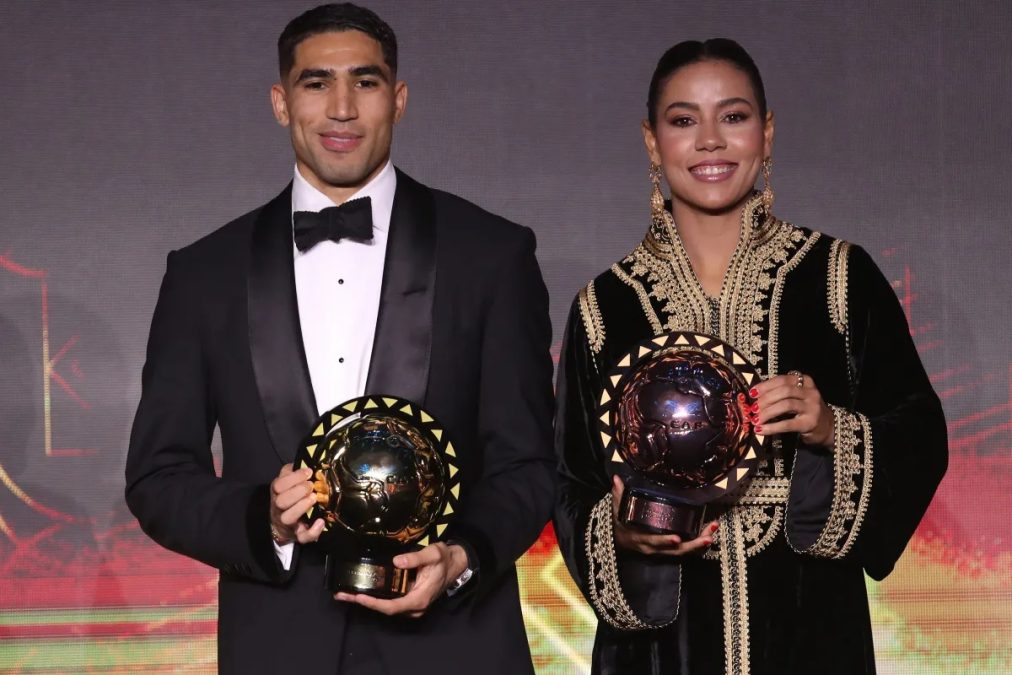
Achraf Hakimi and Ghizlane Chebbak have both been named among the finalists for the FIFPRO World 11 2026, but the Moroccan pair’s selections carry very different weight.
Hakimi’s inclusion in the men’s list is widely expected, while Chebbak’s place among the women’s nominees has prompted debate. Both players have made the shortlist, rather than secured a place in the final teams, which will be announced on 9 November.
The nominations were decided through votes cast by professional footballers. Hakimi was included among the 26 men’s finalists after receiving enough support from the 19,806 players who took part in the men’s vote. He is one of eight defenders selected and the only right-back on the list.
The Paris Saint-Germain and Morocco defender has established himself as one of the leading players in his position worldwide. His energy, attacking contribution and consistency have made him an important figure for both club and country, while his 13th-place finish in the 2026 Ballon d’Or further underlined his status.
Hakimi is no longer being judged solely as one of Europe’s best African players. His performances have placed him among the leading footballers in the world, making his FIFPRO nomination a natural recognition of his progress.
Chebbak’s selection is less straightforward. The captain is a central figure in Moroccan women’s football and has enjoyed an outstanding career. She was also included in the FIFPRO World 11 in 2025, the first time she had received that honour.
However, the 2026 award assesses performances between August 2025 and August 2026. During that period, Chebbak spent time at Al-Hilal before returning to AS FAR in September, but her season was not as influential as the nomination might suggest.
That was particularly evident at the most recent Women’s Africa Cup of Nations, held in Morocco. Chebbak was a substitute for the hosts’ first two matches and played only four games, totalling about 250 minutes. She scored no goals and provided no assists, while Morocco finished fourth after losing two successive matches on penalties.
The contrast with the previous Women’s Africa Cup of Nations, in 2025, is marked. Chebbak was the tournament’s leading scorer with five goals and was selected in the team of the competition.
Despite that, she was one of seven midfielders chosen by the 6,511 players who participated in the women’s vote.
Her nomination appears even more difficult to understand given the absence of Temwa and Tabitha Chawinga. Temwa led Malawi to the Women’s Africa Cup of Nations final and finished 10th in the 2026 Ballon d’Or Feminin, the highest position ever achieved by an African player.
The players were listed in different positional categories, with Chebbak competing among the midfielders and the Chawinga sisters classified as forwards, a particularly competitive section.
The FIFPRO World 11 is selected by players, but peer voting can reflect a reputation built over several seasons as much as one specific campaign. Hakimi’s nomination appears indisputable; Chebbak’s suggests that reputation may have carried greater influence.
-
 FIFPRO World 11 2026: Hakimi’s nomination clear, Chebbak’s raises questions Nov 3, 2026
-
Al Ahly coach Hussein Ammouta urges club to keep momentum Nov 3, 2026
-
Tottenham and Juventus target Younes Ebnoutalib as Eintracht Frankfurt plan contract talks Nov 3, 2026
-
Chelsea and Liverpool make contact over Brentford defender El Hadji Malick Diouf Nov 3, 2026



-
AFCON 2025: Fixtures, Results, Scores and Standings Jan 18, 2026
-
Match hero Taiwo Awoniyi reflects on team effort after Chelsea triumph May 5, 2026
-
Leadership and long-term vision key to rescuing Zamalek and inspiring Egyptian football – Hany Abou Rida Nov 5, 2025
-
South African giants Orlando Pirates set to lose influential forward Monnapule Saleng Mar 19, 2025




-
Barcelona host Aston Villa in Champions League meeting at Spotify Camp Nou Nov 2, 2026
-
Le Havre AC host Paris Saint-Germain as Ligue 1 leaders seek another win Oct 28, 2026
-
DRC’s Leopardeaux beat Oman 2-0 to reach FIFA U15 World Cup quarter-finals Oct 29, 2026
-
Villarreal host unbeaten PSG in first European meeting Nov 2, 2026