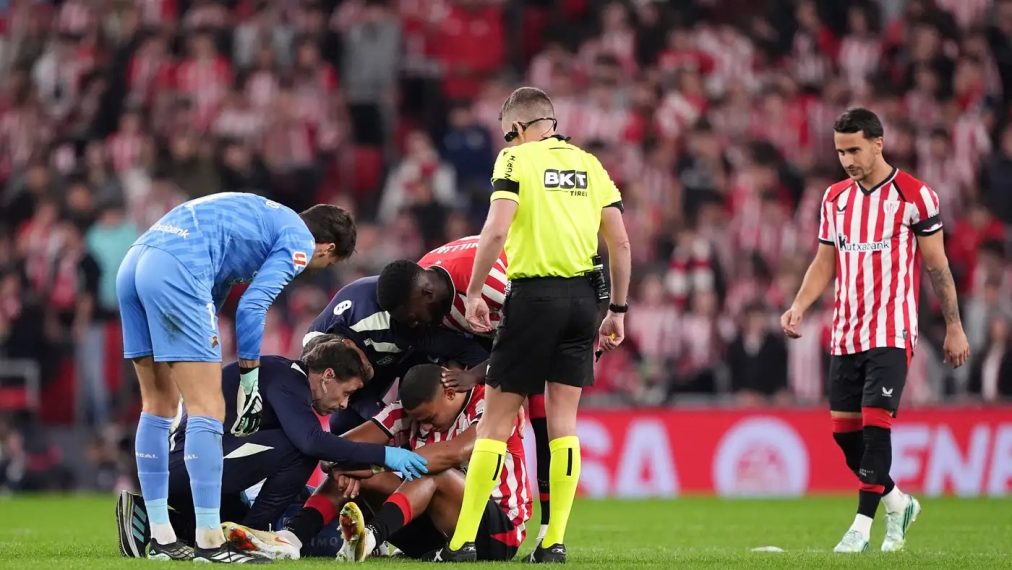
The Spanish Football Federation’s Technical Refereeing Committee has confirmed that a short synchronisation error may have led to the wrong player being identified in the penalty incident during Athletic Bilbao’s match against Real Sociedad.
The game, played at San Mames on Sunday in the 11th round of La Liga, produced Athletic’s second goal from the spot after the referee judged that a Real Sociedad defender had fouled an opposing attacker.
The committee requested a detailed report from Kinexon, the company responsible for developing the connected-ball technology, after questions were raised over which player had touched the ball last.
Before kick-off, the appointed VAR official completed the required protocol synchronisation with the video operator. The highly experienced referee had previously worked with the technology at the World Cup and was the only Spanish official involved in World Cup matches as a VAR.
Mediapro also carried out random checks during the match to verify that the synchronisation process was operating correctly.
When the penalty incident was reviewed by VAR, the connected-ball signal available at the time appeared to show that an Athletic Bilbao player had touched the ball, while the Real Sociedad player had not. That interpretation supported the on-field decision.
However, when the technical data was later added to the television broadcast to improve transparency, it showed that the Athletic player’s contact coincided with the final recorded signal peak before the moment at which the Real Sociedad player was expected to touch the ball. No further peak appeared, suggesting that the Athletic player had not made contact at that point.
Two earlier peaks were also visible, although their relationship with the images was unclear. The Technical Refereeing Committee therefore asked Kinexon to examine the incident and explain those signals.
According to the company’s report, the most likely explanation was a small synchronisation difference of about one or two frames – equivalent to 20 to 40 milliseconds at 50 frames per second – between the ball signal and the video used by VAR.
In the original display, the signal peaks appeared slightly before the corresponding contacts shown in the video. This may have led officials to conclude that the Real Sociedad player had not touched the ball because no additional peak appeared at the apparent moment of contact.
After the signal was realigned with the video, the data matched the images not only during the incident but also in the surrounding play. The clearest peak then corresponded to the Real Sociedad player reaching the ball.
The report therefore concluded that the Real Sociedad player had made the final touch, meaning the penalty award may have been incorrect.
The committee said the VAR decision must nevertheless be assessed using the information available at the time and the synchronisation shown by the system. It added that the VAR team had acted correctly in those circumstances because the connected-ball data provided strong evidence that only an Athletic Bilbao player had touched the ball.
The committee stressed that the technology itself worked properly throughout the match and that the issue was limited to the timing difference between the ball signal and the broadcast video.
Unlike the semi-automated offside system, connected-ball technology used with broadcast cameras is manually synchronised before each match by bouncing the ball in a prescribed way. The offside system continuously synchronises the ball with dedicated tracking cameras using a precision timing protocol accurate to milliseconds.
The committee said it would continue working with technology companies and specialists to improve synchronisation procedures, strengthen reliability and reduce the risk of similar incidents.
-
 Baghdad Bounedjah faces competition for Algeria return Nov 3, 2026
-
Bayern’s Ismael Saibari facing three to four months out with ankle injury Nov 2, 2026
-
Achraf Hakimi shortlisted for FIFPRO World 11 alongside Messi and Ronaldo Nov 2, 2026
-
Jesus Owono red-carded as Tenerife striker Jesus de Miguel suffers cardiac arrest Nov 2, 2026




-
AFCON 2025: Fixtures, Results, Scores and Standings Jan 18, 2026
-
Match hero Taiwo Awoniyi reflects on team effort after Chelsea triumph May 5, 2026
-
Leadership and long-term vision key to rescuing Zamalek and inspiring Egyptian football – Hany Abou Rida Nov 5, 2025
-
South African giants Orlando Pirates set to lose influential forward Monnapule Saleng Mar 19, 2025




-
Barcelona host Aston Villa in Champions League meeting at Spotify Camp Nou Nov 2, 2026
-
Le Havre AC host Paris Saint-Germain as Ligue 1 leaders seek another win Oct 28, 2026
-
DRC’s Leopardeaux beat Oman 2-0 to reach FIFA U15 World Cup quarter-finals Oct 29, 2026
-
Fiorentina and Atalanta meet with both clubs seeking a Serie A revival Oct 27, 2026