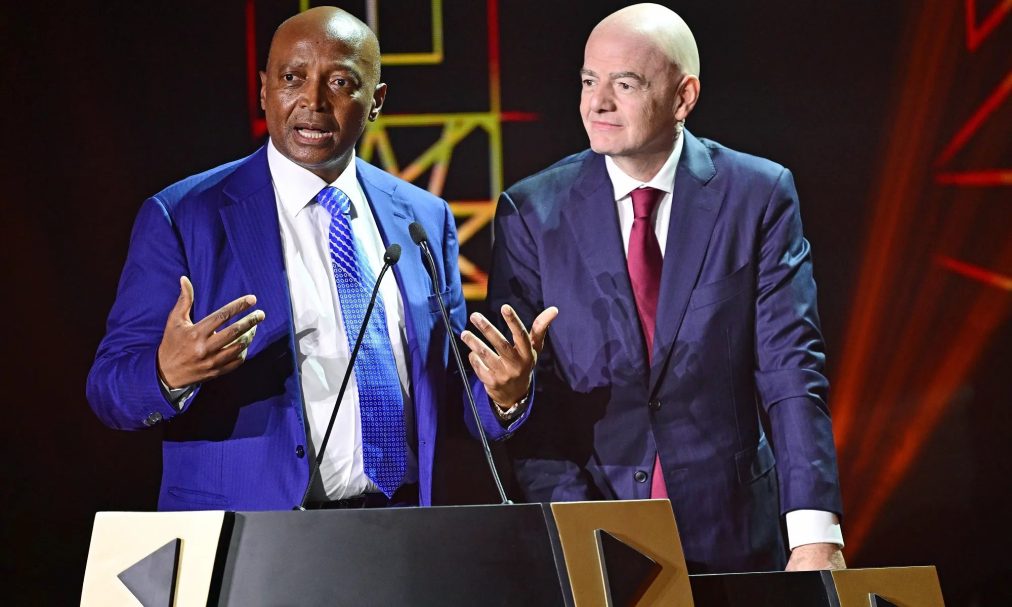
The Africa Cup of Nations will continue to be played every two years, but the decision to abandon a planned move to a four-year cycle has raised fresh questions about the Confederation of African Football’s independence and decision-making.
Speaking on Canal+ Sport Afrique, Senegalese journalist Mansour Loum said the tournament had become a bargaining tool in the wider power struggle between FIFA and UEFA.
Patrice Motsepe and CAF announced in December 2025 that the competition would move to a four-year schedule. They later reversed that decision, preserving the tournament’s traditional biennial format.
The U-turn has been welcomed by many supporters of African football, but Loum questioned the way the policy had been handled. He said the changes had not been approved in advance by CAF’s executive committee and that several members had complained about the process.
He also highlighted what he considered a contradiction in CAF’s public arguments. The move to a four-year cycle had been justified on commercial grounds, with the tournament’s greater rarity expected to increase its value. Those arguments now appear to have been set aside.
“The AFCON is homeless, with no fixed date,” Loum said, before offering a broader assessment of the situation.
“I have the impression that CAF has become the armed wing of the war between FIFA and UEFA.”
Loum believes a four-yearly Africa Cup of Nations, potentially staged during the summer, would have suited European clubs by reducing the disruption caused when their African players leave during the season. Returning to a tournament every two years, with editions potentially held in January or February, could instead renew tensions with clubs in Europe.
“CAF has therefore become the variable used to adjust to this war between FIFA and UEFA,” he said. “Do our leaders see what is in Africa’s interests?”
His comments come amid continuing tensions between Gianni Infantino and UEFA. Disputes over FIFA’s governance, its economic plans and the distribution of power between the confederations have contributed to an increasingly confrontational relationship in recent months.
There is no clear evidence that CAF’s changes are directly the result of that dispute. However, the repeated reversals have strengthened the impression that the organisation has struggled to establish and defend an independent position.
CAF’s perceived alignment with FIFA and Gianni Infantino has already attracted criticism during Motsepe’s presidency. The Club World Cup, which caused the Africa Cup of Nations to be moved away from its usual seasonal position, was among the decisions cited by critics.
The tournament has shifted between winter and summer, then back again. Its schedule has moved from every two years to a proposed four-year cycle, before reverting to its previous format.
The return to a biennial competition is likely to satisfy most African supporters, although figures including Didier Drogba had supported holding it every four years.
For Loum, however, the central issue is not simply which format is preferable. It is who makes these decisions, the criteria used and whose interests they serve.
The Africa Cup of Nations is one of the continent’s most important sporting assets. Its future, he argued, should be shaped by a long-term plan for African football rather than by international power struggles.
“The AFCON deserves better than to serve as a variable used to adjust the global game.”
-
 AFCON caught between FIFA and UEFA power struggle, says Senegalese journalist Nov 2, 2026
-
Motsepe criticised after CAF restores biennial Africa Cup of Nations Nov 2, 2026
-
Barcelona hail Egyptian youngster Hamza Abdel Karim as a ‘natural scorer’ Nov 2, 2026
-
Marseille coach applauds Amine Harit after shining in Toulouse victory Nov 2, 2026


-
AFCON 2025: Fixtures, Results, Scores and Standings Jan 18, 2026
-
Match hero Taiwo Awoniyi reflects on team effort after Chelsea triumph May 5, 2026
-
Leadership and long-term vision key to rescuing Zamalek and inspiring Egyptian football – Hany Abou Rida Nov 5, 2025
-
South African giants Orlando Pirates set to lose influential forward Monnapule Saleng Mar 19, 2025




-
Barcelona host Aston Villa in Champions League meeting at Spotify Camp Nou Nov 2, 2026
-
Liverpool v Chelsea: Barcola backed at 3.25 in EFL Cup quarter-final clash Oct 26, 2026
-
Le Havre AC host Paris Saint-Germain as Ligue 1 leaders seek another win Oct 28, 2026
-
Liverpool host Chelsea in EFL Cup last-16 clash at Anfield Oct 26, 2026