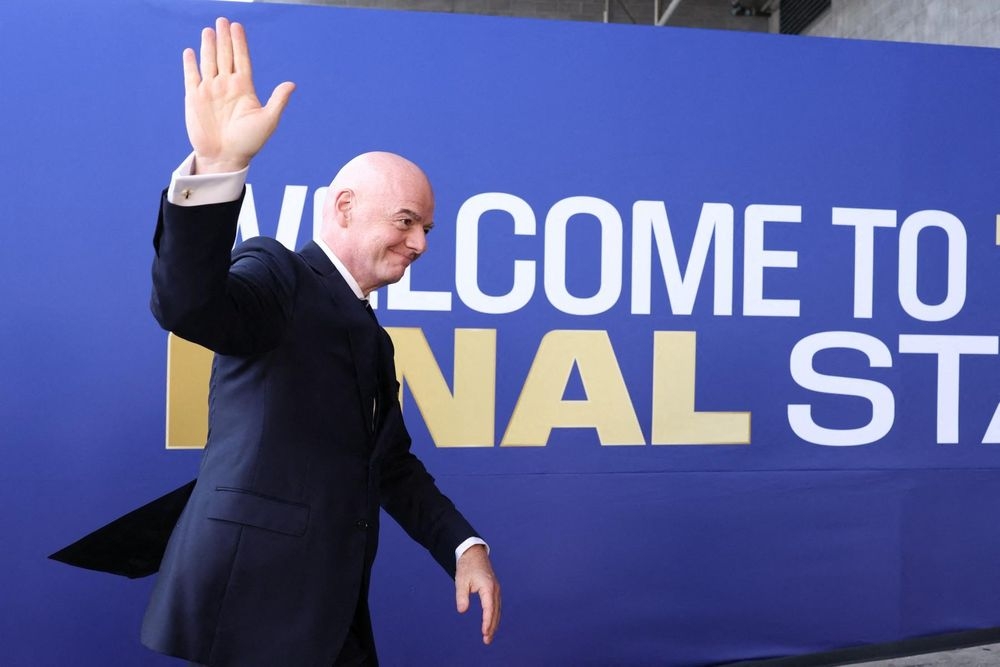
Gianni Infantino remains the clear favourite to win a fourth and final term as FIFA president next March, despite weeks of criticism and growing opposition to his leadership, observers have told AFP.
The 56-year-old Swiss has lost support from several football associations since proposing, and then quickly abandoning, a plan to introduce private investment into the World Cup.
However, Infantino continues to command important backing in Africa and South America.
His FIFA Forward Enterprise (FFE) proposal emerged in July, shortly after the highly successful World Cup. It would have established a commercial subsidiary to manage FIFA’s biggest events, including the World Cup.
Two of Infantino’s strongest critics, UEFA president Aleksander Ceferin and CONCACAF president Victor Montagliani, are reportedly seeking re-election to their respective posts rather than standing for the FIFA presidency.
That has left those seeking to challenge Infantino with limited time to find a credible alternative. Candidates must declare their intention to stand by 18 November.
Terrence Burns, a marketing strategist involved in two successful World Cup hosting bids, said Infantino had always been in a dominant position.
“He holds all the cards and always has,” Burns told AFP. “Any prospective challenger at this point feels either performative or strategic to cut deals.”
Michael Payne, the former marketing chief of the International Olympic Committee (IOC), said it was surprising that no serious challenger had emerged.
“If he is re-elected, which is looking increasingly likely, it will redefine the term Houdini,” Payne told AFP.
Lise Klaveness, president of the Norwegian Football Federation (NFF) and a long-standing critic of Infantino, has won support from many observers but has ruled out entering the race.
Even if she reversed that decision, Klaveness would face the considerable task of becoming the first woman to lead world football, following Kirsty Coventry’s election last year as the first female IOC president.
“People within the IOC administration were working towards the goal of Coventry being elected, as (her predecessor) Thomas Bach’s wish was for her to be president,” an unnamed source close to football governance told AFP.
“Lise faces exactly the opposite. FIFA staff would be working to stop her being elected.”
Legal challenges remain
Infantino’s position is not entirely secure. Opposition figures have launched legal action in the United States and submitted formal complaints to FIFA committees.
Klaveness and the NFF have raised three issues, all linked to Infantino’s relationship with US President Donald Trump. Josh Kushner’s venture capital firm was intended to be the principal investor in FFE. Kushner is the brother of Trump’s son-in-law Jared.
The same source said there was no guarantee the complaints would be examined and warned that any review could take time.
“The fear in the Infantino camp is the Norwegians could take them to CAS (Court of Arbitration for Sport) if dissatisfied with the decision,” the source said.
Burns said the more serious threat could come from UEFA’s legal action in US courts seeking access to documents relating to FFE. FIFA is strongly contesting that case.
“If the FFE was just a case of misguided process and communications strategy, why hide its specifics?” Burns said. “That lack of transparency is a rock in Infantino’s shoe that will not fade away.”
Payne believes the absence of support from major football nations including Spain, France and England could still prove damaging.
“Running a global sports federation requires unity — FIFA will be on the brink of civil war, and this is totally new territory for a sports governing body,” he said.
Burns, though, expects football’s governing bodies to make peace with Infantino unless there is “overwhelming criminal activity to justify it — which there is not”.
He also said there was no “financial upside” for federations in removing the FIFA president, meaning the dispute could ultimately produce “even greater consolidation of power and influence for Infantino when it is all over.”
-
 Yassir Zabiri revives his career in Spain after difficult spell at Rennes Oct 13, 2026
 -
Felix Sanchez appointed Bahrain boss after missing out on Algeria job Oct 13, 2026
-
Nigeria and Ghana penalties cancelled after beach soccer qualifying error Oct 13, 2026
-
Kamissoko makes early case for Mali call-up after first Marseille start Oct 13, 2026


-
AFCON 2025: Fixtures, Results, Scores and Standings Jan 18, 2026
-
Match hero Taiwo Awoniyi reflects on team effort after Chelsea triumph May 5, 2026
-
Leadership and long-term vision key to rescuing Zamalek and inspiring Egyptian football – Hany Abou Rida Nov 5, 2025
-
South African giants Orlando Pirates set to lose influential forward Monnapule Saleng Mar 19, 2025




-
Manchester United host winless Tottenham in Premier League clash Oct 7, 2026
-
Real Madrid fitness update: Valverde a doubt for Villarreal as Kylian Mbappe returns Oct 8, 2026
-
Lens v Lyon: Can the in-form visitors extend their unbeaten Ligue 1 run? Oct 6, 2026
-
Barcelona aim for eighth straight Liga win as Getafe visit Camp Nou Oct 7, 2026