Morocco and Senegal have presented contrasting arguments in their legal battle over the 2025 Africa Cup of Nations (AFCON) title, with Morocco questioning the handling of the final and Senegal raising concerns about the disciplinary process that stripped them of the trophy.
Reports from Senegalese media say Morocco’s lawyers argued that the match should have been ended after Senegal’s players temporarily left the pitch during stoppage time of the final, while Senegal’s defence maintained that the referee’s decision to resume play and complete the match should carry significant weight.
The dispute is now before the Court of Arbitration for Sport (CAS), which is expected to issue a reasoned decision following the closed hearing.
Morocco cite CAF rules and question referee’s handling
According to Senegalese website Sini News, the Moroccan Football Federation relied on Articles 82 and 84 of the Confederation of African Football (CAF) regulations during Thursday’s hearing.
The provisions, as cited in the report, concern situations involving a team leaving the field or refusing to continue a match.
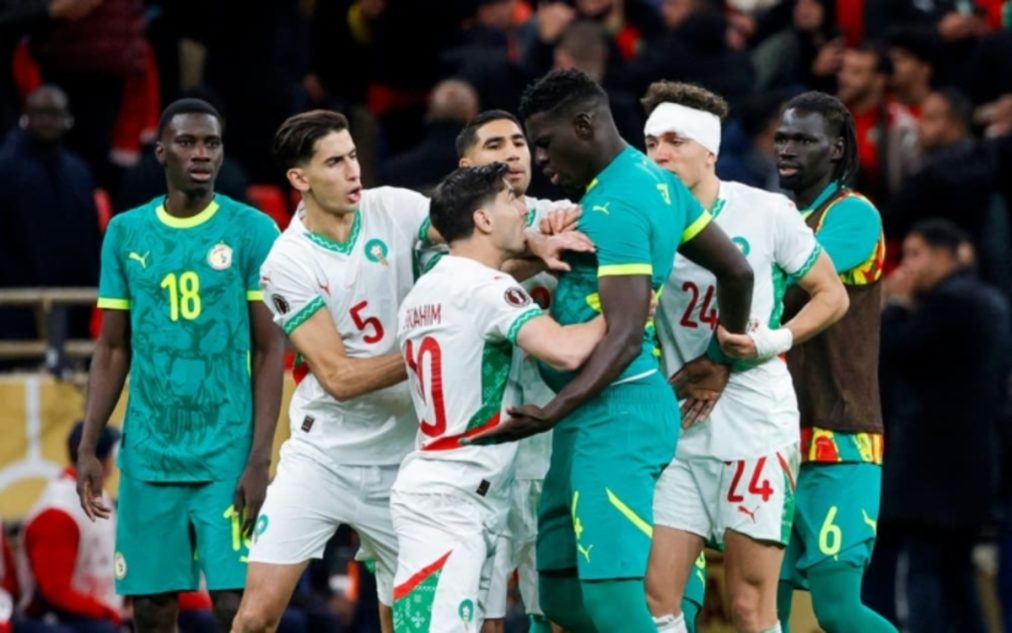
Morocco’s argument centres on the temporary departure of Senegal’s players after a penalty was awarded to the hosts during stoppage time of the final. The Moroccan side maintains that the incident should have resulted in the match being brought to an end.
The report also says Morocco’s legal team questioned whether Olivier Savary, identified as the chairman of CAF’s Referees Committee, influenced the match referee’s handling of the situation.
Morocco reportedly presented photographs that it said showed Savary giving instructions to the referee.
These claims form part of Morocco’s arguments in the case and have not been established as findings by CAS.
The Moroccan side also raised questions about a second refereeing report, an issue that had featured in earlier reports about the proceedings. Senegal’s defence reportedly rejected the arguments surrounding that document.
Senegal defend referee’s authority
Senegal’s lawyers, meanwhile, relied on the principle that the referee has authority over decisions taken during a match.
According to the report, their arguments drew on Law 5 of the Laws of the Game, issued by the International Football Association Board (IFAB), which sets out the referee’s powers and responsibilities.
Senegal also reportedly cited Article 9 of FIFA’s Disciplinary Code in support of its position that the match was completed after the players returned to the pitch.
The defending champions went on to win the final 1-0 after extra time, according to the account of the match cited in the report.
Senegal’s position is that the referee’s decision to restart play and continue the match until its conclusion should be taken into account when determining the outcome of the dispute.
The Senegalese side argues that the result of a completed match should not be redefined retrospectively.
Senegal raise concerns over disciplinary proceedings
The legal challenge also extends beyond events during the final itself.
Senegal’s defence reportedly questioned the procedures that led to CAF’s Appeals Committee ruling on 17 March 2026, which declared Senegal to have forfeited the match 3-0.
According to Sini News, the Senegalese lawyers cited alleged procedural irregularities and raised suspicions of corruption in connection with the process.
Those allegations remain unproven, and the report does not establish that corruption occurred.
The claims add another dimension to an already contentious dispute involving two of African football’s leading national teams.
CAS decision could settle AFCON title dispute
With both federations having presented their arguments during the closed hearing, attention has turned to CAS for a final resolution.
The court’s administration has reportedly indicated that it intends to issue a reasoned decision as soon as possible after the hearing.
The ruling could determine whether CAF’s decision to award Senegal a 3-0 defeat stands or whether the governing body’s disciplinary outcome will be overturned.
For Morocco and Senegal, the stakes extend beyond the result of one match, with the dispute raising questions about the application of competition regulations, the authority of match officials and the procedures used in African football disciplinary cases.
Until CAS issues its decision, the competing claims remain arguments presented by the two sides rather than a final legal determination.
-
 AFCON 2025 dispute: Morocco allege referee influence as Senegal raise corruption concerns Oct 9, 2026
 -
Fares Ghedjemis signs new Frosinone deal through to 2030 Oct 9, 2026
-
Monnapule Saleng unlikely to feature for Mamelodi Sundowns in MTN8 final Oct 9, 2026
-
Oswin Appollis’ remarkable rise praised by former coach Kwanele Kopo Oct 9, 2026




-
AFCON 2025: Fixtures, Results, Scores and Standings Jan 18, 2026
-
Match hero Taiwo Awoniyi reflects on team effort after Chelsea triumph May 5, 2026
-
Leadership and long-term vision key to rescuing Zamalek and inspiring Egyptian football – Hany Abou Rida Nov 5, 2025
-
South African giants Orlando Pirates set to lose influential forward Monnapule Saleng Mar 19, 2025




-
Croatia face Spain with Nations League hopes on the line in Split Oct 5, 2026
-
France v Belgium: Probable line-ups for Nations League clash Oct 3, 2026
-
Morocco coach Mohamed Ouahbi refuses to single out player after Mali draw Oct 4, 2026
-
Italy v Turkey: Mancini’s side set for Nations League clash with key absences Oct 4, 2026