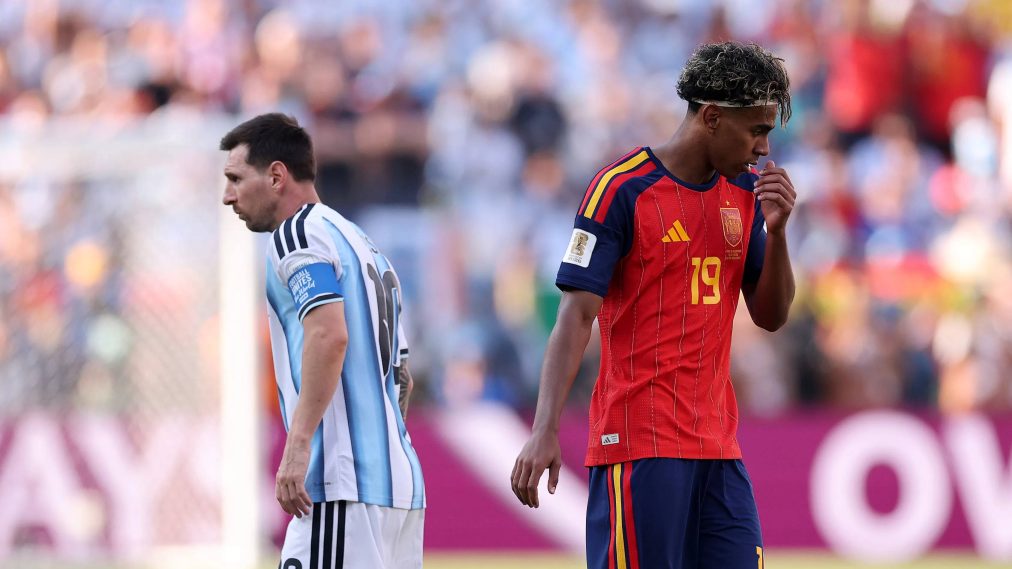
Lionel Messi’s decision to end his international career with Argentina at the age of 39 has prompted understandable sadness among supporters, but football’s history suggests the game will continue to produce new heroes.
The departure of one of the sport’s greatest players may feel like the end of an era. Yet, as Spanish newspaper AS argues in an extensive review of previous farewells, football has repeatedly recovered after losing its leading figures. Its central message is that “the sun always rises again” and that the game remains capable of renewal, even when the initial sense of loss is overwhelming.
Barcelona found a new star
One of the clearest recent examples came at Barcelona, following Messi’s tearful departure from the club in 2021.
There were repeated attempts to give Ansu Fati the number 10 shirt and the responsibility associated with it. But within only two years, Lamine Yamal had emerged as a remarkable new talent.
His arrival restored optimism at Camp Nou and offered supporters a rare source of excitement capable of easing the burden of nostalgia for Messi.
Brazil, Spain and the Netherlands
Brazil faced a similar question after Pele left the international stage in 1971, having won three World Cups. Many believed the country’s greatest period had ended.
Although Brazil then went 24 years without a continental title, AS says the country did not endure a prolonged sense of abandonment. Rivelino, Zico and Socrates soon became outstanding figures, producing an expressive Brazil side at the 1982 World Cup which, in the view of some observers, was even more aesthetically pleasing than the 1970 team.
Spain also moved on quickly after Alfredo Di Stefano left the national side in 1962. Injuries meant “Don Alfredo” never played at a World Cup for Spain, but his absence did not lead to a prolonged period of disappointment. Just months later, Spain won its first major international trophy, lifting the 1964 European Championship at the Santiago Bernabeu.
The Netherlands adapted after Johan Cruyff’s unexpected retirement in 1977, which followed a terrifying armed robbery involving his family. With Ruud Krol and Rob Rensenbrink among their leading players, the Dutch reached the 1978 World Cup final. A later generation, inspired by Marco van Basten and Ruud Gullit, then won Euro 88.
Maradona’s departure was different
According to AS, the one departure that left a particularly deep and lasting gloom was Diego Maradona’s forced exit from the 1994 World Cup after a doping crisis.
Argentina struggled to replace him, moving between players including Ariel Ortega and Juan Roman Riquelme. The country did not fully recover from that shock until Messi emerged and eventually claimed football’s greatest prize at Qatar 2022.
Messi, however, leaves Argentina as a decorated champion, rather than amid the turmoil that surrounded Maradona. AS compares his departure with the dignified final chapters of Rafael Nadal and Roger Federer.
The story is not entirely over. Messi remains active with Inter Miami, while Pele played for eight years after retiring from international football, Di Stefano for four and Cruyff for seven. The lesson, therefore, is not to mourn only what has ended, but to appreciate every remaining moment of Messi’s career on the pitch.
-
 Braga v Sporting CP: probable line-ups for Liga Portugal’s eighth-round clash Oct 7, 2026
 -
Deon Hotto chasing sixth MTN8 final appearance for Orlando Pirates Oct 7, 2026
-
Messi scores in Argentina farewell as Benin beaten 3-0 Oct 7, 2026
-
Benin hold Argentina to half-time draw as Messi farewell takes centre stage Oct 7, 2026



-
AFCON 2025: Fixtures, Results, Scores and Standings Jan 18, 2026
-
Match hero Taiwo Awoniyi reflects on team effort after Chelsea triumph May 5, 2026
-
Leadership and long-term vision key to rescuing Zamalek and inspiring Egyptian football – Hany Abou Rida Nov 5, 2025
-
South African giants Orlando Pirates set to lose influential forward Monnapule Saleng Mar 19, 2025




-
Croatia face Spain with Nations League hopes on the line in Split Oct 5, 2026
-
France v Belgium: Probable line-ups for Nations League clash Oct 3, 2026
-
Morocco coach Mohamed Ouahbi refuses to single out player after Mali draw Oct 4, 2026
-
Noussair Mazraoui leaves Morocco squad early after injury Oct 2, 2026