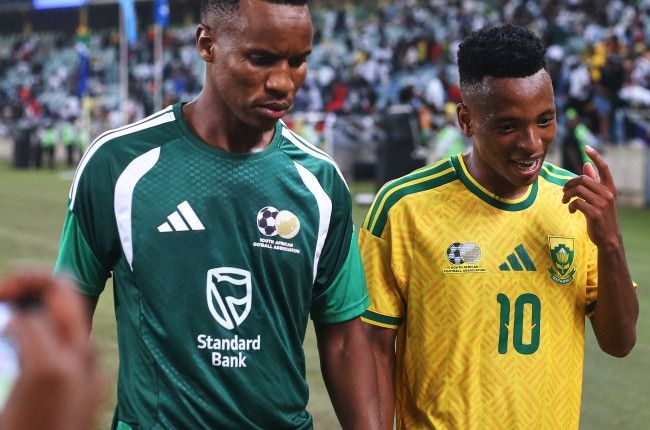
Years ago, being handed the number 10 shirt for Bafana Bafana came with significant responsibility. Today, the choice of squad numbers is viewed as a more administrative decision, rather than a distinction earned through ability and status.
That was the focus of the latest episode of The Carwash Podcast, where Teko Modise, Brighton Mhlongo, Linda Mntambo and Delmain Faver were joined by mystery guest Roger Feutmba to discuss whether traditional expectations around shirt numbers have been lost.
Modise, known as Don, recalled a time when numbers were treated with far greater importance. He said there was an understood order within a team, with particular shirts reserved for players who had demonstrated the talent and qualities expected of them.
According to Modise, both players and supporters understood the significance attached to those numbers. Wearing one was not simply a matter of selection or preference; it represented recognition and responsibility.
Feutmba offered his own example from his time with Mamelodi Sundowns. When the Cameroon legend joined the PSL giants, he said he did not know who had worn the number 10 shirt before him.
Instead, he asked for the number he had regularly worn throughout his career as a creative playmaker. The club agreed to give it to him.
For Feutmba’s generation, the number 10 carried a clearly understood role, and he was prepared to accept the demands that came with it.
“You had to think about the whole team, that generosity to make sure you don’t think about [yourself], to make sure that you give the tempo and you give the direction in the game,” he said.
Has the old shirt-number hierarchy disappeared?
The panel stopped short of saying that the tradition had completely vanished. However, the discussion suggested that squad numbers no longer hold the same meaning they once did in South African football.
Modise reinforced that view by referring to the pride and prominence associated with wearing numbers 6, 8, 10 and 11. These shirts were often linked to specific responsibilities and influential positions on the pitch.
The debate also raised a broader question for the modern game. In the PSL, and within Bafana Bafana, should the significance of particular numbers still help shape a team’s identity?
Or has football moved beyond a system in which a player’s shirt number reflects their role, status and contribution to the side?
-
 Why Bafana Bafana’s iconic shirt numbers no longer carry the same weight Sep 21, 2026
 -
Orlando Pirates punish Ronnie Kanalelo’s unbeaten boast in Gallants defeat Sep 21, 2026
-
Ouaddou sets new standards as Pirates’ unbeaten run reaches 20 matches Sep 21, 2026
-
Ouaddou says Orlando Pirates have become a ‘point machine’ Sep 21, 2026




-
AFCON 2025: Fixtures, Results, Scores and Standings Jan 18, 2026
-
Leadership and long-term vision key to rescuing Zamalek and inspiring Egyptian football – Hany Abou Rida Nov 5, 2025
-
South African giants Orlando Pirates set to lose influential forward Monnapule Saleng Mar 19, 2025
-
Match hero Taiwo Awoniyi reflects on team effort after Chelsea triumph May 5, 2026




-
Atletico Madrid vs Real Madrid: Derby date, kick-off time and where to watch Sep 18, 2026
-
Atletico Madrid v Real Madrid: Mbappe backed to score in key La Liga derby Sep 17, 2026
-
African Stars choose Botswana’s Lucas Moripe Stadium to host Orlando Pirates in CAF Champions League Sep 16, 2026
-
Europa League: AC Milan, Benfica and Lyon begin new league phase Sep 16, 2026