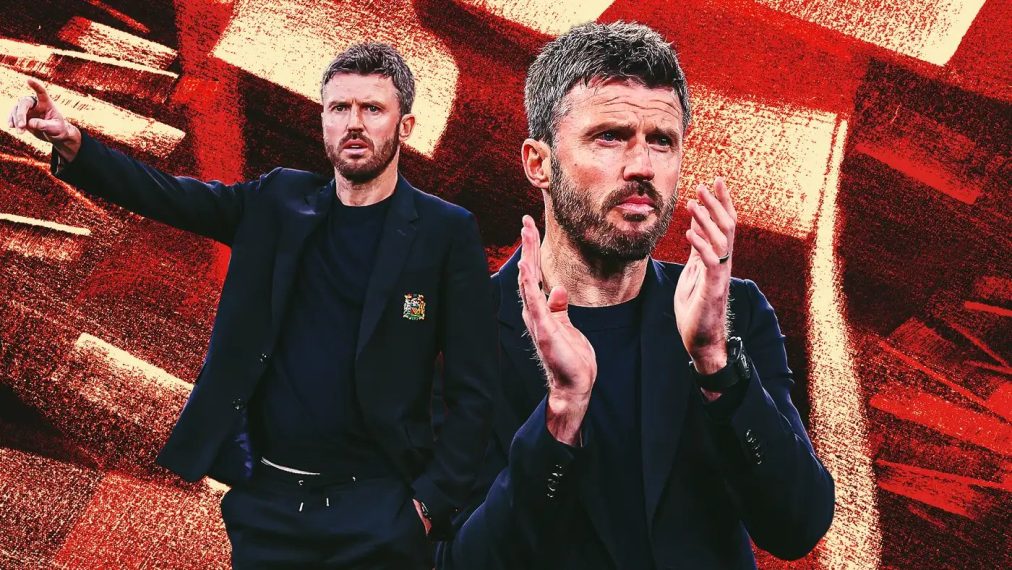
Manchester United’s 1-0 defeat by Manchester City has intensified scrutiny of Michael Carrick, with the manager facing questions over his team’s failure to exploit a numerical advantage, limited attacking options and growing reliance on Bruno Fernandes.
The loss was the third time in less than 10 months that United have failed to beat an opponent who played with 10 men before half-time. That record has made it difficult to blame the latest setback solely on a refereeing decision or the disputed goal scored by Erling Haaland.
The main controversy after the match centred on an official apology from refereeing body PGMOL, which said there had been an “error of judgement” in the incident involving Haaland’s goal. But the concerns surrounding United extend well beyond that decision.
United have taken only four points from their opening four matches and have won just once, against newly promoted Ipswich Town. Carrick had previously rejected the idea that four points from three matches – including last weekend’s game against Everton – represented a poor start. The latest result has made the gap between performance and expectation harder to ignore.
After the defeat, Carrick said: “We don’t need a break or a fresh start. We just need to move forward and get back to winning ways.”
He has little time to do so. United host Brighton in the League Cup on 16 September before travelling to Fulham four days later. Carrick will need a clear reaction and an improved performance before the next international break, which will last three weeks and could bring further scrutiny of the team’s decline at Old Trafford.
The challenge against a defensive side
Phil Foden’s red card changed the match, according to City manager Enzo Maresca. Yet Maresca also pointed to a tactical paradox: playing with 10 men forced City to retreat and close the spaces United usually target on the counter-attack.
“They are a team that love counter-attacks and exploiting the space behind the defensive line,” Maresca said. “When we played with 10 men, we dropped back and waited for them, which meant they could not counter-attack us or find space behind us. That made the game more difficult for both teams.”
The result raised a central question for Carrick: can United break down an organised team that sits deep, or do they remain more effective when opponents leave room to attack?
Since Jose Mourinho arrived at United more than a decade ago, the side have generally been most dangerous in transition. Ole Gunnar Solskjær attempted to develop a different identity but did not fully achieve it. Erik ten Hag and Ruben Amorim also struggled to move the team away from that reliance after arriving at Old Trafford following domestic success built partly on possession and control.
Carrick, who preferred to keep the ball and avoid losing it during his playing career, appears keen to introduce a similar philosophy. But possession alone does not create chances. United need players capable of finding solutions in tight areas, as well as a structure that can unsettle a compact defence.
Questions over recruitment and Fernandes
United spent about £155m strengthening midfield during the summer transfer window. However, Youri Tielemans has yet to regain full fitness and his usual level, Carlos Baleba has not made his debut, while Andre Santos has disappeared from the starting side since the opening match against Hull and remained an unused substitute against City.
There was also no new left-back signing despite expectations that the club would reinforce the position. Luke Shaw’s run of 41 consecutive Premier League starts has now ended.
In attack, Josh Zirkzee was introduced instead of Marcus Rashford only seven minutes before the final whistle, underlining Carrick’s limited choices. United used just two substitutes during the match, adding to doubts over whether the squad has been built for the manager’s preferred style.
Bruno Fernandes is another concern. He had one of the strongest seasons of his career last term, winning the Professional Footballers’ Association and Football Writers’ Association player of the year awards after scoring nine goals and providing 22 assists, a Premier League record.
This season he has scored three times and recorded one assist, but his overall influence has appeared reduced. Some observers noticed signs of fatigue against City.
Fernandes had played the full 90 minutes against Azerbaijan’s Sabah in the Champions League, despite United leading 3-0 at half-time and facing City only three days later. Carrick had used all five available substitutes but kept his captain on the pitch throughout.
With Fernandes entering the final year of his contract, although United have an option to extend it until the summer of 2028, the extent of their dependence on him is an increasing concern.
Carrick must provide answers
Carrick was appointed permanent manager in May on a two-year contract after leading United to 12 wins in 17 matches as interim boss following Amorim’s dismissal. That record persuaded the club and supporters that he could restore stability.
It also invited comparisons with Solskjær, who received a permanent appointment after a successful interim spell in 2019. Despite the criticism he faced, Solskjær remains the only United manager since Sir Alex Ferguson to lead the club to two successive top-three finishes.
Carrick must now prove he can maintain strong results across a full season while managing injuries, transfers, pressure from supporters and the media, and major matches.
He believed United had controlled parts of the City game, saying: “I think we had the initiative to some extent, particularly in the second half. Before they scored, I felt we were the better team. I thought we could improve on the second part of the first half and build attacking momentum after the break.”
United hit the post and, according to Carrick, the match had been developing as he wanted before City scored. But he admitted: “We could have finished the game better, and we could have been more creative.”
That may explain the wider problem. United had possession without creating enough danger, gained a numerical advantage without making it count and invested heavily without seeing the new arrivals make a decisive impact.
There is no suggestion of panic at the club, and Carrick still has time to change direction. But the questions are familiar: can United attack deep defences, are the summer signings sufficient, does Carrick have enough options from the bench, and is the team too dependent on Fernandes?
The answers will come on the pitch, beginning with Brighton and then Fulham. The defeat by City may be only one result, but the manner of it has revived doubts that many at Old Trafford believed had been left behind.
-
 Egypt reject Bolivia international friendly proposal Sep 14, 2026
 -
PAOK complete season-long loan deal for DR Congo striker Simon Banza Sep 14, 2026
-
Barcelona seek sixth straight LaLiga win against Racing Santander Sep 14, 2026
-
Junior Khanye backs Polokwane City goal and blames Chiefs goalkeeper Petersen Sep 14, 2026




-
AFCON 2025: Fixtures, Results, Scores and Standings Jan 18, 2026
-
Leadership and long-term vision key to rescuing Zamalek and inspiring Egyptian football – Hany Abou Rida Nov 5, 2025
-
South African giants Orlando Pirates set to lose influential forward Monnapule Saleng Mar 19, 2025
-
Full schedule for 2025 Africa Cup of Nations in Morocco confirmed Feb 12, 2025




-
Porto v Manchester City: Probable line-ups for Champions League opener Sep 7, 2026
-
African trio Vozinha, Bounou and Eduard Mendy nominated for 2026 Men’s Goalkeeper of the Year award Sep 8, 2026
-
Bayern Munich begin Champions League campaign against unbeaten Bodø/Glimt Sep 9, 2026
-
Bayer Leverkusen prepare bumper contract for Cameroon forward Christian Kofane Sep 7, 2026