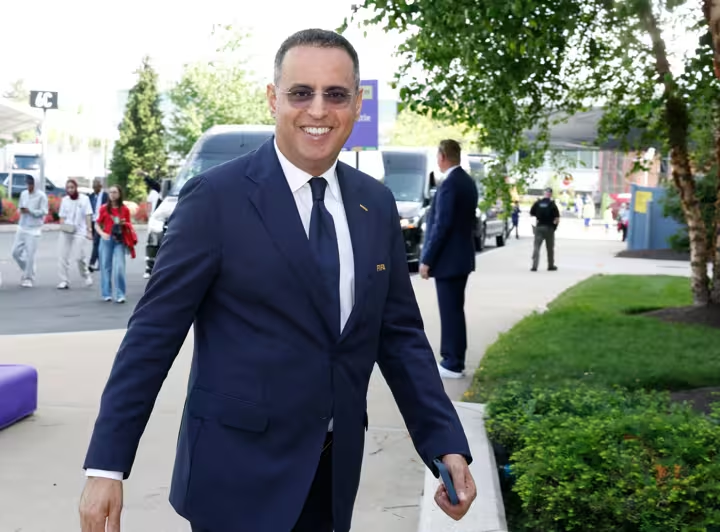
Football Federation of the Islamic Republic of Mauritania (FFRIM) President and FIFA Council Member Ahmed Yahya has praised the transformative impact of the FIFA Forward Programme on the development of football in Mauritania.
The West African nation has experienced significant growth in recent years, with investment in infrastructure, youth development, medical facilities and national teams helping to reshape the country’s football landscape.
Mauritania’s men’s national team, which was ranked below 200th in the FIFA/Coca-Cola World Ranking as recently as 2013, has climbed to 113th.
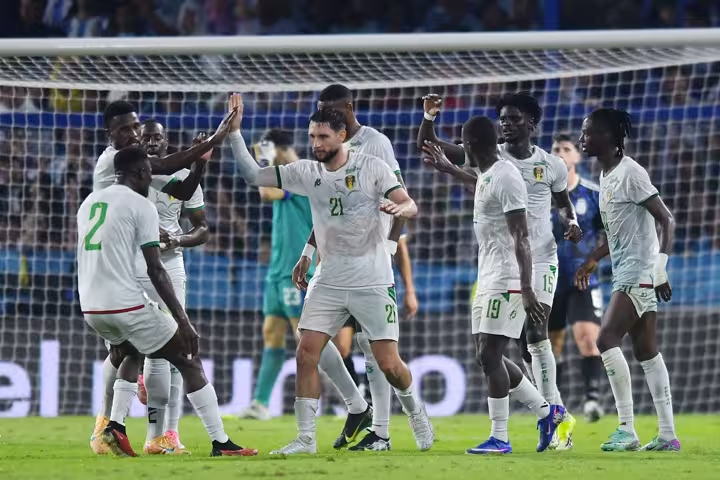
The Lions of Chinguetti have also qualified for three consecutive Africa Cup of Nations tournaments in 2019, 2022 and 2024, reaching the round of 16 for the first time in their history at the 2024 edition.
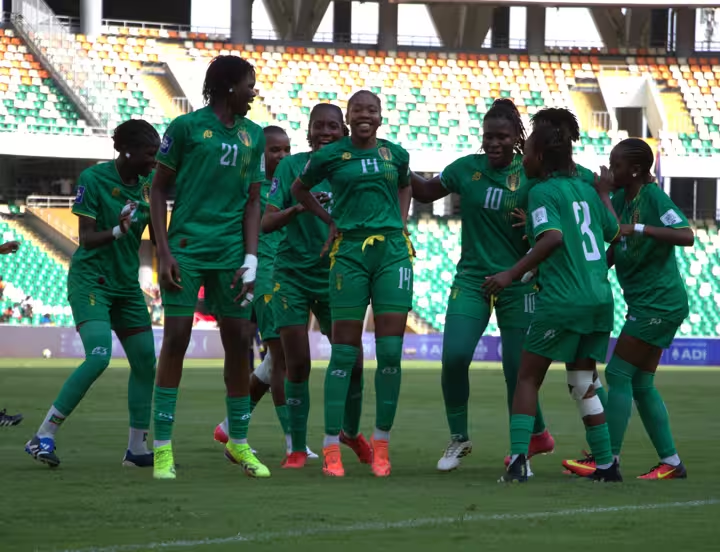
The country’s women’s football has also made progress, returning to competitive action at the WAFU-A Women’s Cup in 2025 before participating in the inaugural FIFA Series, where they recorded victories over Pakistan and the Turks and Caicos Islands.
Mauritania also made its debut at a FIFA tournament at the 2025 FIFA Beach Soccer World Cup in Seychelles.

“Over the past few years, our football has significantly developed. We’ve been improving on the pitch, obviously, but we’ve also dramatically grown as a federation, with the FIFA Forward Programme playing a vital role in this development,” Yahya said.
“We’ve seen the results on the pitch, with three consecutive qualifications to the (CAF) Africa Cup of Nations, including a historic first-ever qualification back in 2019,” he added. “However, more importantly, and going beyond our sporting results, the (FIFA) Forward Programme has allowed us to structure, invest and build.”
Since 2016, FIFA Forward has channelled nearly USD 5.1 billion into football development at national and regional levels.
During the current Forward 3.0 cycle from 2023 to 2026, each FIFA Member Association can receive up to USD 8 million.
Mauritania has used the funding for several major projects, including the renovation and expansion of the Stade Cheikha Ould Boïdiya in Nouakchott, which is being upgraded to accommodate 16,000 spectators.
Other investments include a new synthetic pitch at the Stade Municipal de Nouadhibou, vehicles for the women’s national team, the introduction of Video Assistant Referee (VAR) technology for the top domestic league and improvements to the FFRIM headquarters and training facilities.
FIFA Forward funding has also supported the development of the FFRIM Football Academy in Nouakchott, including the construction of a health centre.
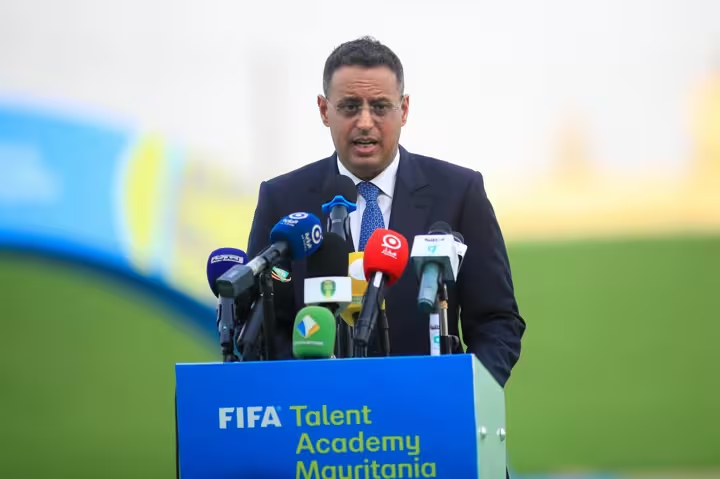
That investment helped pave the way for the opening of the FIFA Talent Academy Mauritania in February 2025, the first FIFA Talent Academy opened in Africa under FIFA’s Talent Development Scheme.
“I would really like to highlight two projects in particular: the academy and the sports and medical centre. Firstly, the academy because it’s our future. Today, we are able to recruit young players, train them and support them here in Mauritania, in a place that favours their development, both in terms of sports and education. This is crucial for us,” Yahya said.
“Then, there is the sports and medical centre,” he continued. “Today, we are able to better support our players, manage their medical follow-up, work on preventing injuries, and provide care and recovery support with appropriate equipment. We are extremely proud of these two projects. They are here for the long run and to serve several generations of players.”
Mauritania had already demonstrated its commitment to grassroots and educational development by becoming the first African country to launch FIFA Football for Schools in March 2022. The federation has also implemented the FIFA Foundation’s Digital Education Programme.
Yahya, who has served as FFRIM president since 2011, believes the investments will continue to benefit future generations and provide a sustainable foundation for football development in the country.
“Today, we’ve become a respected organisation and a model for development, and, I believe, a good example of what the FIFA Forward Programme can help build over the long term,” he said.
“This is the impact of the FIFA Forward (Programme). We can clearly see the results of this impact today, but more importantly, these investments will keep supporting our football for many years to come,” Yahya concluded. “This is what makes this programme so important for a federation like ours.”
-
 FIFA U15 Festival Baku 2026: Burkina Faso beat Antigua and Barbuda in opening match Oct 24, 2026
 -
Al Ahly Tripoli take 4-0 lead into Welwalo Adigrat return Oct 24, 2026
-
CAF Confederation Cup: CS Sfaxien face AFAD Plateau in decisive second leg Oct 24, 2026
-
Azam FC v ZED FC: How to follow CAF Confederation Cup tie Oct 24, 2026


-
AFCON 2025: Fixtures, Results, Scores and Standings Jan 18, 2026
-
Match hero Taiwo Awoniyi reflects on team effort after Chelsea triumph May 5, 2026
-
Leadership and long-term vision key to rescuing Zamalek and inspiring Egyptian football – Hany Abou Rida Nov 5, 2025
-
South African giants Orlando Pirates set to lose influential forward Monnapule Saleng Mar 19, 2025




-
Barcelona v Real Madrid: Catalans backed at 1.65 to win October Clasico Oct 23, 2026
-
Barcelona and Real Madrid meet in pivotal 265th Clasico Oct 23, 2026
-
PSG v Barcelona: fiery attacks set up Champions League classic at Parc des Princes Oct 18, 2026
-
Champions League: PSG beat Barcelona as Liverpool complete comeback against Villarreal Oct 20, 2026