Pressure mount on coach Jorge Vilda as Morocco’s pursuit of WAFCON glory ends in frustration again
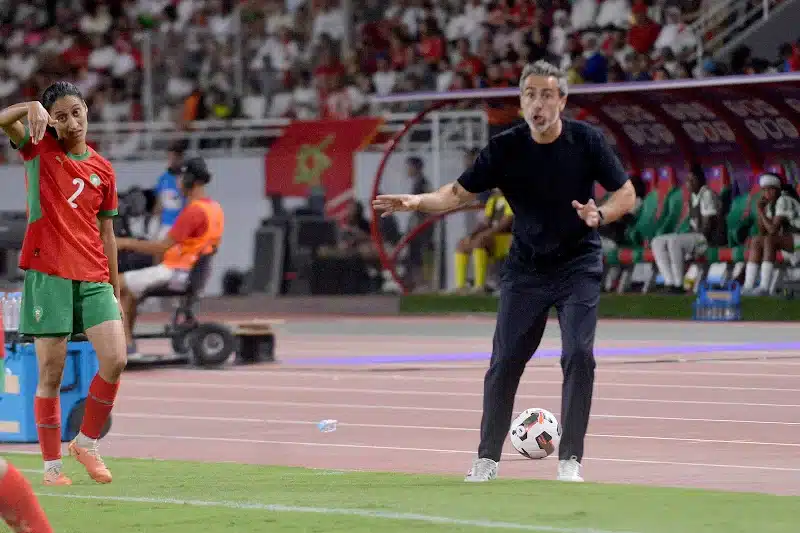
The Royal Moroccan Football Federation’s decision to appoint Jorge Vilda as head coach of the women’s national team was viewed as a statement of intent.
Vilda arrived in Morocco with considerable prestige after leading Spain to the 2023 FIFA Women’s World Cup title, raising expectations that his experience at the highest level could help the Atlas Lionesses take the final step and win the Women’s Africa Cup of Nations for the first time.
The federation has invested heavily in the development of women’s football, while Morocco possesses a talented generation of players capable of competing with the continent’s best.
Yet, despite clear progress and several encouraging performances, Vilda’s tenure has increasingly been defined by painful failures at decisive moments.
The latest came at the 2026 WAFCON, where Morocco once again fell short of continental glory after losing to Cameroon in the semi-finals.
With the pressure growing, Vilda’s record presents an intriguing question for the Royal Moroccan Football Federation: has the Spanish coach taken the Atlas Lionesses as far as he can, or does the team simply need more time to convert its progress into trophies?
Olympic dream ends in disappointment
One of the first major setbacks of Vilda’s tenure came during the qualification campaign for the Paris 2024 Olympic Games.
Morocco appeared to have taken a significant step towards securing their place at the tournament after defeating Zambia 2-1 in the first leg.
However, the advantage quickly disappeared in the return fixture in Rabat.
The Atlas Lionesses suffered a 2-0 defeat on home soil, bringing their Olympic qualification hopes to an end.
The elimination was particularly frustrating because Morocco had entered the second leg with a one-goal advantage and home support behind them.
Instead of completing the job, they were unable to find a response and surrendered their opportunity to qualify for the Olympics.
It was an early indication of a recurring problem that has followed Vilda’s team: Morocco have shown they can compete with top opponents, but converting important opportunities into decisive results has proved considerably more difficult.
Another WAFCON final slips away
The 2024 Women’s Africa Cup of Nations, staged in Morocco in 2025, provided Vilda with another opportunity to deliver a historic trophy.
The Atlas Lionesses appeared to be on course for glory when they raced into a 2-0 lead against Nigeria in the final.
Playing on home soil and holding a two-goal advantage, Morocco seemed destined to lift their first continental title.
But the match dramatically turned in Nigeria’s favour.
The Super Falcons mounted a stunning comeback, scoring three times to complete a 3-2 victory and once again deny Morocco the WAFCON crown.
For Vilda and his players, the manner of the defeat was particularly difficult to accept.
Morocco had been in a commanding position but failed to manage the game and protect their advantage against a Nigerian side with enormous experience of winning major tournaments.
The defeat also meant the Atlas Lionesses finished runners-up for the second consecutive edition, although Vilda was not in charge when Morocco lost the 2022 final to South Africa.
Nevertheless, the defeat highlighted the gap between reaching the latter stages of a tournament and actually winning it.
Cameroon deliver another painful blow
Morocco entered the 2026 WAFCON with another opportunity to change the narrative.
After defeating South Africa 2-1 in the quarter-finals, the Atlas Lionesses were just one victory away from reaching the final for a third consecutive time.
But once again, the decisive moment went against them.
Morocco faced Cameroon in the semi-final at the Moulay Hassan Stadium in Rabat on Wednesday, but neither side could break the deadlock during 120 minutes.
The hosts were handed a huge opportunity to settle the contest when they were awarded a late penalty, but they failed to convert it.
The match ultimately went to a penalty shootout, where Cameroon prevailed 3-1.
The defeat was another bitter disappointment for Morocco, particularly because it came in front of their home supporters and ended their hopes of competing for the trophy once again.
Instead of returning to the final, the Atlas Lionesses were left to reflect on another missed opportunity.
World Cup qualification offers a major positive
Vilda’s tenure, however, cannot be judged solely by the trophies Morocco have failed to win.
The Spanish coach has also overseen an important achievement by guiding the Atlas Lionesses to qualification for the upcoming FIFA Women’s World Cup in Brazil.
The qualification marks only the second time in Morocco’s history that the women’s national team has secured a place at the global tournament.
That represents significant progress for Moroccan women’s football and provides Vilda with an important achievement to point to during his time in charge.
The challenge now is turning that progress into silverware.
Has Morocco reached the point where participation is no longer enough?
The debate surrounding Vilda’s future is therefore unlikely to be a simple one.
On one hand, Morocco have established themselves as one of Africa’s leading women’s football nations. They have qualified for the World Cup, reached successive WAFCON finals and semi-finals and consistently competed deep into major tournaments.
On the other hand, the Atlas Lionesses have repeatedly fallen short when the biggest prize has been within touching distance.
They have now endured another painful failure to win the continental title despite possessing home advantage, strong financial backing and a squad increasingly capable of competing at the highest level.
For the Moroccan federation, that creates a difficult decision.
The objective is no longer simply to qualify for major tournaments or reach the latter stages. Morocco have already demonstrated that they can do that.
The Atlas Lionesses are now expected to win.
Vilda’s World Cup-winning pedigree undoubtedly remains a major asset, but his inability to guide Morocco across the final hurdle has raised legitimate questions about whether his project is moving towards its intended destination.
The Royal Moroccan Football Federation must now decide whether the progress achieved under Vilda is sufficient to justify continuing the Spanish experiment or whether the repeated failures in decisive matches require a change in direction.
For a nation that has invested heavily in women’s football and produced a generation of players capable of challenging for major honours, another near miss may no longer be considered enough.
-
 AFCON 2027 qualifiers: Botswana hold Tunisia in 2-2 draw Sep 28, 2026
 -
AFCON 2027 qualifiers: Mohamed Ouahbi urges patience for new Morocco players Sep 28, 2026
-
AFCON 2027 qualifiers: Mohamed Ouahbi confirms Morocco are without Nayef Aguerd for Lesotho clash Sep 28, 2026
-
Mohamed Ouahbi insists Morocco selection will be based on merit ahead of Lesotho clash Sep 28, 2026


-
AFCON 2025: Fixtures, Results, Scores and Standings Jan 18, 2026
-
Leadership and long-term vision key to rescuing Zamalek and inspiring Egyptian football – Hany Abou Rida Nov 5, 2025
-
Match hero Taiwo Awoniyi reflects on team effort after Chelsea triumph May 5, 2026
-
South African giants Orlando Pirates set to lose influential forward Monnapule Saleng Mar 19, 2025




-
AFCON 2027 Qualifiers: Matchday 1 & 2 fixtures, kick-off times and venues confirmed Sep 22, 2026
-
AFCON 2027 qualifiers: Burkina Faso held by Benin in Group F Sep 25, 2026
-
Sierra Leone step up AFCON 2027 preparations ahead of Zimbabwe opener Sep 22, 2026
-
AFCON 2027 qualifiers: Algeria, Morocco and Nigeria among winners on opening matchday Sep 26, 2026